Description
Nichibou Shuppansha, Published 2009. Paperback, 93 pp. plus [3] unnumbered pp.; 30 cm; text in Japanese and English; First Edition (colophon states first printing, 15 January 2009); color photographs throughout, line-drawing sketch collection.
Condition & notes
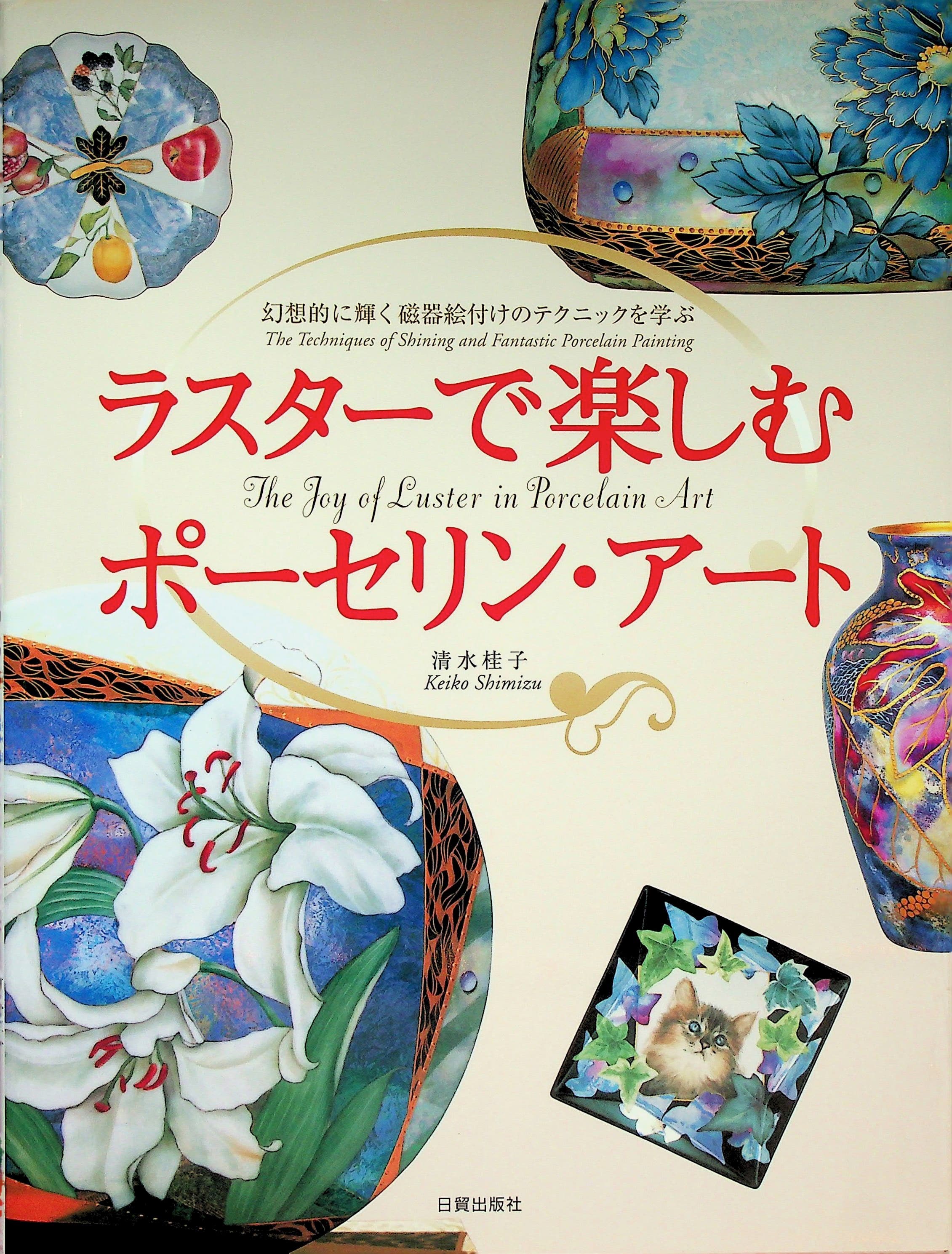
In Very Good condition with a Very Good dust jacket. White glossy wraps lettered in gold on front cover and spine, mild shelf wear. Binding tight. Inscribed and signed by the author on front free endpaper, in Japanese ("Let's paint with joy") and in English ("Happy painting!"). Previous owner's name and telephone number in ink at head of the same leaf. Publisher's order card still tipped in at rear. Otherwise unmarked. Pictorial dust jacket showing the author's luster-painted vases, plates and boxes, mild shelf wear. Now in an archival quality (removable) Brodart cover. Luster (iridescent metallic overglaze) technique for porcelain painters, by a Tokyo teacher trained at the Harajuku Togasha porcelain painting school and in Peter Faust's seminars, and certified IPAT Master Artist and Teacher. Bilingual throughout: the English text is the author's own summary of the Japanese, added at the request of overseas painters. The collection of works (pp. 6-44) shows finished pieces with dimensions; the technique section covers materials, tools, a 32-swatch color chart, firing, flux, masking, marble and crack lotions, cut-blue, raised paste and chipping-off, with three step-by-step projects photographed firing by firing. Ends with a sketch collection of tracing designs and a supplier list for Japan, Australia and the UK. [From Preface] Do you know about luster? We can find it on the work of Old-Noritake shining as metallic iridescent colors. Do you remember the olden days in some homes, there were tea cups having rainbow colors like that of the seashell? That is luster. . . . Luster delicately differs in color by the thickness of application, the firing temperature and the kind of porcelain used. Most painters think luster cannot be mixed, however it is not true. Luster mixes delicately and changes showing unexpected color development. . . . When you open the kiln, enjoy the impressive moment. Contents: Preface; A plate with feather; The collection of works (Illusion in white lilies; Poppy; A fairy; A kitty 1, 2, 3; A box with blue peony; A box with peony; Roses; Shall we dance?; A girl; Flower Angel; A castle; Three towers; My dog; A dragonfly; A rooster; A white horse; Four seasons; Harvest 1, 2; A vase with leaves; Marble pattern 1, 2; Stained glass-like vase; Stained glass-like box; Wind in spring; A box with marble pattern, A box with flying butterflies; A vase with lace pattern; A box with pearl; Treasures from the mountain, For you; Treasures from the sea, A bud vase with luster; Accessories; Ornaments of Christmas); The foundations of luster technique (What is luster made of?; Attention in the handling; In the case of using luster for tableware; Painting tools and materials; Make a color chart; About firing; About flux; Useful practical hints; Challenge to Luster 1, A box with polka-dot; Challenge to Luster 2, A box with grapevine; Challenge to Luster 3, A plate with a heart-shaped frame); Let's enjoy luster techniques more (How to apply luster; Stained glass-like brooch; Luster flow; Using straw; Marble pattern; Marble-lotion and crack-lotion; Cut-blue; Useful practical hints; Chipping-off); Sketch collection; Tools and materials shop list; The encounter with luster.