Description
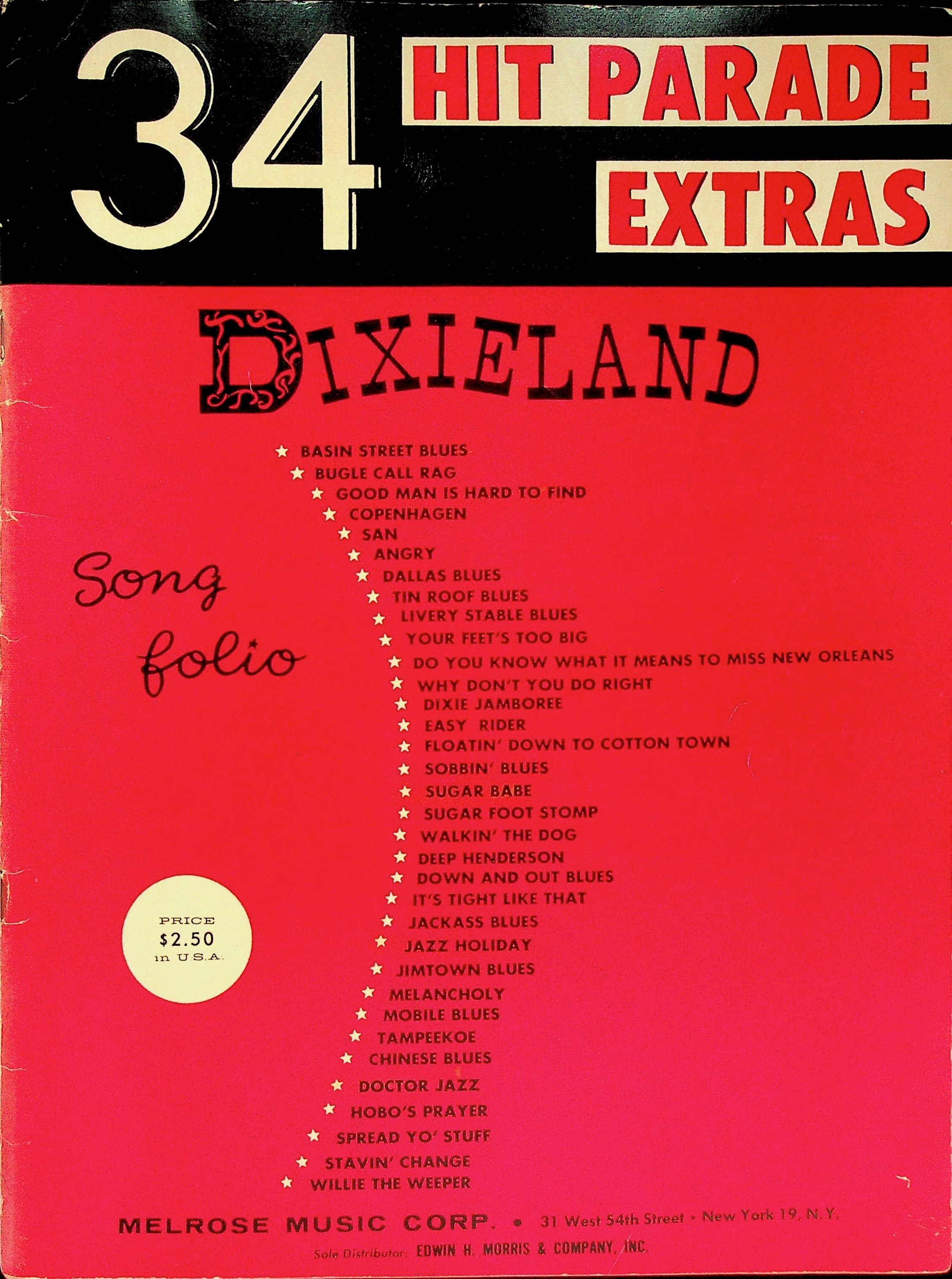
Melrose Music Corp., Published 1960. Sheet music, 85 pp.; 29 cm; catalog no. 03-01854-1191; piano and vocal scores with chord symbols and ukulele diagrams; red and black illustrated paper covers listing the 34 titles.

Rare, out-of-print & unusual books · Since 1997
Turn the pages with the arrows, keyboard, or a swipe.
Melrose Music Corp., Published 1960. Sheet music, 85 pp.; 29 cm; catalog no. 03-01854-1191; piano and vocal scores with chord symbols and ukulele diagrams; red and black illustrated paper covers listing the 34 titles.
In Good condition. Paper covers, staple bound, with mild shelf wear, light bumping and creasing to edges and corners, toning, and some color loss along edges. Center sheet (pp. 43-46) has pulled away from the staples and is laid in. Pages toned with a few dog-eared corners, including a folded corner at p. 40; music otherwise unmarked, with no performance annotations. Thirty-four Dixieland and early jazz standards from the Melrose catalog, most first published in the 1920s, with a two-page publisher's foreword on the Dixieland style. Each song carries a short headnote and a list of "Best Known Recordings" with label and catalog numbers (Louis Armstrong, King Oliver, Bix Beiderbecke, Fats Waller, Benny Goodman, Bob Crosby, Cab Calloway and others). The Dixieland volume of the 34 Hit Parade Extras series; the only one devoted to jazz repertoire. [From the publisher's foreword] "Dixieland" is a term applied to the pure New Orleans Jazz style and its modified derivatives played before the swing era. When, in November 1917, the New Orleans Storyville district was forced to close, musicians began a migration to the north on the Mississippi River boats. Some remained as entertainers on the boats, but many found jobs on Chicago's teeming South Side. There, they were heard by young musicians such as the late Bix Beiderbecke, Miff Mole, Muggsy Spanier and the great clarinetist Frank Teschmacher. . . . Historically speaking, Dixieland was the first step away from the pure New Orleans form as played by "King" Oliver, Louis Armstrong and "Jelly Roll" Morton, toward the big band music of today. This folio of Dixieland tunes includes many which were written and featured by the outstanding Dixielanders of the 1920's. Contents: Basin Street Blues (Spencer Williams); Copenhagen (Charlie Davis, Walter Melrose); Angry (Jules Cassard, Henry Brunies, Merritt Brunies, Dudley Mecum); Why Don't You Do Right (Joe McCoy); Stavin' Change (Al Bernard); Tin Roof Blues (New Orleans Rhythm Kings, Walter Melrose); Willie the Weeper (Grant V. Rymal, Walter Melrose, Marty Bloom); Bugle Call Rag (Jack Pettis, Billy Meyers, Elmer Schoebel); Chinese Blues (Oscar Gardner, Fred D. Moore); Doctor Jazz (Joseph "King" Oliver, Walter Melrose); Livery Stable Blues (Marvin Lee, Ray Lopez, Alcide Nunez); Spread Yo' Stuff (Al Bernard, Jules Levy, Paul Crane); Dallas Blues (Hart A. Wand, Lloyd Garrett); Dixie Jamboree (Howard Johnson, Joe Davis); Sugar Babe (Boyd Senter, Walter Melrose); Sobbin' Blues (Art Kassel, Victor Burton); Walkin' the Dog (Shelton Brooks); San (Lindsay McPhail, Walter Michels); Floatin' Down to Cotton Town (F. Henri Klickmann, Jack Frost); Easy Rider (Shelton Brooks); Sugar Foot Stomp (Joseph "King" Oliver, Walter Melrose); Your Feet's Too Big (Ada Benson, Fred Fisher); Deep Henderson (Fred Rose); It's Tight Like That (Thomas "Georgia Tom" Dorsey, Hudson Whittaker); Tampeekoe (Walter Melrose, Louis Panico, Elmer Schoebel); Jimtown Blues (Charlie Davis, Fred Rose); Mobile Blues (Fred Rose, Albert E. Short); A Good Man Is Hard to Find (Eddie Green); Jackass Blues (Art Kassel, Mel Stitzel); Melancholy (Marty Bloom, Walter Melrose); A Jazz Holiday (Benton Overstreet, Walter Melrose); Down and Out Blues (Arthur Sizemore, W. Earthman Farrell); Do You Know What It Means to Miss New Orleans (Louis Alter, Eddie De Lange).