Description
New York Graphic Society, Published 1970. Hardcover, 156 pp.; 27 cm; illustrated with 8 color plates and 105 black-and-white illustrations; issued in both wraps and hardcover, this is the hardcover issue in dust jacket.

Rare, out-of-print & unusual books · Since 1997
Turn the pages with the arrows, keyboard, or a swipe.
New York Graphic Society, Published 1970. Hardcover, 156 pp.; 27 cm; illustrated with 8 color plates and 105 black-and-white illustrations; issued in both wraps and hardcover, this is the hardcover issue in dust jacket.
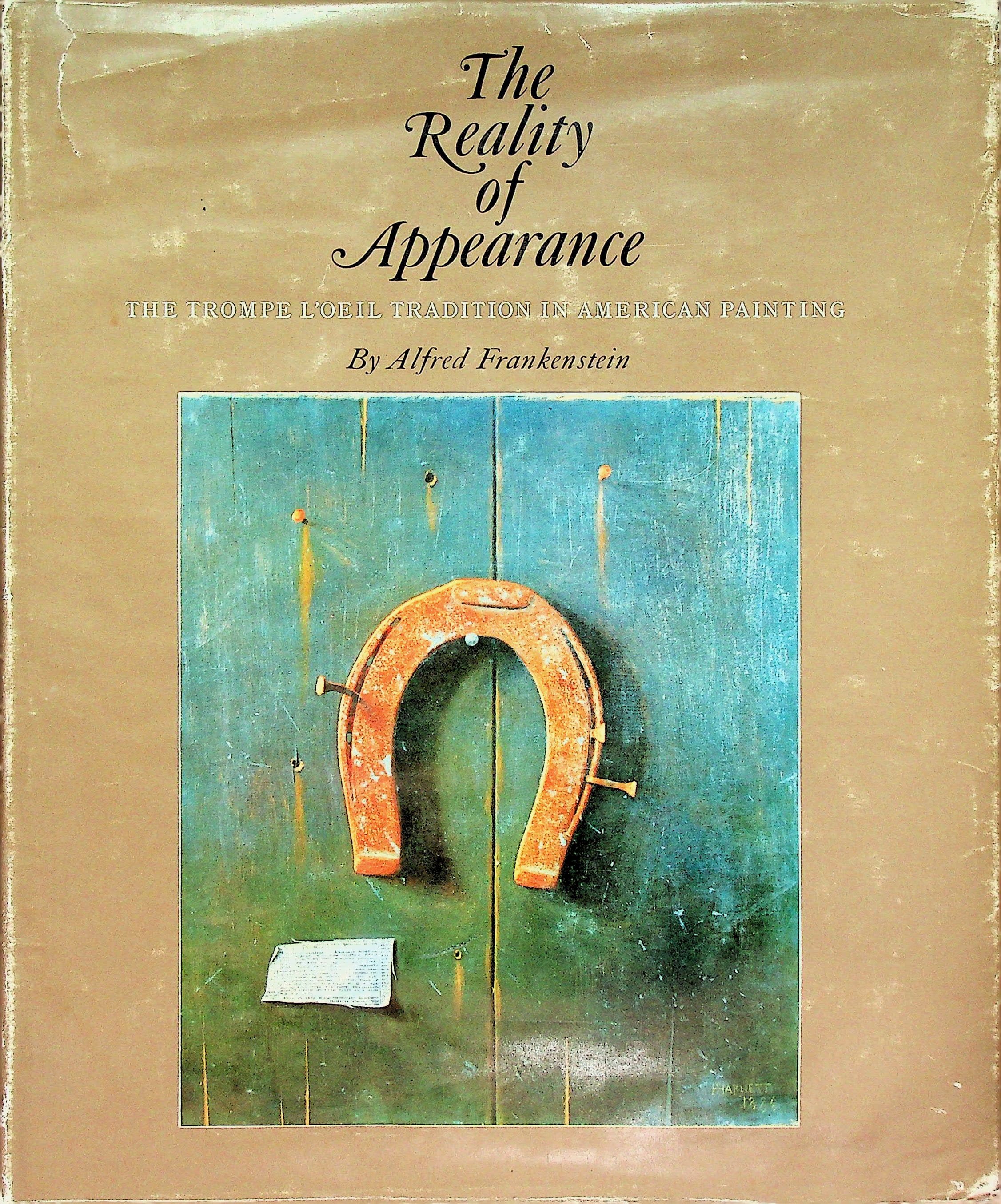
In Good condition with an Acceptable dust jacket. Olive tan cloth boards, gilt lettering on front cover and spine, light bumping, scuffing and fading along edges. Binding tight. Pages lightly toned, otherwise unmarked. Pictorial dust jacket reproduces Harnett's Golden Horseshoe against a tan ground; a 1.5 inch tear over the top edge of the front panel near the spine has been repaired with clear tape, with several smaller nicks and tears, creasing along edges, and a chip at the lower fore-corner. Rubbing along top and bottom edges has abraded through to the paper core in places, with a crease and light paper lifting at top center of the rear panel. Moderate scuffing and light soiling overall, heavier along edges and spine. Not price clipped. Now in an archival quality (removable) Brodart cover. Catalogue of the first major museum exhibition of American trompe l'oeil painting, organized by Alfred Frankenstein for the University Art Museum, Berkeley, and shown at the National Gallery of Art, the Whitney Museum of American Art, the California Palace of the Legion of Honor and the Detroit Institute of Arts between March and October 1970. 107 works by 29 artists, each annotated by Frankenstein, with William Michael Harnett and John Frederick Peto most heavily represented. Frankenstein came to the subject through After the Hunt (1953), the study that separated the two painters' work. Peto died in 1907 almost unknown, and dealers subsequently altered or added Harnett signatures to his canvases, one name carrying a market that the other did not. Frankenstein assembled the documentation to reattribute the forged pictures and establish Peto as an artist in his own right. The catalogue notes carry that work forward: the entry for Peto's Old Souvenirs points out the faked Harnett signature on the canvas.