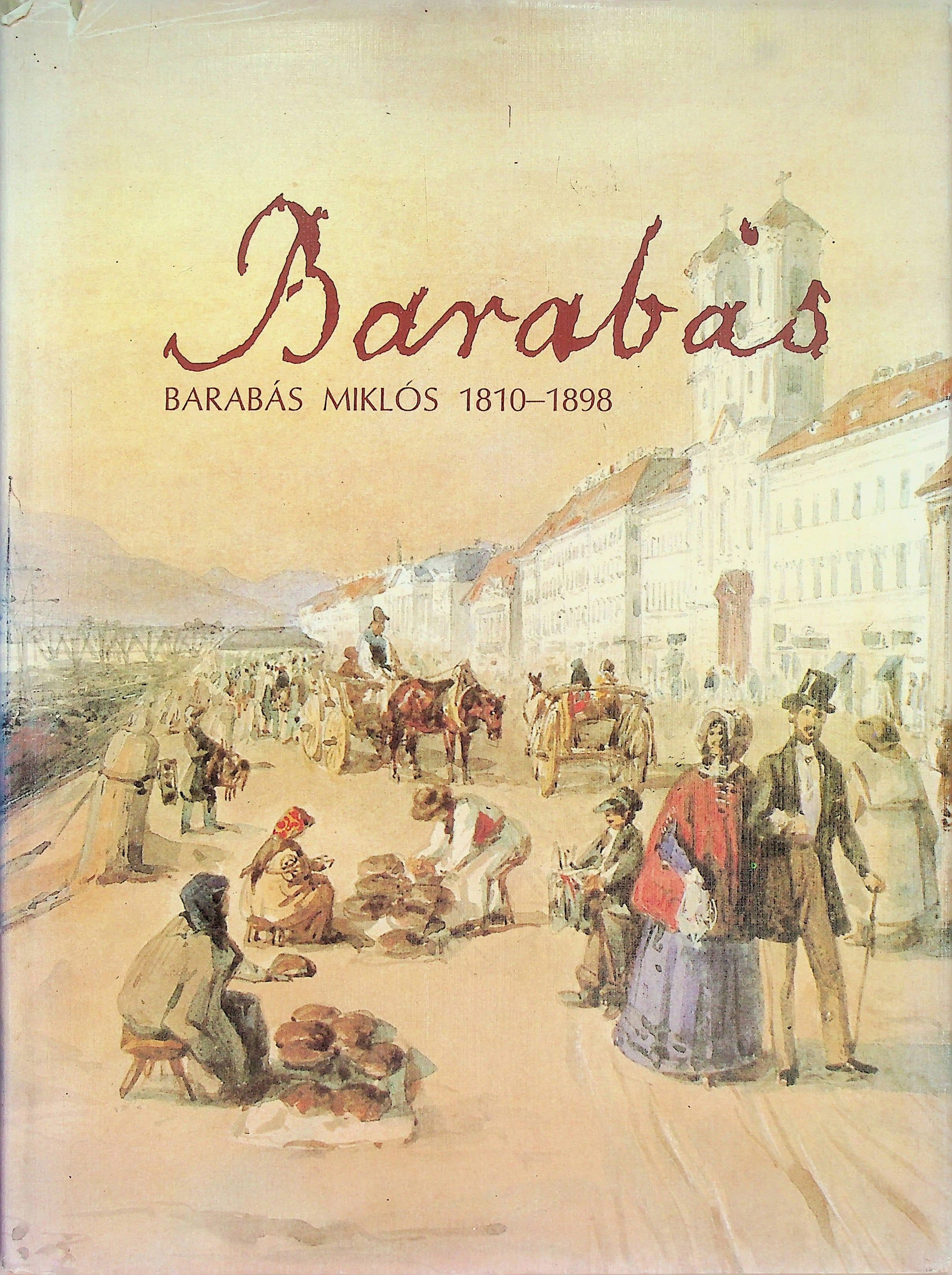
Description
Kepzomuveszeti Kiado, Published 1983. Hardcover, 124 pp. plus [16] unnumbered pp. of plates; 32 cm; text in Hungarian; illustrated with 34 pages of color plates and several hundred black-and-white reproductions, including an illustrated catalogue of the oeuvre.
Condition & notes
In Very Good condition with a Good dust jacket. Pale sage-green cloth boards, the artist's facsimile signature stamped in black on the front board; mild shelf wear with light rubbing to the corners and mild fading along the edges of the covers. Binding tight. Pages clean and unmarked. Pictorial dust jacket reproduces Barabas's watercolor of the Pest riverfront (A Pesti Aldunasor, 1842) on the front panel and a Danube barge scene on the rear; a chip of about an inch and a half at the lower corner of the rear panel, further small chips and short tears along the top edge, creasing and mild scuffing along the edges, and fading to the spine. Now in an archival quality (removable) Brodart cover.Barabas Miklos (1810-1898) is the visual record of nineteenth-century Hungary. Born in Transylvania and trained in Vienna, Bucharest and Italy, he settled in Pest and from the early 1840s was called "the painter of the nation." He painted Liszt in 1847 and Franz Joseph in 1853; Szechenyi, Kossuth, Petofi, Deak, Batthyany, Eotvos and Arany all sat for him, and his lithographic portraits preserve the features of nearly every significant Hungarian public figure of the century. He was a founder of the Pest Art Society and its president from 1862 until his death, and sat in Parliament for Pest from 1867. His own account book recorded 2,473 works; his descendants brought the figure to 3,146, some 3,500 are documented today, and his contemporaries put the total past five thousand.Szvoboda D. Gabriella's monograph, the standard modern treatment, follows the career chronologically from the Transylvanian pictures through the Reform era, 1848 and the late official portraiture, drawing throughout on the painter's own autobiography. It serves a non-Hungarian reader well. The catalogue section at the rear gives each work's title, date, medium, dimensions in centimeters, signature transcription and present collection, information that reads in any language and makes this the reference tool for identifying a Barabas.Contents: A nemzet festoje; A palyavalasztas; Az Akademia; Bukarest; Italia; A pesti letelepedes; Az erdelyi kepek (1837-40); A pesti Muegylet; A kozeleti portrek; "Derek kepironk" (1840-45); A 40-es evek kozepetol 1848-ig; A forradalom es az 50-es evek eleje; A nemzeti muveszet eszmejenek kiteljesedese; Klasszikus mesterunk; A "hivatalos" festo; A veteran festo; Jegyzetek; Kepjegyzek; Szines kepek; Katalogus.