Description
Star of the Republic Museum, Published 1992. Wraps, 28 pp.; 28 cm; illustrated with black-and-white reproductions of watercolors, portraits, engravings, and museum artifacts.

Rare, out-of-print & unusual books · Since 1997
Turn the pages with the arrows, keyboard, or a swipe.
Star of the Republic Museum, Published 1992. Wraps, 28 pp.; 28 cm; illustrated with black-and-white reproductions of watercolors, portraits, engravings, and museum artifacts.
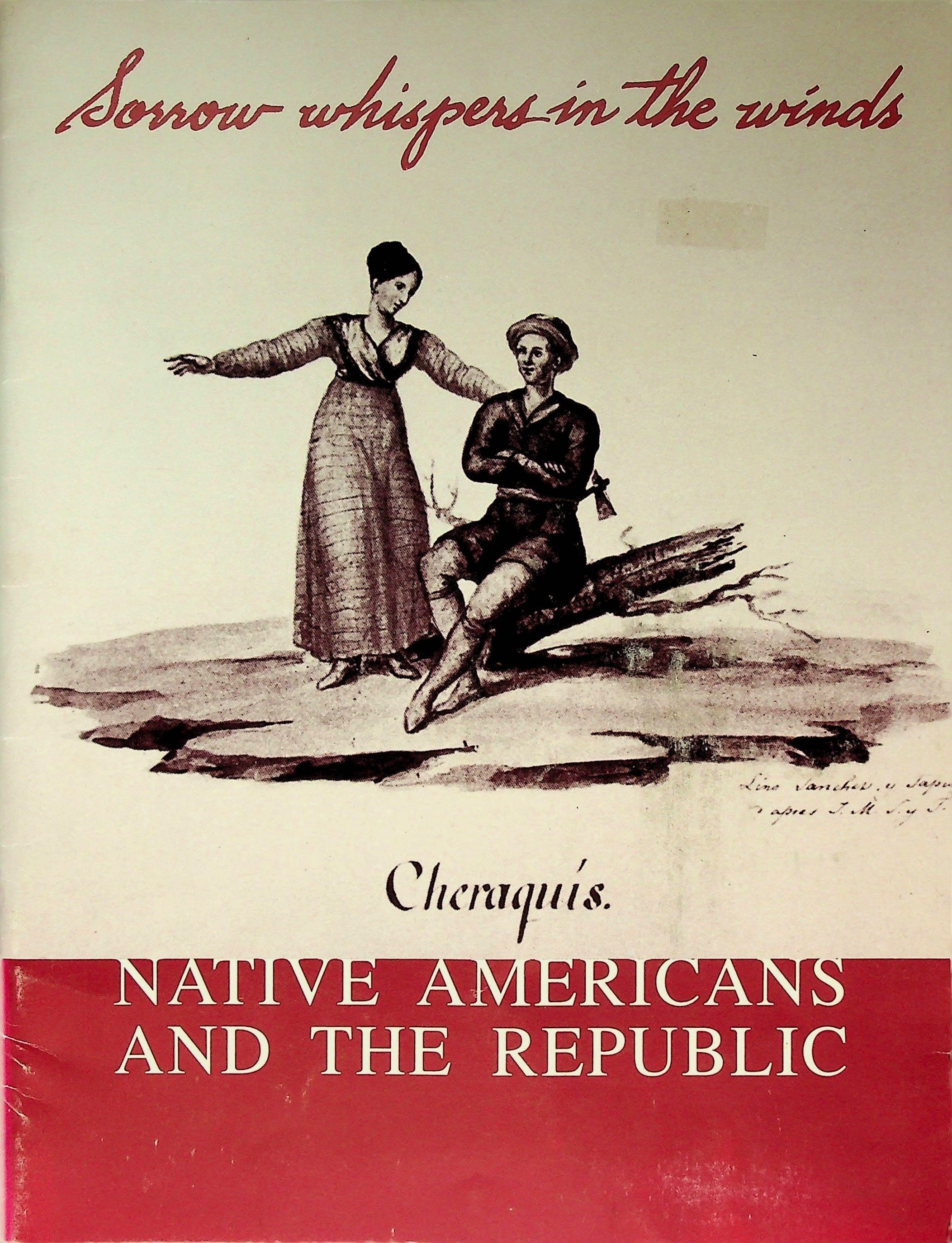
In Very Good condition. Pictorial wraps, the cover reproducing Lino Sanchez y Tapia's watercolor of Cherokee Indians of eastern Texas; mild shelf and edge wear, with light bumping and creasing to the edges and corners, some soiling and scuffing, some color loss along the edges and spine, and price sticker residue at the upper right of the front cover. Staple bound, binding tight. Pages clean and unmarked. Catalog of the exhibition mounted at the Star of the Republic Museum, Washington-on-the-Brazos, February 29 through October 31, 1992, and written by the museum's curator of exhibits, Ellen N. Murry. The title comes from the letter of condolence Sam Houston wrote on March 23, 1843 to the elder Flacco, chief of the Lipans, on the death of his son: "The loud voice of grief is heard from your women and children. Sorrow whispers in the winds." Flacco the Younger had scouted for Jack Hays and the Texas Rangers and ridden with the Somervell expedition to the Rio Grande; he was murdered near San Antonio in the winter of 1842, and the Lipans believed white Texans had killed him. Murry surveys the peoples living in Texas between 1836 and 1846, the Karankawas and Caddos, the Cherokees, Delawares, Shawnees and Kickapoos pushed west into Texas by federal removal, and the Comanches, Kiowas, Tonkawas and Lipan Apaches of the plains, drawing throughout on the accounts of settlers and European travelers (Jean Louis Berlandier, Ferdinand Roemer, Noah Smithwick, William Bollaert, Mary Maverick) and reading those accounts critically rather than at face value. The catalog does not soften what followed: its central section, "Houston and Lamar: Coexistence or Extermination," sets Houston's policy of accommodation against Mirabeau B. Lamar's declared intention to "expel, defeat, or exterminate" the Republic's Indians, and closes on the Cherokee chief Duwali, killed and scalped at the Battle of the Neches. Illustrated with watercolors by Lino Sanchez y Tapia, George Catlin's Buffalo Chase and his portrait of the Kiowa girl White Weasel, John Mix Stanley's portrait of the Delaware scout Jim Shaw, a manuscript in the Cherokee syllabary written by Chief Big Mush in 1836, and artifacts from the museum and the Texas Memorial Museum. With a "For Further Reading" bibliography.