
Description
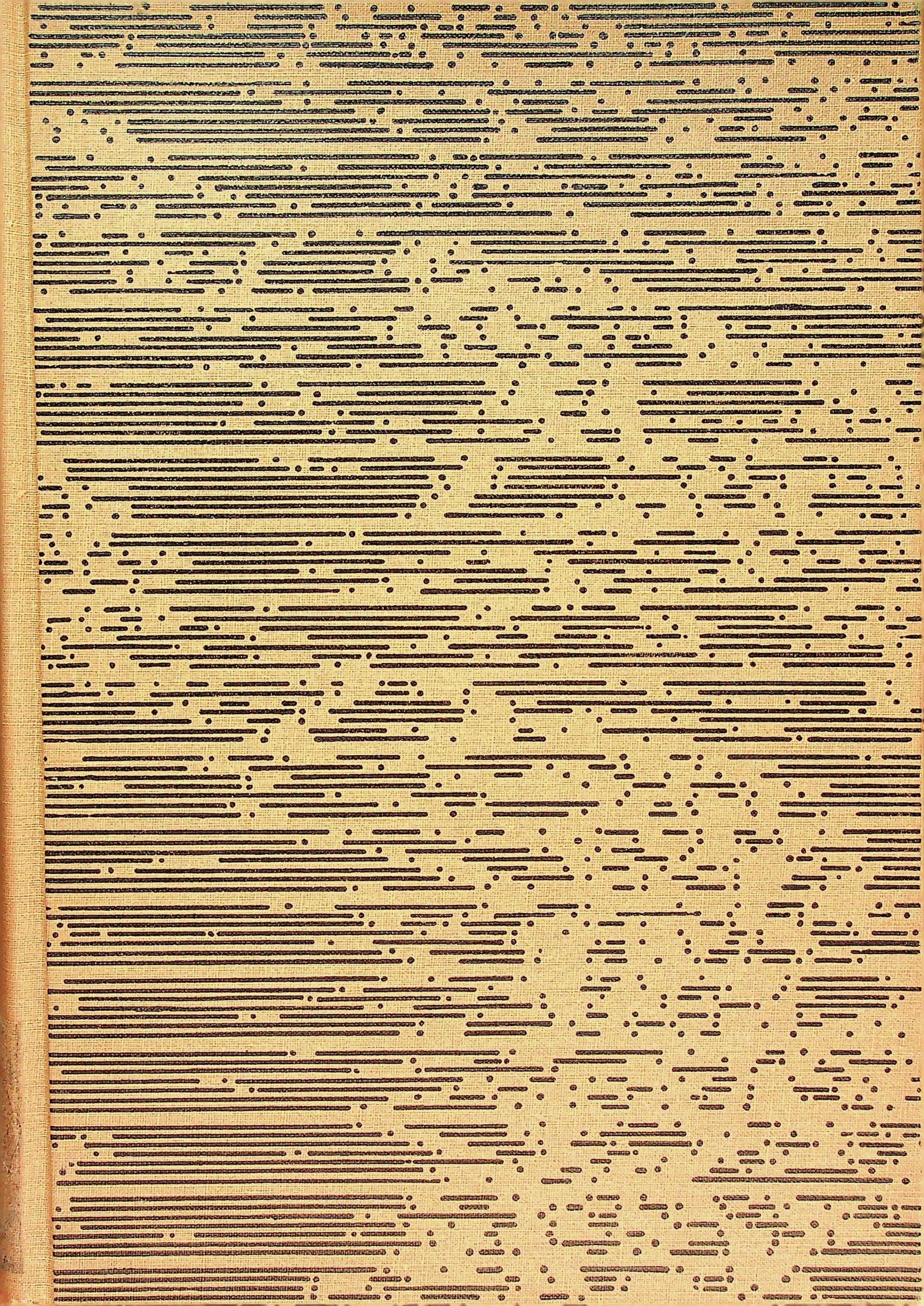
The University of Chicago Press, Published 1963. Hardcover, x + 552 pp.; 23 cm; revised and enlarged edition; illustrated with text figures, apparatus diagrams, charts, and actograms. EX-LIBRARY. In Good Plus condition, no dust jacket. Tan cloth boards printed in a black dash-and-dot pattern that reproduces the look of Kleitman's own sleep actograms (compare Fig. 15.2 in the text), black lettering on spine with the Chicago colophon at the foot; mild shelf wear, with soiling and darkening to the cloth at the spine foot and sticker residue at the tail of the spine. Binding tight. Relatively few library and ex-library markings, including "Withdrawn" stamped on the front pastedown, adhesive residue where the card pocket was removed, and "Department of Anesthesia" and "Withdrawn" stamps on all three edges of the text block. Pages otherwise clean and unmarked. The revised and enlarged edition of the foundational text of modern sleep science, first published in 1939 and reworked here across a quarter century of new findings, with the preface dated Santa Monica, October 1962. Nathaniel Kleitman (1895-1999) ran the sleep laboratory at the University of Chicago, where in 1953 he and his graduate student Eugene Aserinsky identified rapid eye movement sleep, and where he and William Dement went on to map the architecture of the sleep cycle; the 1963 revision is the book in which that discovery is folded into the whole prior literature on the subject. Kleitman is also the man who spent thirty-two days underground in Mammoth Cave in 1938 trying to force the human body onto a 28-hour day, an experiment recounted in the chapters on periodicity. Sober, exhaustive, and built on a bibliography running to thousands of entries, it discusses the physiology of the sleep phase, dreaming and depth of sleep, the 24-hour rhythms of temperature and activity, sleep deprivation, narcolepsy and insomnia, the pharmacology and hygiene of sleep, hibernation and hypnosis, and the competing neural, humoral, and evolutionary theories of sleep. Contents: Part 1, Functional Differences between Sleep and Wakefulness; Part 2, Course of Events during the Sleep Phase; Part 3, Periodicity; Part 4, Interference with Sleep and Wakefulness; Part 5, Spontaneous Changes in the Sleep-Wakefulness Rhythm; Part 6, Means of Influencing Sleep and Wakefulness; Part 7, States Resembling Sleep; Part 8, Theories of Sleep; with bibliography and author index, and subject index.