
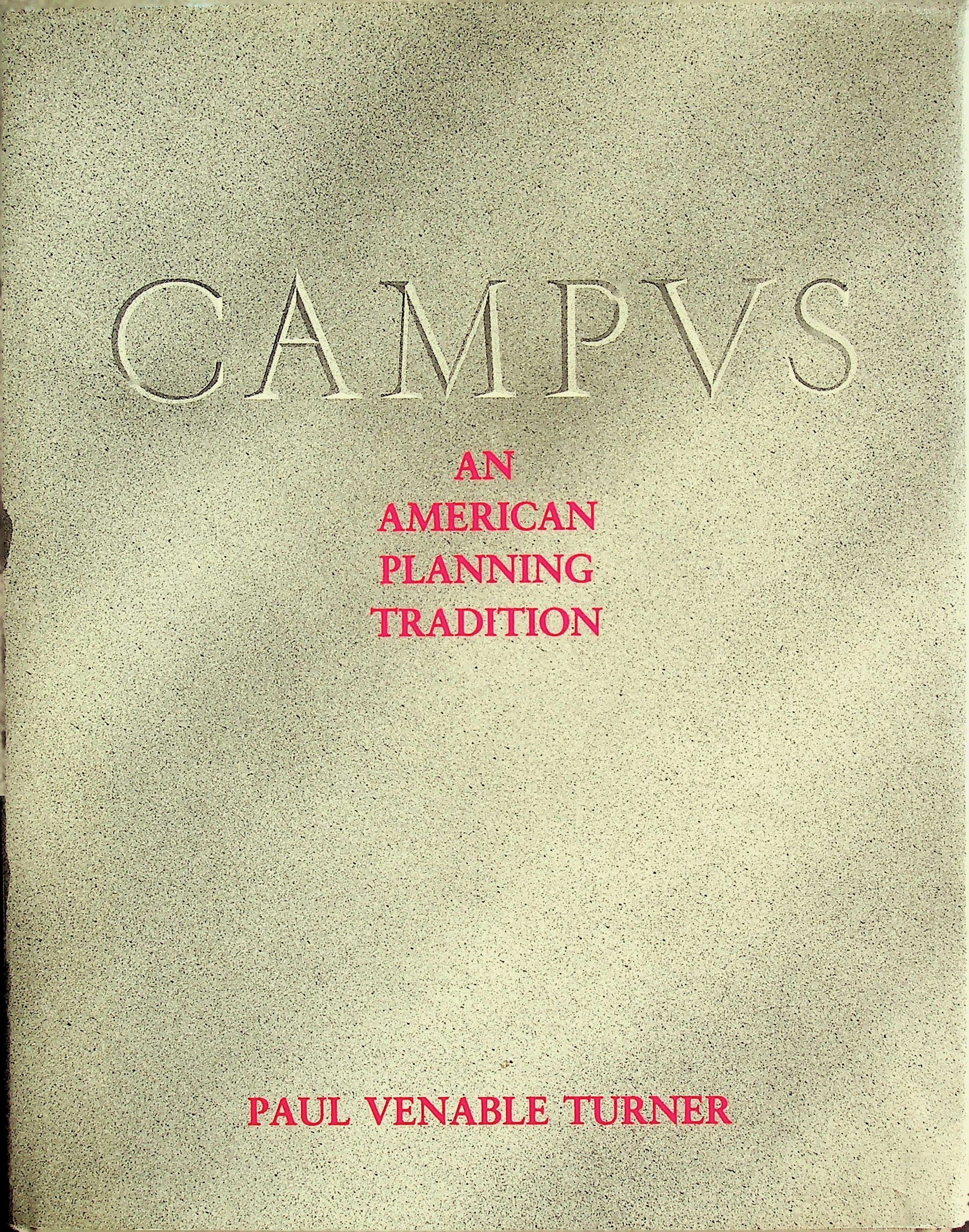
Description
The Architectural History Foundation and The MIT Press, Published 1984. Hardcover, xii plus 337 pp.; 26 cm; second printing, 1985; designed by Marc Treib; illustrated with black-and-white photographs, engravings, and campus plans throughout. In Good+ condition with a Very Good dust jacket. Gray cloth-covered boards with red lettering on the spine, the title blind-stamped onto the front cover. Bumping to the bottom corner of the front cover and mild surface wear. The binding is tight. A faint damp stain affects the bottom corner of the entire text block. Private institutional presentation sticker to a previous owner pasted on the front free endpaper. Otherwise the pages are clean and unmarked. The dust jacket has a few small nicks and creasing to the edges and mild shelf wear. Now in an archival quality (removable) Brodart cover.Volume VII in the Architectural History Foundation / MIT Press Series. Paul Venable Turner, Associate Professor of Architectural History at Stanford University, presents the first comprehensive study of the American college and university campus as a distinctive architectural and planning tradition. From the colonial period to the present, Turner traces how the campus has reflected changing educational ideals and utopian social visions, examining the work of Thomas Jefferson, Benjamin Henry Latrobe, Alexander Jackson Davis, Frederick Law Olmsted, Ralph Adams Cram, Charles Z. Klauder, Frank Lloyd Wright, Eero Saarinen, Skidmore Owings and Merrill, William Turnbull, and Charles Moore.Contents: Acknowledgments; Preface, The American Campus as an "Academical Village"; Introduction, The British College on the Eve of American Colonization; The Colonial College; Schools for a New Nation; Expansion and Mythmaking; The Democratic College; The University as City Beautiful; The Monastic Quadrangle and Collegiate Ideals; Dynamism, Change, and Renewal; Notes; Index.