Description
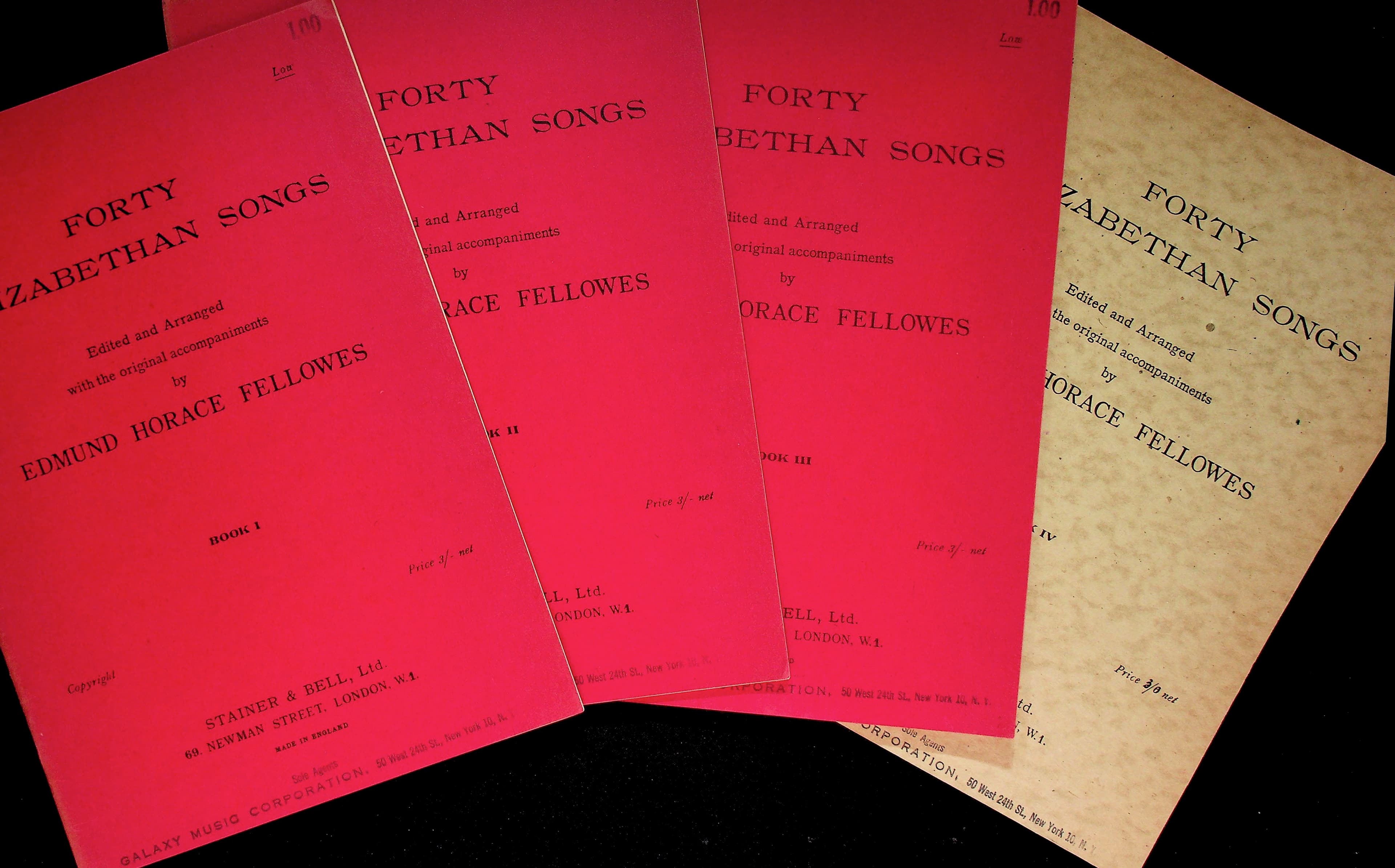
Stainer & Bell, Ltd., London (sole American agents Galaxy Music Corporation, New York). Copyright 1925; this set comprising later reprintings, with Books I, II, and III bearing the firm's 69 Newman Street imprint (consistent with a printing date in the 1948-1965 range) and Book IV bearing the earlier 58 Berners Street imprint (consistent with a pre-1948 printing). Four separate paper-wrapped sheet music pamphlets; 25 cm; complete set of all four books in the Low Voice edition.
Condition & notes
In Very Good condition. Books I, II, and III in printed red paper wraps, Book IV in mottled tan paper wraps as photographed. All four show mild shelf wear with bindings tight and pages clean, lightly toned, otherwise unmarked. Books I, II, and III bear a previous price stamp ("1.00") in ink at the top right corner of each front cover; Book IV has the corresponding price area inked out at the top right corner. Each booklet marked "Low" at the cover head, indicating the low-voice transposition.A complete four-book set of Edmund Horace Fellowes's seminal anthology drawing forty songs from the English lutenist song writers of Shakespeare's generation. Fellowes, the leading early-twentieth-century scholar of the Elizabethan and Jacobean lutenist repertoire, transcribed the original lute accompaniments into modern notation for piano, with each book containing ten songs in the low-voice transposition by composers including John Dowland, Thomas Campian, Philip Rosseter, Thomas Ford, Francis Pilkington, Robert Jones, William Corkine, John Bartlet, Tobias Hume, John Attey, and Michael Cavendish.[From the preface] These four song-albums have been produced with the object of providing singers with a choice selection from the works of the famous school of English Song-Writers who were the contemporaries of Shakespeare. The original accompaniments, designed by the composers for the lute, are here exactly transcribed in modern notation for use on the pianoforte. The albums are published in two keys and are thus made available for voices of every compass, both male and female. The songs of these English composers should occupy an important place in the repertory of all English singers, whether in the Concert Room or the home.Contents (Book I): What then is love, sings Corydon (Ford); Flow, my tears (Dowland); When Laura smiles (Rosseter); Say, Love, if ever thou didst find (Dowland); My sweetest Lesbia (Campian); There is a garden in her face (Campian); In Sherwood lived stout Robin Hood (Jones); Rest, sweet nymphs (Pilkington); Down, down, proud mind (Corkine); Of all the birds that I do know (Bartlet).Contents (Book II): Come again, sweet love doth now invite (Dowland); Follow your saint (Campian); When to her lute Corinna sings (Campian); Fair sweet cruel (Ford); Willow song (Anonymous); Now what is love? (Jones); Sleep, wayward thoughts (Dowland); Sorrow, stay (Dowland); If she forsake me (Rosseter); Diaphenia, like the daffadowndilly (Pilkington).Contents (Book III): Love is a bable (Jones); Fain would I change that note (Hume); Down a down, thus Phyllis sung (Pilkington); Weep you no more, sad fountains (Dowland); What then is love but mourning? (Rosseter); The cypress curtain of the night (Campian); Jack and Joan (Campian); If my complaints could passions move (Dowland); Awake, sweet love (Dowland); Now I see thy looks were feigned (Ford).Contents (Book IV): On a time the amorous silvy (Attey); Finetta, fair and feat (Cavendish); Not full twelve years twice told (Ford); Come, Phyllis, come into these bowers (Ford); I saw my lady weep (Dowland); Fine knacks for ladies (Dowland); Love's god is a boy (Jones); Now peep, bo-peep (Pilkington); Fair, if you expect admiring (Campian); Follow thy fair sun (Campian).