Description
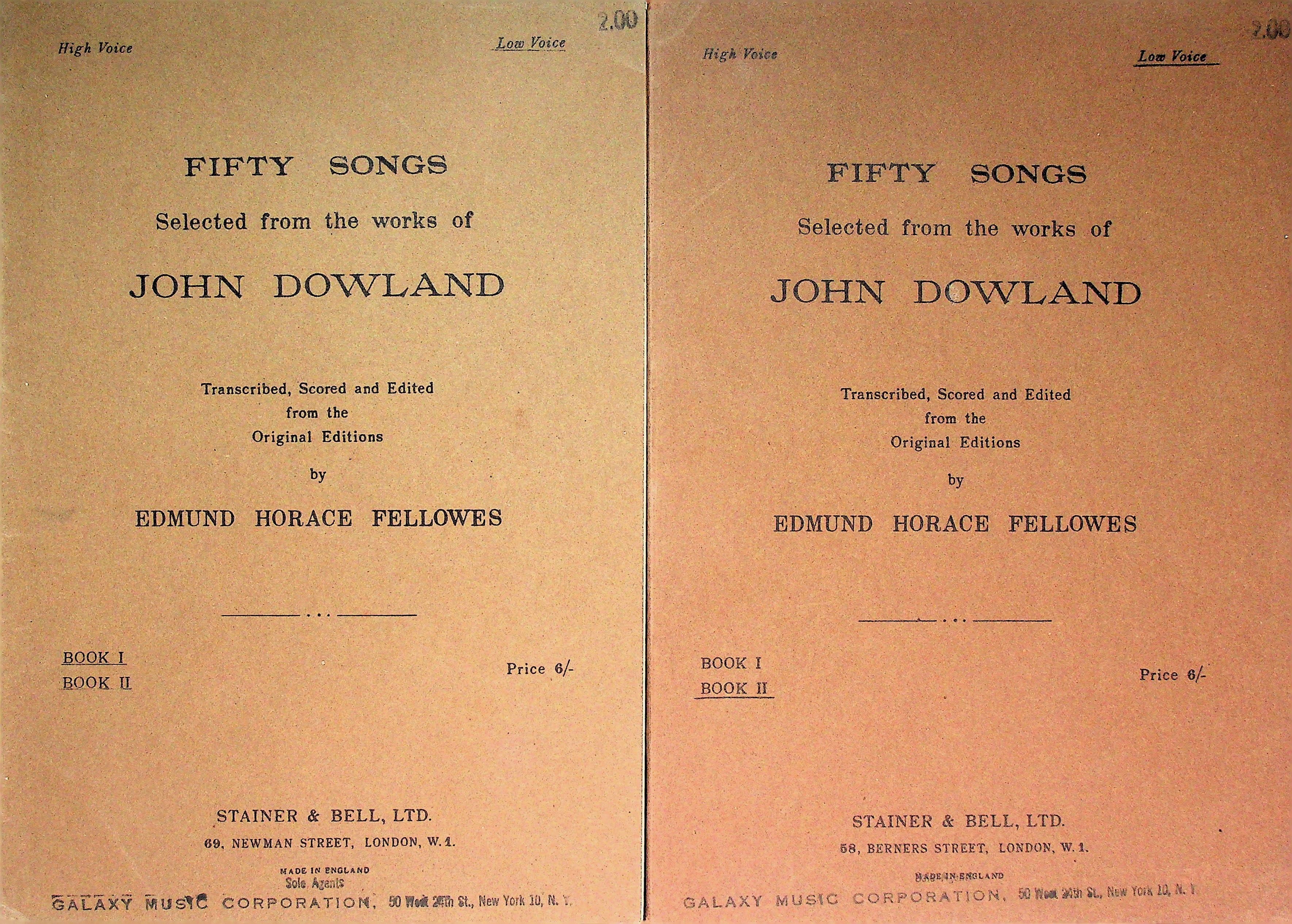
Stainer & Bell, Ltd., London (sole American agents Galaxy Music Corporation, New York). Copyright 1925; this set comprising later reprintings, with Book I bearing the firm's 69 Newman Street imprint (consistent with a printing date in the 1948-1965 range) and Book II bearing the earlier 58 Berners Street imprint (consistent with a pre-1948 printing). Two paper-wrapped sheet music pamphlets, approximately 50 pp each; 25 cm; complete set of all fifty songs in the Low Voice edition. Issued as part of The English School of Lutenist Song Writers, Second Series.
Condition & notes
In Very Good condition. Two staple-bound paper-wrapped sheet music pamphlets as photographed. Both show mild shelf wear with bindings tight and pages clean and unmarked. Both volumes bear a previous price stamp ("2.00") in ink at the top right corner of each front cover. Each booklet marked "Low Voice" at the cover head, indicating the low-voice transposition.Edmund Horace Fellowes's selection of fifty songs by John Dowland (1563-1626), the supreme songwriter of the English lutenist school. Drawn from Dowland's First, Second, and Third Books of Songs or Ayres and from A Pilgrim's Solace, the collection covers nearly the entire range of his published songs for solo voice, from the celebrated melancholy of "Flow, my tears" and "In darkness let me dwell" to lighter lyrics such as "Fine knacks for ladies" and "Come again, sweet love." Fellowes (1870-1951), the leading early-twentieth-century scholar of the Elizabethan and Jacobean lutenist repertoire, here transcribes the original lute tablatures into modern notation for piano without alteration, preserving Dowland's irregular barring and original chord voicings. Book I contains songs I-XXV; Book II contains songs XXVI-L.[From the preface] This selection of Dowland's songs is published in two keys so that they may be available for voices of every compass. The original accompaniment, literally translated from the lute-tablature, is given here without any variation. Those who desire accompaniments specially adapted to the modern pianoforte will find them in the editor's complete edition of Dowland's songs (together with a reprint of the tablature) in "The English School of Lutenist song-writers." The original barring is not invariably retained, but the editor has adhered to the principle of irregular barring as found in the original editions.Contents (Book I): Unquiet thoughts; Who ever thinks or hopes of love; My thoughts are winged with hope; If my complaints could passions move; Can she excuse my wrongs?; Now, O now I needs must part; Dear, if you change; Burst forth, my tears; Go, crystal tears; Come away, come, sweet love; Rest awhile, you cruel cares; Sleep, wayward thoughts; Wilt thou, unkind, thus reave me?; Come again, sweet love doth now invite; His golden locks; Awake, sweet love, thou art returned; Come, heavy sleep; I saw my lady weep; Flow, my tears; Sorrow, stay; Mourn! Day is with darkness fled; Fine knacks for ladies; Now cease, my wandering eyes; White as lilies was her face; A shepherd in a shade.Contents (Book II): Shall I sue?; Clear or cloudy; Time stands still; Me, me, and none but me; Say, Love, if ever thou didst find; Flow not so fast, ye fountains; What if I never speed?; By a fountain where I lay; O what hath overwrought?; Farewell, unkind!; Weep you no more, sad fountains; It was a time when silly bees; The lowest trees have tops; Disdain me still; Sweet, stay awhile; Love those beams; Shall I strive with words to move?; Were every thought an eye; Tell me, true love; If that a sinner's sighs; Where sin sore wounding; My heart and tongue were twins; Far from triumphing court; Lady, if you so spite me; In darkness let me dwell.