Description
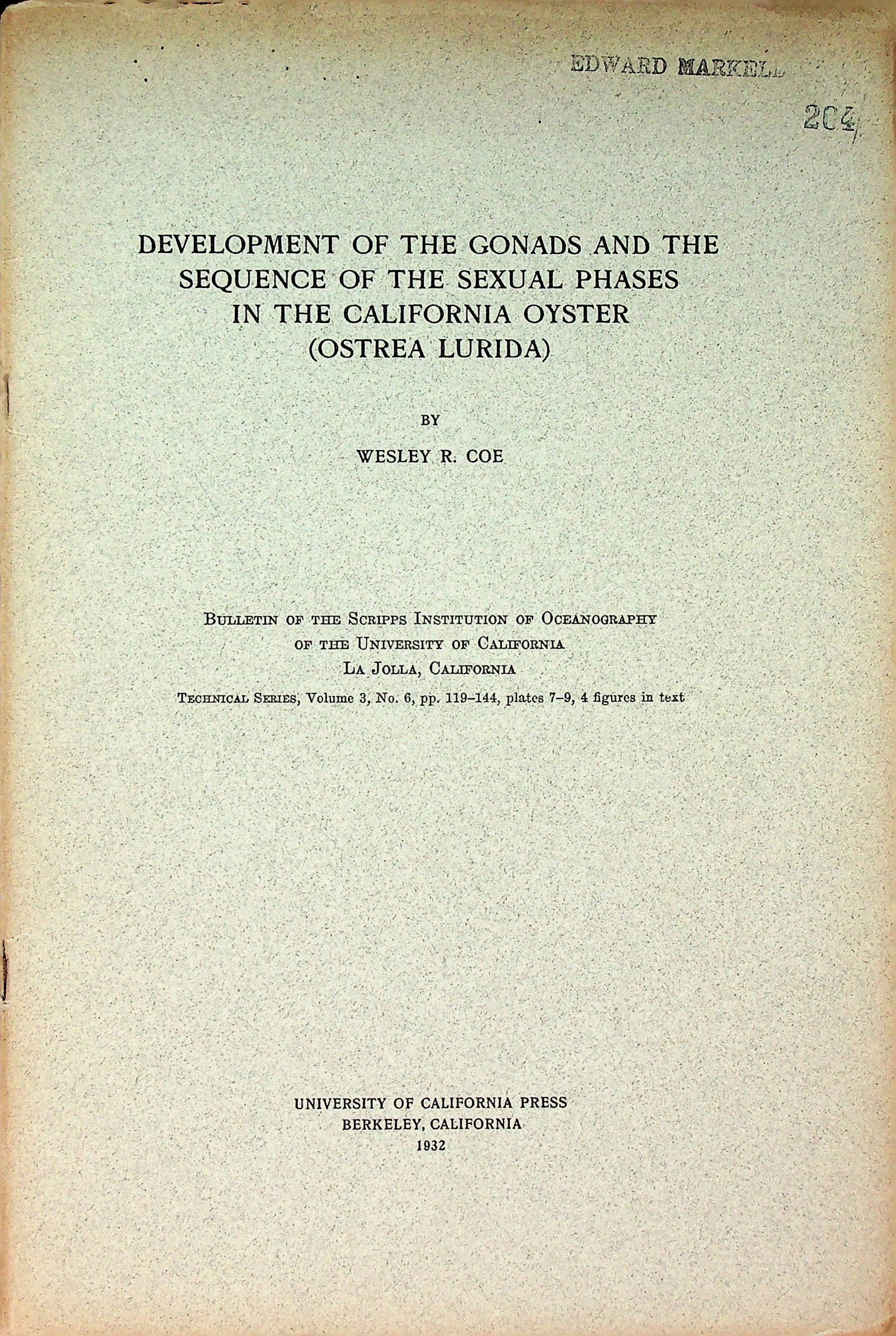
University of California Press, Published 1932 (issued March 26, 1932). Wraps, 34 pp.; 28 cm; illustrated with 4 figures in text and 3 full-page plates (Plates 7-9, combining line drawings of oyster gonad anatomy and histological photomicrographs). Bulletin of the Scripps Institution of Oceanography, Technical Series, Volume 3, No. 6, pp. 119-144. Contribution from the Osborn Zoological Laboratory, Yale University, and the Scripps Institution of Oceanography.
Condition & notes
In Good condition. Original grey printed wraps show mild shelf wear with a few small nicks and tears and light creasing along edges. Covers are starting to split along the fold at the top and bottom of the spine but remain attached at the staples. Previous owner's rubber-stamped name at top right of front cover with accession number "204" inked beneath. Binding sound (staple bound). Interior pages lightly toned with a few small marginal tears; several leaves still uncut along the fore-edge and top edge (the book was only partially opened by its first owner). A light moisture stain affects the inner margin of the plate-facing pages for Plates 8 and 9 but does not touch the plate images themselves. Otherwise unmarked.A histological and genetical study by Wesley R. Coe (Yale University and Scripps Institution of Oceanography) of sex-phase alternation in the California oyster, Ostrea lurida. Coe traces the development of the primary gonad through successive male and female phases, describing the rhythmic sequence of protandry, hermaphroditism, and female maturation across multiple years of experimental observation at the Scripps pier. The paper includes a key discussion of self-fertilization, wintering condition, and the genetical basis of sexual sequence, and is illustrated with detailed line drawings and photomicrographs of gonadal tissue at each phase.Contents: Introduction; Development of primary gonads; Sequence of sexual phases; Modification of the typical sexual sequence; True hermaphroditism; Typical protandry; Spermatogenesis; Secondary gonad, development of female phase; Gonads immediately after ovulation; Second male phase; Resting period; Second female phase; Third male phase and later sexual phases; Wintering condition; Hermaphroditism in other species; Genetical explanation; Summary; Literature Cited; Explanation of Plates.