
Description
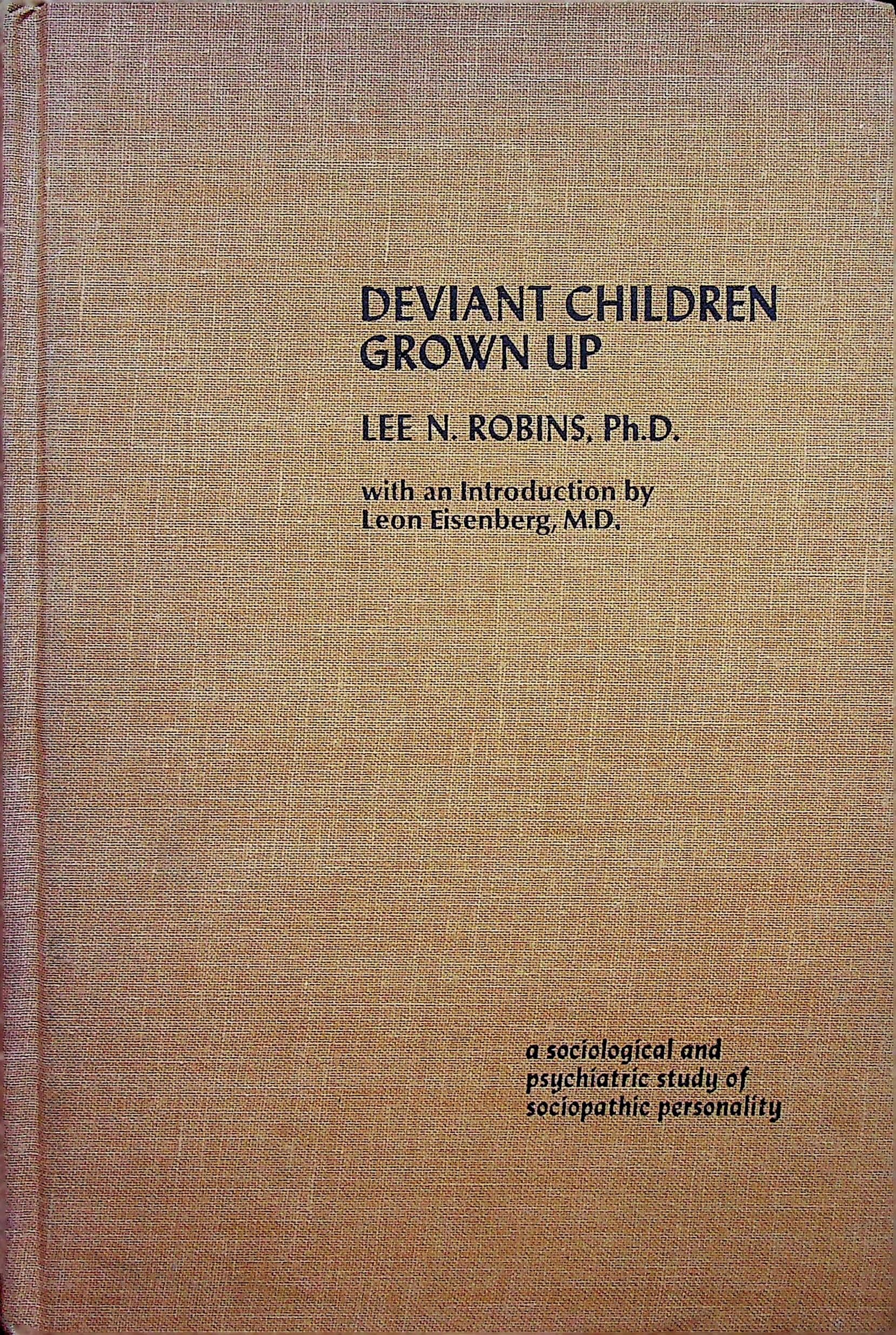
Williams & Wilkins, 1966. Hardcover, 351 pp. First edition. In acceptable condition/ NO dust jacket. Brown cloth covered boards are bound upside down and backwards (with front cover at the back - binding error). Textblock itself bound correcly - just the covers are backwards. Light bumping and scuffing to edges of covers. Binding tight. Previous owner's name on front free end paper. Otherwise pages are clean and unmarked. NOT Ex-Library. NO remainder marks. No dust jacket [From Preface] This study, which traces the adult social and psychiatric outcomes of 524 child guidance clinic patients and compares them with the adult social and psychiatric status of 100 normal school children of the same age, sex, neighborhood, race, and IQ, finds the antisocial children to be the group most in need of help. The neurotic children as adults resembled the control subjects. But the antisocial children produced a high proportion with arrests, alcoholism, divorce, poor job histories, child neglect, dependency on social agencies, and psychiatric hospitalization. Diagnosis by two psychiatrists at follow-up 30 years after initial referral shows the antisocial children more often psychiatrically ill, and particularly more often fitting the diagnostic syndrome sociopathic personality. The present study examines in detail the childhood factors that appear to predict which disturbed children grow into adults with the widespread antisocial behavior characterizing the patient diagnosed sociopathic personality. It traces the fate of the adult symptoms, describing those ex-patients who eventually give up their antisocial behavior and investigating the circumstances leading to remission. It questions many commonly held beliefs - that abandoned antisocial behavior is replaced by neurotic symptoms, that alcoholics follow a downward path unless they stop drinking entirely, that sociopaths do not suffer from anxiety, that neurotic symptoms in childhood predict adult neurosis, that behavior legally defined as antisocial is "normal" in lower-class men. It further questions the belief that valid life history data is obtainable only in the privileged, long-enduring relationship between doctor and patient, as it compares answers to structured interviews obtained in a traditional doorbell-ringing survey with results obtained from a search of police, hospital, social agency, credit bureau, school, and other records. It adds to the extensive literature on psychopathic personality a careful evaluation of the degree and diversity of the disturbances in adjustment in a sample of 90 persons diagnosed sociopathic personality and discusses the childhood histories prognostic of this syndrome, as distinguished from the histories which predict schizophrenia, alcoholism, and hysteria.