Description
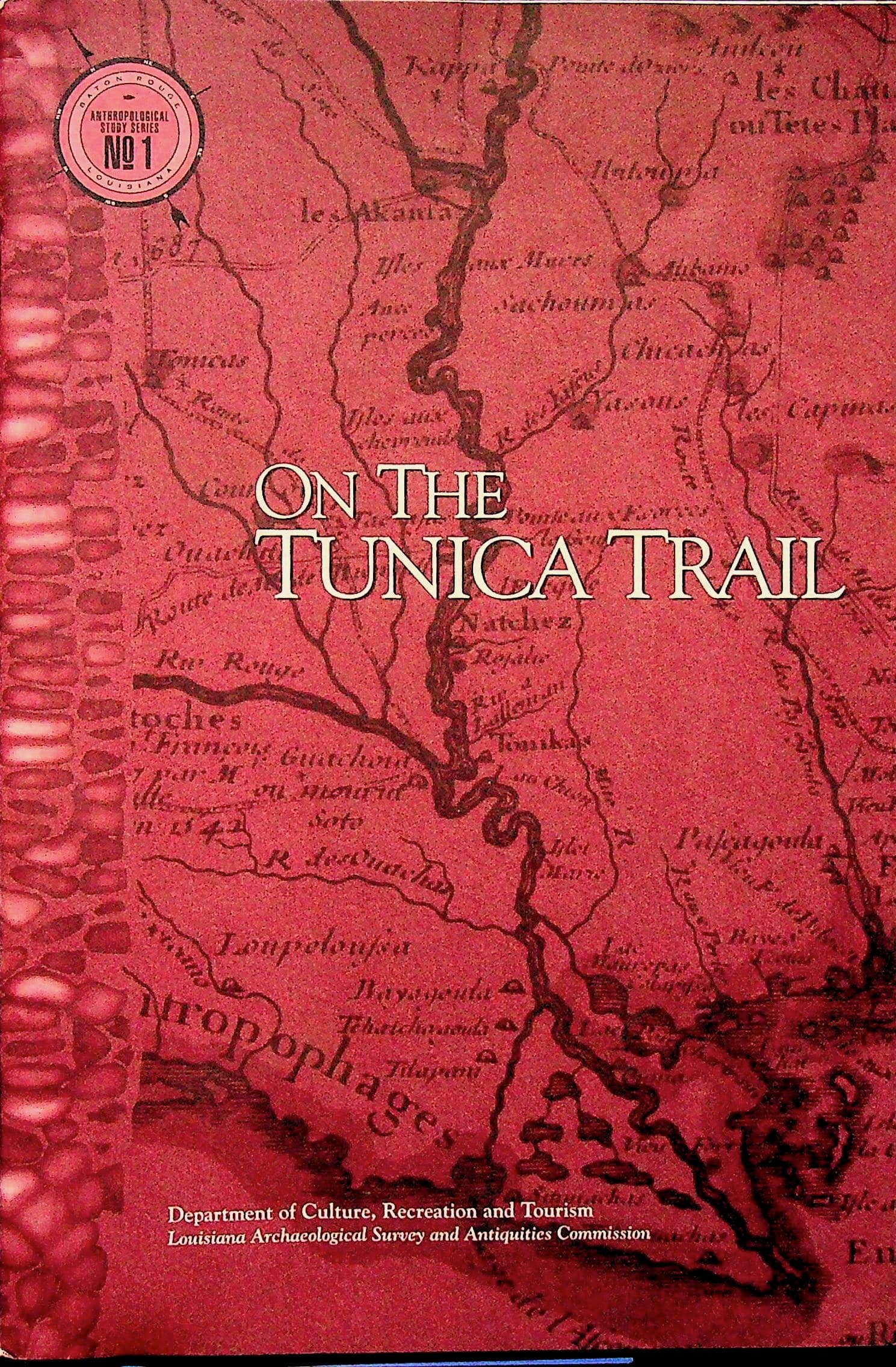
Louisiana Department of Culture, Recreation and Tourism, Anthropology Study Series No. 1 [Published Date: 1994]. Paper covers, 23 pp. Third Edition, September 1994.

Rare, out-of-print & unusual books · Since 1997
Turn the pages with the arrows, keyboard, or a swipe.
Louisiana Department of Culture, Recreation and Tourism, Anthropology Study Series No. 1 [Published Date: 1994]. Paper covers, 23 pp. Third Edition, September 1994.
In very good condition. Brown illustrated paper covers have light bumping to edges and light overall scuffing. Binding tight (staple bound). Pages clean and unmarked. NOT Ex-Library. NO remainder marks. [From Introduction] The Tunica are a good people . . . They have become nearly extinct . . . They had come down the Mississippi [to the place] where they lived [Youchigant, cited in Haas 1950:143]. In their own folklore, this is a capsule history of an exceptional group of North American Indians. The Tunica (which may be translated as "the people") were one of a small number of Lower Mississippi Valley tribes that played a very important role in late prehistoric and early historic events in the valley. Similar in cultural heritage to many other Indian groups in the southeastern United States, and especially in the Mississippi Valley, the Tunica nevertheless have a special significance for the native history of the area. Unlike most Lower Mississippi Valley tribes, they are not lost to history but instead are still amongst us on their tribal lands in Marksville, Louisiana. In northwestern Mississippi, a great center of power was spawned in the late prehistoric period by expansion of the Mississippian cultural tradition from its core area near the confluence of the Mississippi, Ohio, and Missouri rivers. One of the groups participating in the Mississippian tradition, which represents the zenith of native North American cultural attainment, was called the Quizquiz. Their capital was a town with the same name that was located close to where De Soto crossed the Mississippi River in 1541. Disease and population decline apparently led to a breakdown of social and political structures during the seventeenth century. When the French found the remnants of great Quizquiz on the lower Yazoo River in 1699 they were called the Tunica. It is in the time and setting outlined above that the Tunica became known to history. Like other Indian groups they were left adrift in a changing native world which was soon to change beyond native recognition as the Europeans began to take control. The history of the Tunica and their ethnic continuity are the twin themes that are to be explored in the following pages. The story starts with the first known identification of the Tunica at the fabled town of Quizquiz.