Description
Pantheon Books (Bollingen Foundation), Published 1965. Hardcover, xxxi, 466 pp.; 26 cm; Second Edition, Revised, reprinted 1965; Bollingen Series XXXV.5; illustrated with over 500 black-and-white and color illustrations (18 in color), frontispiece engraving after Frederick de Wit.
Condition & notes
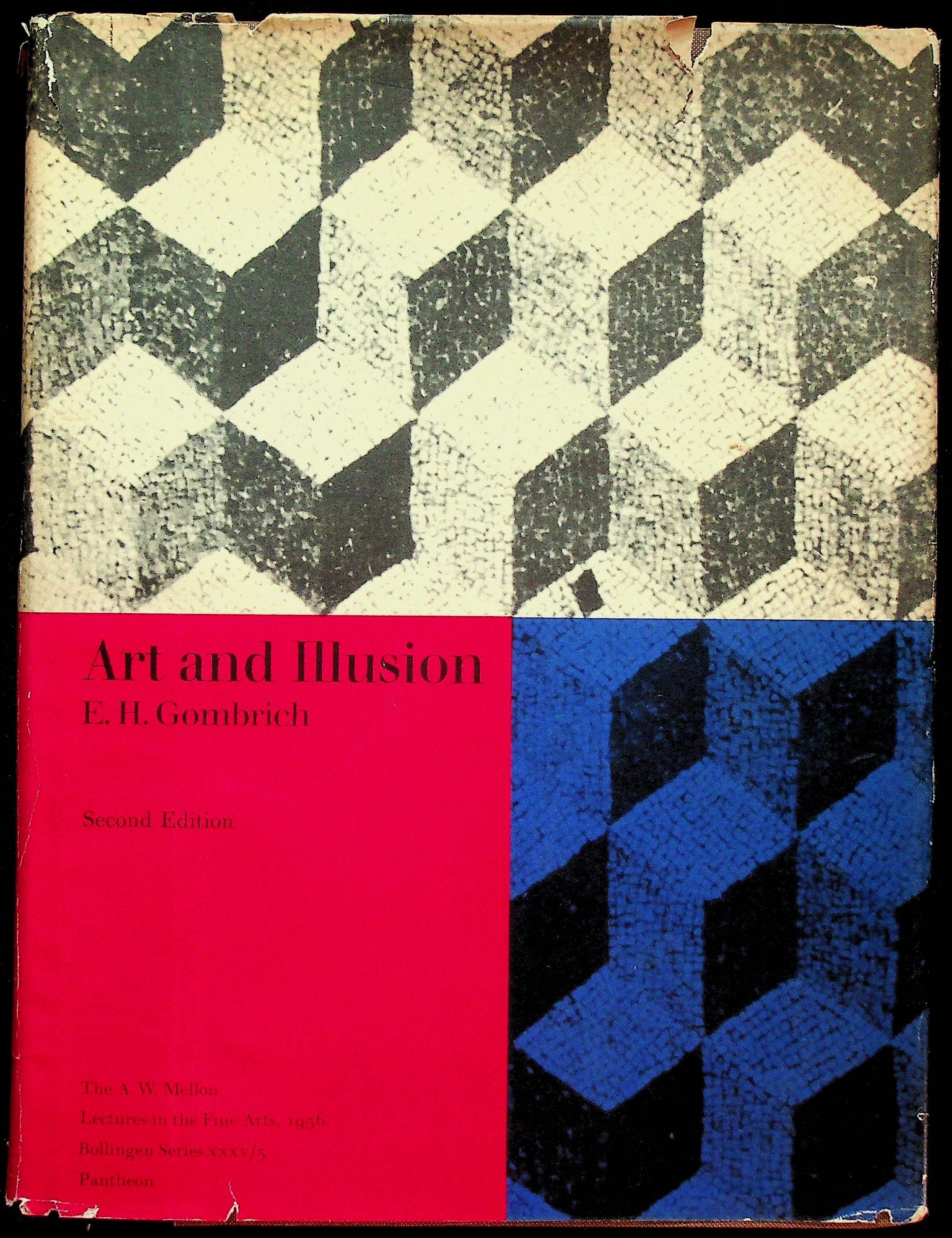
In Very Good condition with a Good dust jacket. Brown cloth boards with black cloth spine, gilt Bollingen device on front cover and gilt lettering on spine; mild shelf and edge wear. Binding tight. Mild toning and foxing to endpapers, with some offset toning from jacket flaps; otherwise pages are unmarked. Paul Rand pictorial dust jacket (photographed mosaic of tumbling cubes over red and blue panels) shows two 1-inch tears along top edge of front panel, chipping at head of spine, several smaller nicks and tears, and creasing along edges; moderate overall toning and scuffing with some color loss along edges and spine folds, heavier toning to spine panel, and rubbing to black panel on rear. Now in an archival quality (removable) Brodart cover. The A. W. Mellon Lectures in the Fine Arts for 1956, delivered at the National Gallery of Art in Washington and published as volume XXXV.5 of Bollingen Series. Gombrich draws on the psychology of perception to ask why art has a history, and why artists of different periods represented the visible world so differently. His answer was that artists start from inherited formulas, or schemata, and correct them against observation, and that the viewer completes the image ("the beholder's share"). It became his most influential book, read well beyond art history. Examples range from Egyptian reliefs, Villard de Honnecourt and Durer to Constable, Turner, caricature and Alfred Leete's 1914 Kitchener recruiting poster. This printing includes Gombrich's Preface to the Second Edition, dated London, January 1961. Book designed by Andor Braun; jacket design by Paul Rand. Contents: Preface; Preface to the Second Edition; List of Illustrations; Introduction: Psychology and the Riddle of Style; Part One, The Limits of Likeness: From Light into Paint; Truth and the Stereotype; Part Two, Function and Form: Pygmalion's Power; Reflections on the Greek Revolution; Formula and Experience; Part Three, The Beholder's Share: The Image in the Clouds; Conditions of Illusion; Ambiguities of the Third Dimension; Part Four, Invention and Discovery: The Analysis of Vision in Art; The Experiment of Caricature; From Representation to Expression; Retrospect; Notes; Index.