Description
Oxford University Press, Published 1983. Hardcover, ix, 385 pp.; 24 cm; First Edition (with full number line).

Rare, out-of-print & unusual books · Since 1997
Turn the pages with the arrows, keyboard, or a swipe.
Oxford University Press, Published 1983. Hardcover, ix, 385 pp.; 24 cm; First Edition (with full number line).
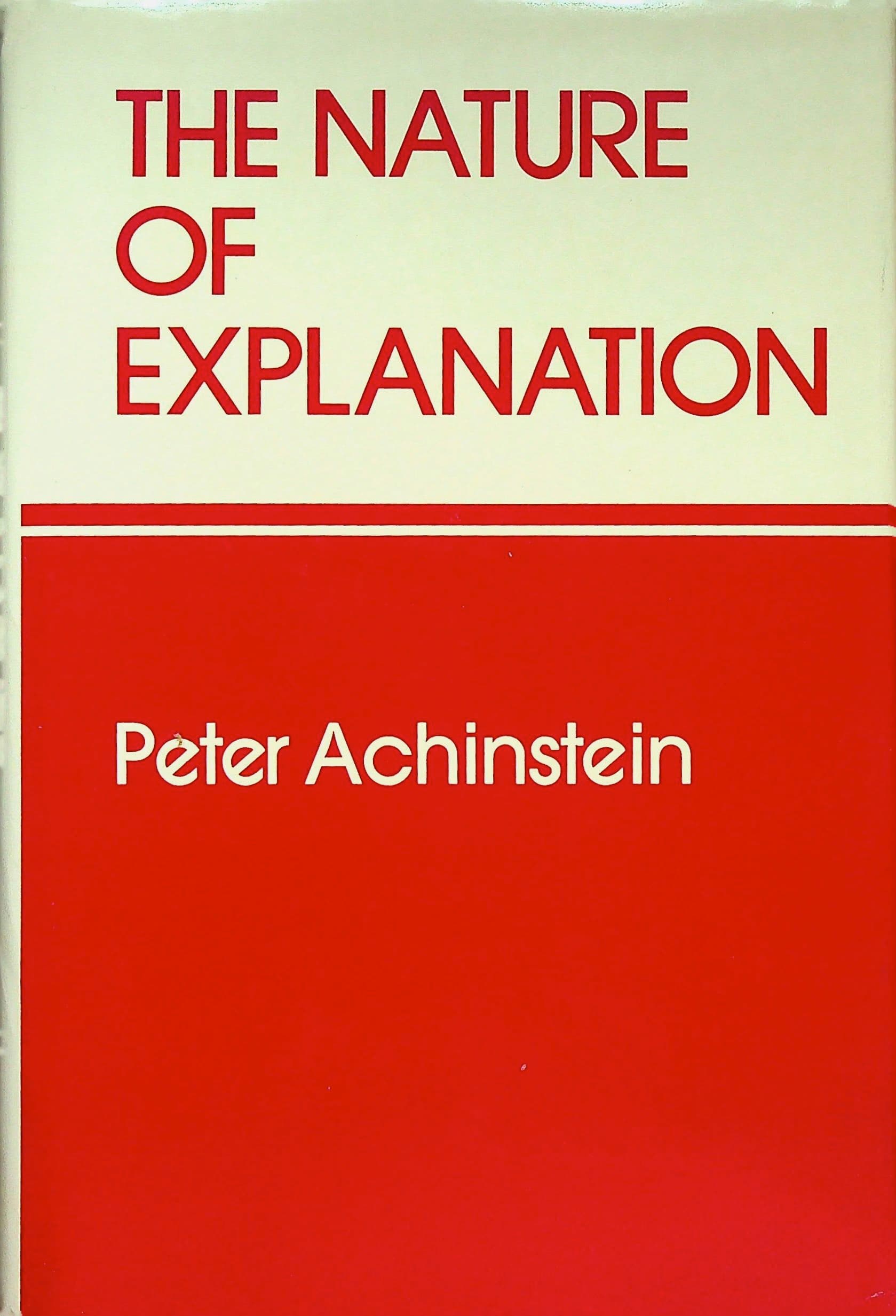
In Very Good condition with a Very Good dust jacket. Blue cloth boards, gilt lettering on spine; mild shelf and edge wear. Binding tight. Endpapers mildly toned, with heavier toning along gutters. Pages otherwise clean and unmarked. Cream and red dust jacket lettered in red and cream shows a few small nicks and short tears and light creasing along edges, mild overall toning, and shelf and edge wear. Now in an archival quality (removable) Brodart cover. Achinstein's account of scientific explanation sets aside the standard formal models (Hempel's deductive and statistical models, Salmon's statistical-relevance model) and begins instead with the explaining act, developing an "illocutionary" theory of explanation and applying it to causal and functional explanation, the limits of explanation, and the relation between explanation and evidence. The Stanford Encyclopedia of Philosophy names this book, with van Fraassen's The Scientific Image (1980), as one of the two systematic statements of the pragmatic approach to explanation published in the 1980s. Achinstein (b. 1935), Krieger-Eisenhower Professor of Philosophy at Johns Hopkins and founder of its Center for History and Philosophy of Science, shared the 1993 Lakatos Award for Particles and Waves. Contents: Introduction; Explaining; What Is an Explanation?; The Evaluation of Explanations; Can There Be a Model of Scientific Explanation?; The Causal Relation; Causal Explanation; Functional Explanation; The Limits of Explanation; Evidence and Explanation; Evidence: Additional Topics; Index.