Description
The Travel Association of Great Britain and Northern Ireland (Tourist Division of the British Tourist and Holidays Board), Published 1948. Wraps, 80 pp.; 19 cm; "Edition for 1948"; illustrated with black-and-white photographs throughout; printed by Alabaster, Passmore & Sons, London and Maidstone.
Condition & notes
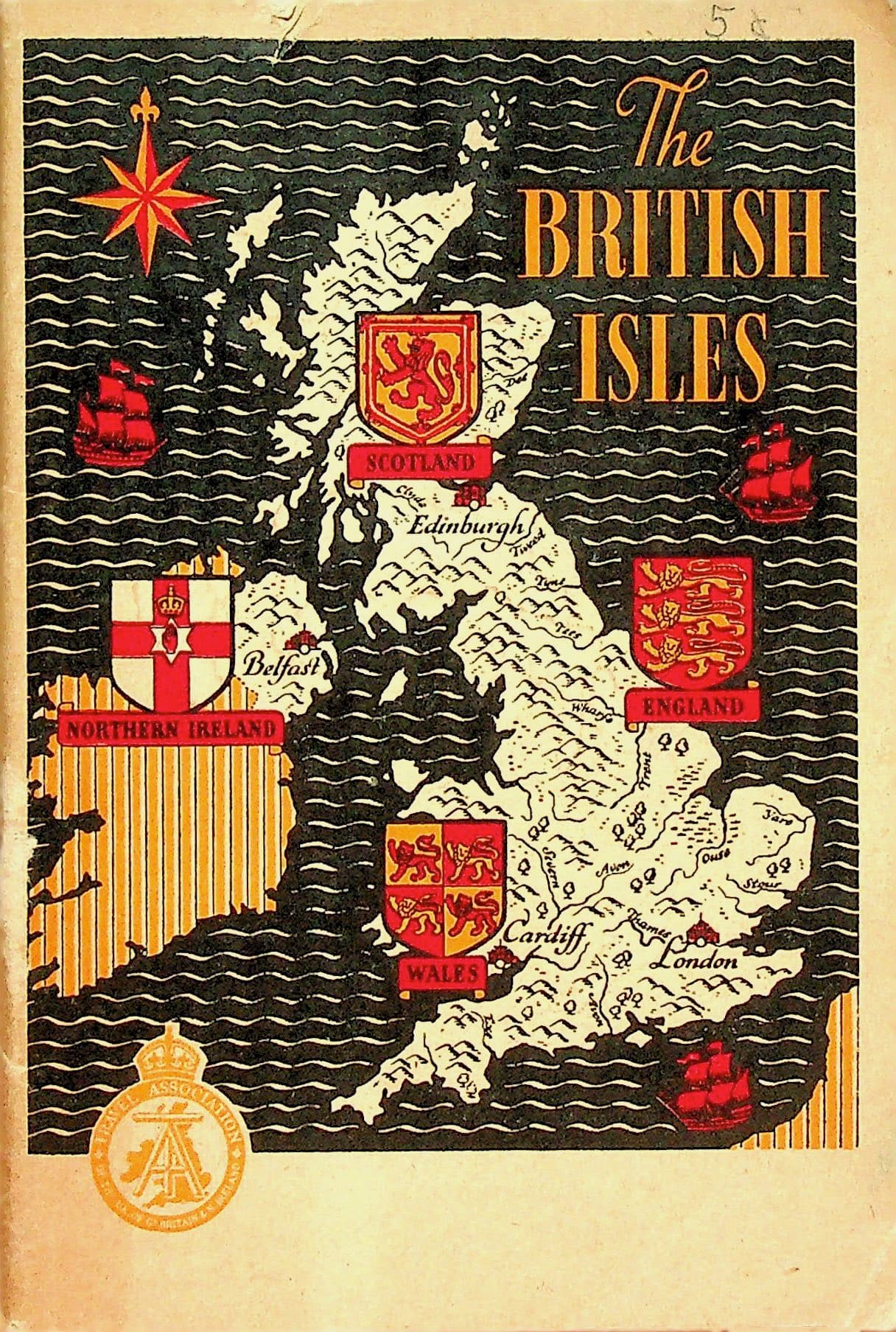
In Good condition. Illustrated paper covers with a pictorial map of the British Isles and the arms of England, Scotland, Wales and Northern Ireland, repeated on rear cover. Small tear and crease at upper edge of front cover. A few small nicks to edges, some bumping and creasing, mild to moderate shelf and edge wear, toning and light soiling. "5" cents in pencil at upper corner of front cover. Staple bound, binding tight. Pages clean. Otherwise unmarked. Postwar tourist booklet issued from the Association's Tourist Information Centre at 47 Leicester Square. The Travel Association was founded in 1929 to bring overseas visitors, especially Americans, to Britain. Much of the text is aimed at American tourists: Sulgrave Manor and the Washington family, the tomb of Robert E. Lee's ancestor at Hardwick, Penn's family home, the Pilgrim Fathers at Boston, the Magna Carta copy that spent the war in New York, and the Carrickfergus ancestors of Andrew Jackson. London is absent because the Association published a separate London booklet, listed with its other publications on inside rear cover. Nine regional tours (Home Counties, Midlands, South Coast, West Country, East Anglia, North Country, Wales, Scotland, Northern Ireland) are written for travel by bus, road or train, with photographs credited to the Southern Railway and L.M.S. Railway, companies nationalized into British Railways in January 1948. The war is still close: Kent as "bomb alley" under the flying bombs, Coventry "laid in ruins," Southampton largely destroyed, and the South Coast as "Britain's front line." The Northern Ireland section quotes Churchill that "but for the loyalty of Northern Ireland we should have been confronted with slavery and death," and Eisenhower on Ulster as the staging ground for American forces, noting that the Irish Free State remained neutral.