Description
Bergman Publishers, Published 1967. Hardcover, 127 pp.; 22 cm; illustrated with an engraving of the interior of the Spanish Portuguese Synagogue, Amsterdam 1639, and a facsimile of the 1740 London title page.

Rare, out-of-print & unusual books · Since 1997
Turn the pages with the arrows, keyboard, or a swipe.
Bergman Publishers, Published 1967. Hardcover, 127 pp.; 22 cm; illustrated with an engraving of the interior of the Spanish Portuguese Synagogue, Amsterdam 1639, and a facsimile of the 1740 London title page.
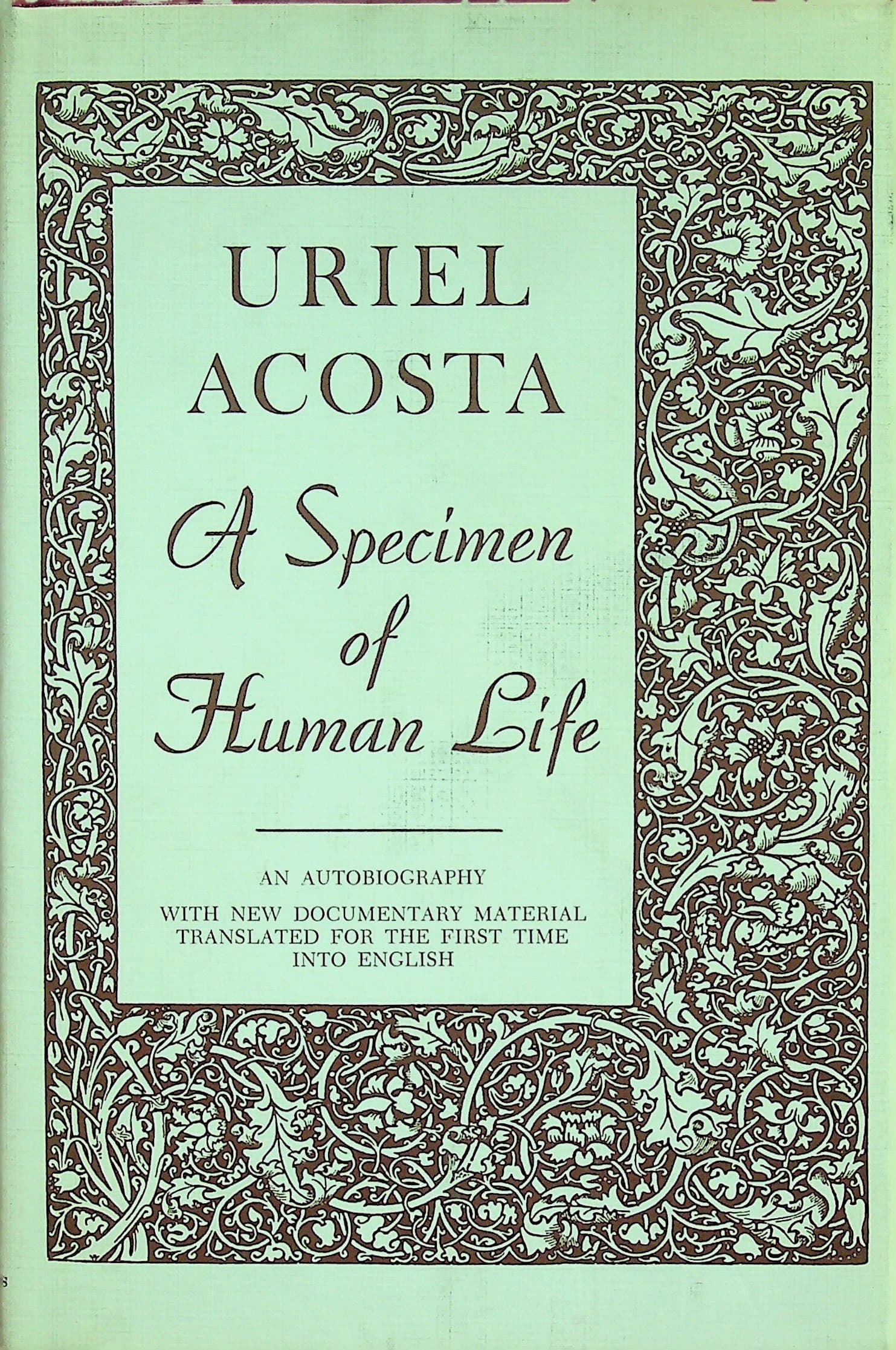
In Very Good condition with a Very Good dust jacket. Maroon cloth boards with silver lettering on spine, mild shelf and edge wear. Binding tight. Pages clean and unmarked. Cream illustrated jacket with brown foliate border in the William Morris manner has light bumping and creasing to edges, mild shelf wear, and some light overall scuffing, toning and soiling. Now in an archival quality (removable) Brodart cover. Uriel Acosta (1585-1640) was born in Oporto to a Portuguese family of Jewish descent forced to convert to Catholicism. He left Portugal for Amsterdam to return to the religion of his ancestors and was excommunicated after attacking rabbinic tradition. He wrote this autobiography as a last testament, and the manuscript was found on his desk after his death in 1640; it survives only because Philippus van Limborch printed it in his "Amica Collatio" (Gouda, 1687), and was first put into English by John Whiston in London in 1740, whose title page is reproduced here. Acosta is generally treated as a forerunner of Spinoza. This edition gathers the autobiography with the Eleven Theses, five excommunication documents, and Limborch's reply; the title page states that the new documentary material appears in English for the first time, and the copyright page assigns those translations to Peter M. Bergman. Jacket and book design by P.M.B. Contents: Uriel Acosta's Account of his own life (Exemplar Humanae Vitae); Uriel Acosta's Eleven Theses against the Tradition; Excommunication of Uriel Acosta, comprising Proclamation of the Jewish Community in Venice, Excerpt from the Court Register Amsterdam, Resolution of the Deputies of the Jewish Nation in Amsterdam, Question by the Jewish Community in Amsterdam, and Resolution of the Holy Community "Talmud-Torah"; Limborch's Defense of Christianity in Answer to Acosta's Objections; Bibliography.