Description
University of California, College of Agriculture, Agricultural Experiment Station, Published 1947. Wraps, 24 pp.; 24 cm; staple bound; California Agricultural Experiment Station Circular 367, March 1947; printed in green and black; illustrated with black-and-white photographs.
Condition & notes
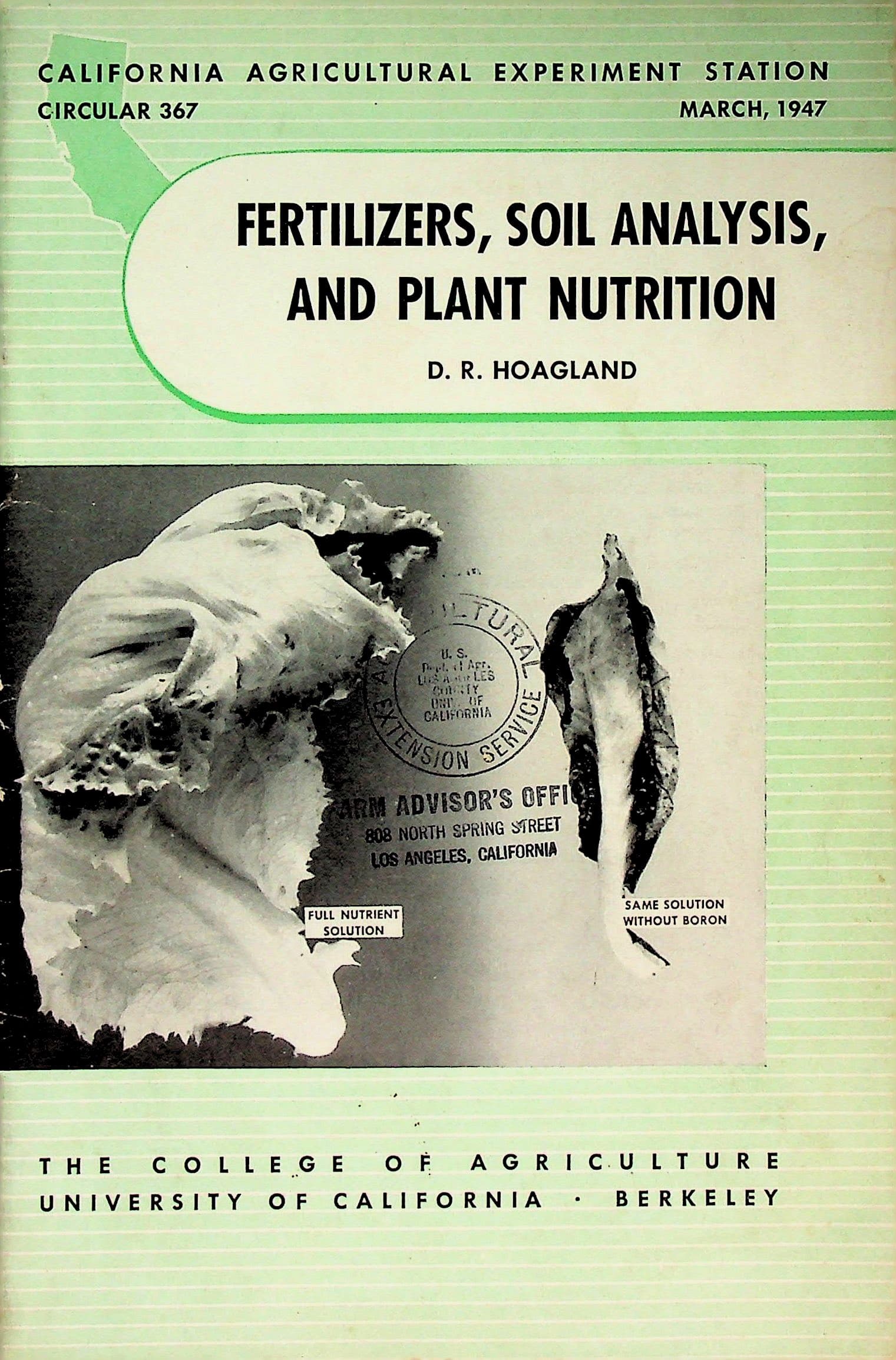
In Good condition. Green, black and white pictorial paper covers, cover photograph contrasting lettuce grown in a full nutrient solution with the same solution lacking boron. Nicking and chipping to edges with creasing to corners and a chip at the top corner of the front cover. Mild shelf wear, toning and light soiling overall, with scattered light staining to rear cover. Handstamp of the Agricultural Extension Service, Los Angeles County Farm Advisor's Office, 808 North Spring Street, on front cover. Staple bound, binding tight. Pages toned but otherwise unmarked. Printer's code at the foot of the last page records a run of 15,000 copies in March 1947. Hoagland (1884-1949) was Professor of Plant Nutrition at Berkeley and the author of the Hoagland solution, still the standard nutrient formula in plant science laboratories. This circular is his plain-language account of the water-culture research behind it, written for California farmers rather than for researchers, two years before his death. He sets out the mineral elements plants require, adding boron, manganese, copper, zinc and molybdenum to the older list of seven, and illustrates deficiency from his own experiments: tomato leaflets starved of manganese, lettuce raised without nitrogen, potassium or phosphorus, tomato roots in aerated and unaerated solution. He declines throughout to give a formula, holding that each crop on each soil is a separate problem, and sends the reader to the county farm advisor. Contents: Chemical elements of the soil essential to plants; The soil as a nutrient medium for crops; The absorption of essential elements by roots; Availability of potassium; Availability of phosphorus; Use of nitrogen and other fertilizers; Chemical effects of the soil on added fertilizers; Covercrops and rotation of crops; Use of animal manure; Observations on role of organic matter; Fertilization and quality of the crop; Plant nutrition and nutritional value of crops; Acid and alkaline soils; Soil analysis; Plant analysis for diagnosing soil deficiencies; Where to go for help with fertilizer problems.