Description
International Textbook Company, Published 1936. Hardcover, v, 44, 61, 46 pp.; 20 cm; illustrated with black-and-white line engravings, force diagrams and tables throughout.

Rare, out-of-print & unusual books · Since 1997
Turn the pages with the arrows, keyboard, or a swipe.
International Textbook Company, Published 1936. Hardcover, v, 44, 61, 46 pp.; 20 cm; illustrated with black-and-white line engravings, force diagrams and tables throughout.
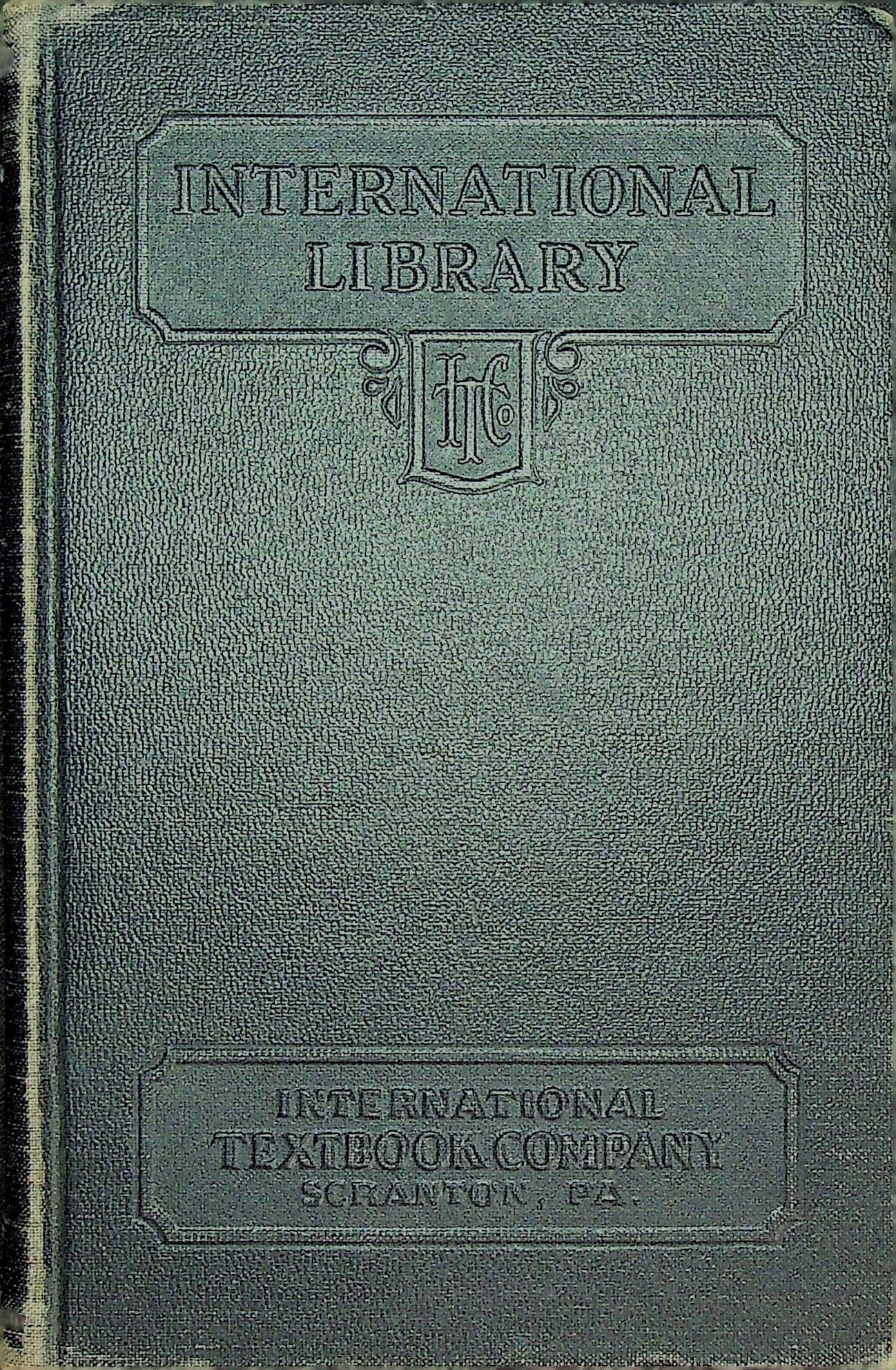
In Good condition, no dust jacket. Black pebble-grained cloth, blind-stamped International Library panel and International Textbook Company monogram on front cover, blind-stamped publisher's panel at foot. Gilt lettering on spine present but rubbed, volume number at foot of spine heavily rubbed, reading from the foot upward as in all volumes of the series. Mild to moderate shelf wear, with wear to edges and along spine and some color loss, and nicking to the cloth at the corner tips. Binding tight. Green and cream marbled endpapers, blue-stained page edges. Mild toning, with light scattered spotting to the title leaf. Otherwise unmarked.Volume 325 in the bound series issued by International Textbook Company, the publishing arm of the International Correspondence Schools of Scranton, Pennsylvania. ICS grew out of a mine-safety question-and-answer column run by Thomas J. Foster in the Colliery Engineer and Metal Miner and enrolled its first class of 500 miners in 1891; cumulative enrollment reached four million by 1930, making it the most successful correspondence school in American history. The bound volumes gathered the loose serial-numbered Instruction Papers into permanent form, this one comprising Fundamental Principles of Mechanics (Serial 914, Edition 2) and Elements of Statics Parts 1 and 2, by A. DeGroot, Director of the Civil Engineering Schools, in collaboration with Samuel Baker, Dean of the Schools of Technology. The opening paper is elementary mechanics from the ground up, and characteristically careful about its definitions: matter, phenomenon, body and substance, motion and rest and relative position, velocity in uniform and in variable motion, then force and mass, balanced and unbalanced forces, equilibrium, weight as against the measure of a force, and the divisions of mechanics. The fundamental laws of dynamics follow, the law of inertia with Galileo's law of the independent effect of forces and an experimental verification a student could rig on a bench, acceleration, mass, the law of action and reaction with tension, compression and pressure, and closing formulas for retardation. Statics Part 1 is the composition and resolution of forces, magnitude, line of action and direction, vectors and the transferability of the point of application, then collinear and concurrent forces, the parallelogram, triangle and polygon of forces, resolution into rectangular components, three and several balanced concurrent forces by both graphic and analytic method, and on to parallel forces, moments, the resultant of parallel forces and its location by inspection, couples, balanced parallel forces and the determination of reactions, ending with the graphic methods. Part 2 finishes the composition of forces with frames having non-parallel reactions and non-concurrent forces that are not parallel, then takes up center of gravity for elementary plane figures, the parallelogram, triangle, trapezoid, quadrilateral, circular sector and segment, for complex and irregular plane figures and for solids, and closes with friction, the coefficient and angle of friction, angle of repose and minimum force under sliding friction, and rolling friction worked out on locomotive wheels and a nine-hundred-ton train. Fundamental Principles of Mechanics carries the 1936 and 1930 copyrights, both Statics parts the 1928, with no periodic-review notice or later edition date. Printed by The Haddon Craftsmen of Scranton, printer's key 94342 at foot of the copyright page.Contents: Fundamental Principles of Mechanics: Motion; Introductory Definitions; Matter and Body; Motion and Rest; Velocity; Velocity in Uniform Motion; Velocity in Variable Motion; Force and Mass; Definitions Relating to Force, Measure of Force; Definition and Divisions of Mechanics; Fundamental Laws of Dynamics; Law of Inertia; Acceleration; Mass; Law of Action and Reaction; Immediate Consequences of the Preceding Laws; Important Formulas; Retardation. Elements of Statics, Part 1: Composition and Resolution of Forces; Fundamental Principles; Concurrent Forces; Collinear Forces; Composition of Concurrent Forces; Concurrent Components of a Force; Three Balanced Concurrent Forces; Several Balanced Concurrent Forces; Parallel Forces; Moments of Forces; Resultant of Parallel Forces; Couples; Balanced Parallel Forces; Graphic Methods for Parallel Forces. Elements of Statics, Part 2: Composition and Resolution of Forces (Continued); Frames with Non-Parallel Reactions; Non-Concurrent Forces Which Are Not Parallel; Center of Gravity; Introductory Explanations; Location of Center of Gravity; Elementary Plane Figures; Complex Plane Figures; Irregular Plane Figures; Center of Gravity of Solids; Friction; Sliding Friction; Rolling Friction.