Description
International Textbook Company, Published 1939. Hardcover, iv, 68, 52 pp.; 20 cm; illustrated with black-and-white line engravings, diagrams, and tables throughout.

Rare, out-of-print & unusual books · Since 1997
Turn the pages with the arrows, keyboard, or a swipe.
International Textbook Company, Published 1939. Hardcover, iv, 68, 52 pp.; 20 cm; illustrated with black-and-white line engravings, diagrams, and tables throughout.
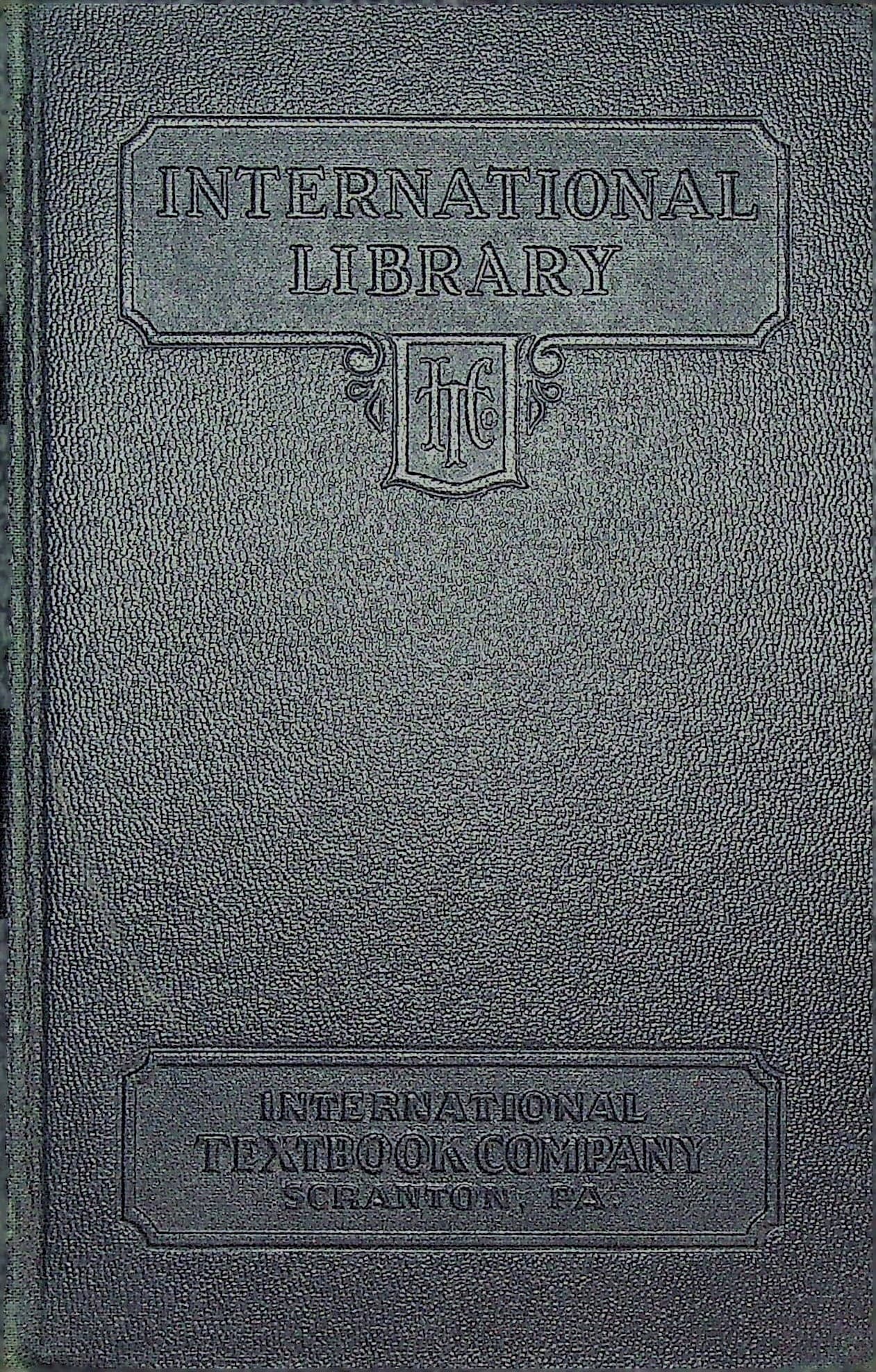
In Very Good condition, no dust jacket. Black pebble-grained cloth, blind-stamped International Library panel and International Textbook Company monogram on front cover, blind-stamped publisher's panel at foot, gilt lettering on spine reading from the foot upward as in all volumes of the series. Small surface scuff on front cover, mild rubbing along edges of covers. Binding tight. Green and cream marbled endpapers, blue-stained page edges. Pages clean and unmarked.Volume 292 in the bound series issued by International Textbook Company, the publishing arm of the International Correspondence Schools of Scranton, Pennsylvania. ICS grew out of a mine-safety question-and-answer column run by Thomas J. Foster in the Colliery Engineer and Metal Miner and enrolled its first class of 500 miners in 1891; cumulative enrollment reached four million by 1930, making it the most successful correspondence school in American history. The bound volumes gathered the loose serial-numbered Instruction Papers into permanent form, this one comprising Determination of True Meridian (Serial 2911-2, Edition 1) by Samuel G. Barton, Associate Professor of Astronomy at the University of Pennsylvania, and Fundamentals of Law for Surveyors by Frank Emerson Clark, attorney-at-law. Barton's section teaches the surveyor enough practical astronomy to find north: elements of the sphere, great and small circles, the earth's axis, poles, equator and meridians, then the celestial sphere with zenith and celestial horizon and the apparent motion of the stars and sun, and sidereal, solar and standard time. From there it is observation, first of Polaris at culmination and at elongation, which the text calls the most accurate method available, then location of the meridian by observing the sun, using the American Ephemeris and the conversion of local into Greenwich civil time, determination of altitude by transit with corrections for index error and refraction, determination of azimuth, and finally determination of latitude. Clark's section is the legal half and the more consequential one: identification of boundaries and the responsibility of the surveyor, methods of describing land through the rectangular system down to the subdivision of sections, corner monuments and accessories, original field notes and the official plat, description by metes and bounds, then relocating original boundaries, correcting defects in original surveys, conflicts and ambiguous calls, distribution of error among adjoining lots, changes in boundaries along bodies of water, and the legal principles affecting title, boundaries established by mutual consent, title to public ways, limitations of riparian rights, title by adverse possession, and land courts. Clark is the author of A Treatise on the Law of Surveying and Boundaries (Bobbs-Merrill, 1922), cited by him in the present text, which survives as Clark on Surveying and Boundaries and is still relied on by American courts. Of particular interest is the short section on State Plane-Coordinate Systems, which reprints the New Jersey act approved March 25, 1935 in full; New Jersey was the Coast and Geodetic Survey's test case for a north-south transverse Mercator zone, and the plane-coordinate systems had been designed only in 1933 and 1934, so this is instruction in a method then almost new. Determination of True Meridian carries the 1936 copyright, Fundamentals of Law for Surveyors the 1939, with no periodic-review notice or edition date; the serial number 2911-2 marks a revision of the original Instruction Paper. Printed by The Haddon Craftsmen of Scranton, printer's key 94084 at foot of the copyright page.Contents: Determination of True Meridian: Introduction; Preliminary Definitions and Explanations; The Celestial Sphere; Time; Observations for True Meridian; Observation of Polaris; Locating Meridian by Observing Sun; Basis of Method; The American Ephemeris; Determination of Altitude; Determination of Azimuth; Determination of Latitude. Fundamentals of Law for Surveyors: Identification of Boundaries of Tracts; Responsibility of Surveyor; Methods of Describing Tracts of Land; Rectangular System; Description by Metes and Bounds; State Plane-Coordinate Systems; Special Boundaries; Relocating Original Boundaries; Fundamental Principles in Relocation; Correction of Defects in Original Surveys; Changes in Boundaries Along Bodies of Water; Legal Principles Affecting Title to Land; Boundaries Established by Mutual Consent; Title to Public Ways; Limitations of Riparian Rights; Title by Adverse Possession; Land Courts.