Description
International Textbook Company, Published 1927. Hardcover, iv, 51, 53 pp.; 20 cm; illustrated with black-and-white line engravings throughout.

Rare, out-of-print & unusual books · Since 1997
Turn the pages with the arrows, keyboard, or a swipe.
International Textbook Company, Published 1927. Hardcover, iv, 51, 53 pp.; 20 cm; illustrated with black-and-white line engravings throughout.
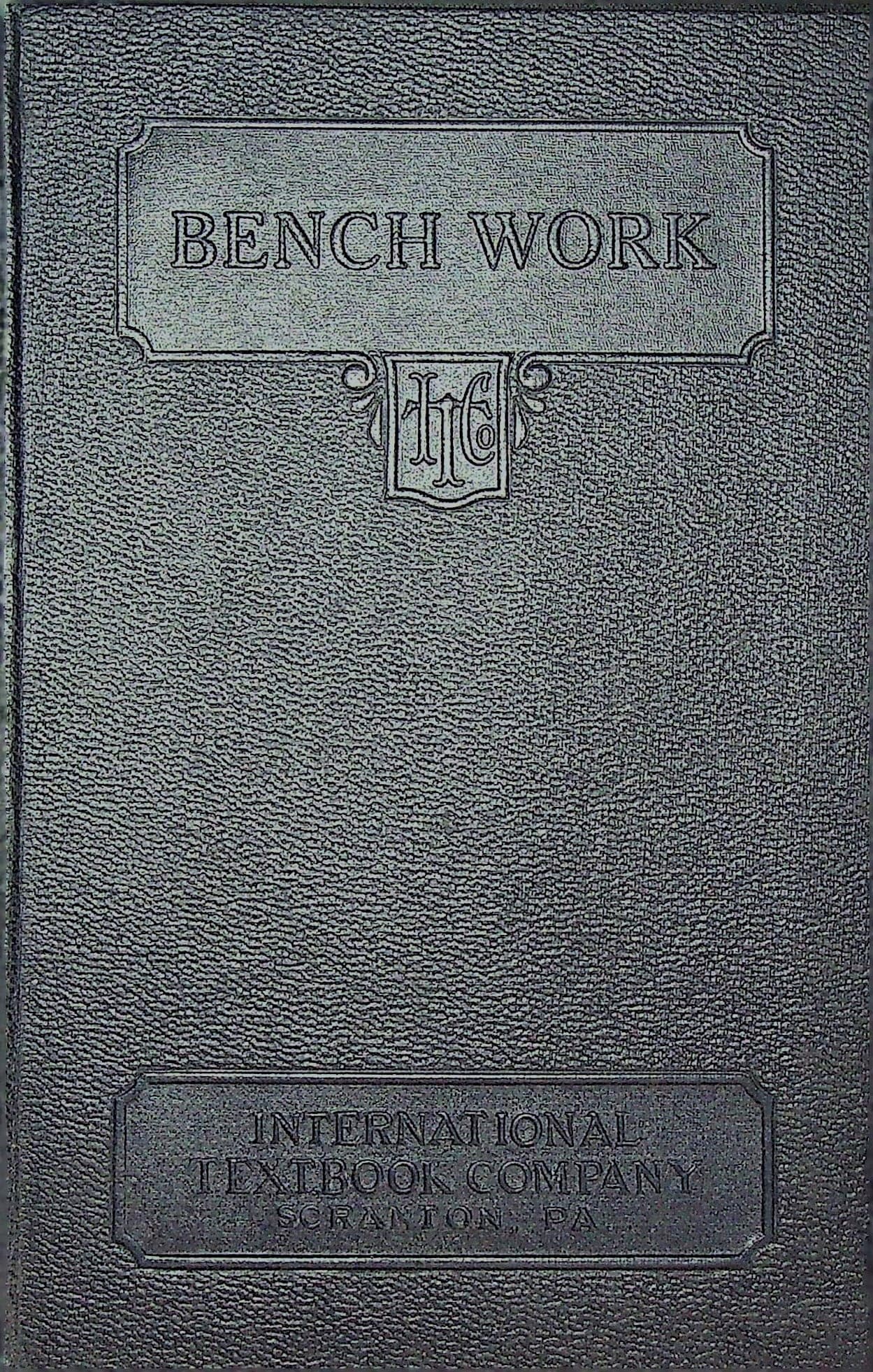
In Very Good condition, no dust jacket. Black pebble-grained cloth, blind-stamped title panel and International Textbook Company monogram on front cover, blind-stamped publisher's panel at foot, gilt lettering on spine bright. Very minor surface and edge wear. Binding tight. Green and cream marbled endpapers, blue-stained page edges. Pages clean and unmarked.Volume 186 in the bound series issued by International Textbook Company, the publishing arm of the International Correspondence Schools of Scranton, Pennsylvania. ICS grew out of a mine-safety question-and-answer column run by Thomas J. Foster in the Colliery Engineer and Metal Miner and enrolled its first class of 500 miners in 1891; cumulative enrollment reached four million by 1930, making it the most successful correspondence school in American history. The bound volumes gathered the loose serial-numbered Instruction Papers into permanent form, this one comprising Bench Work Part 1 (Serial 2235A, Edition 1) and Part 2, by Roger O. Alden with the I.C.S. Staff. The subject is what a machinist does by hand when the job does not warrant tooling up a machine, and the text opens by saying so plainly: bench work is skilled work, and a shop should have as little of it as possible. Part 1 is tools and the operations of removing metal, ball-peen and cross-peen hammers, center and prick punches, scribers, bench centers and the screw straightening press, hand and power hack saws, the full run of wrenches down to the Stillson and the alligator and the trick of turning pipe with a doubled rope, vises and vise benches, the layout and lighting of the bench itself, then chipping with chisels and the pneumatic hammer, and a long treatment of filing covering forms of file teeth, grading, shapes, holding and cross-filing, the effect of oil, and filing jigs and machines. Part 2 moves to fitting and layout: hook and bearing scrapers and the frosting of surfaces, hand broaching, fitting keys and gauging keyways, reaming, thread cutting by tap and die including pipe threads, then laying out, marking mixtures and coatings, laying-out plates and appliances, locating centers and subdividing circles, and a closing set of practical examples working through bolt holes for pipe flanges, a large journal cap, a crank, a crosshead, an engine bed, a sheet-iron guard, a shaft, and an arm on a thick plate, ending with the inspection of finished bench work.Contents: Bench Work, Part 1: Tools and Fixtures Employed; Tools; Wrenches; Vises; Benches; Chipping; Filing. Bench Work, Part 2: Scraping; Hand Broaching; Fitting Keys; Reaming; Thread Cutting; Laying Out; Principles and Appliances; Practical Examples of Laying Out.