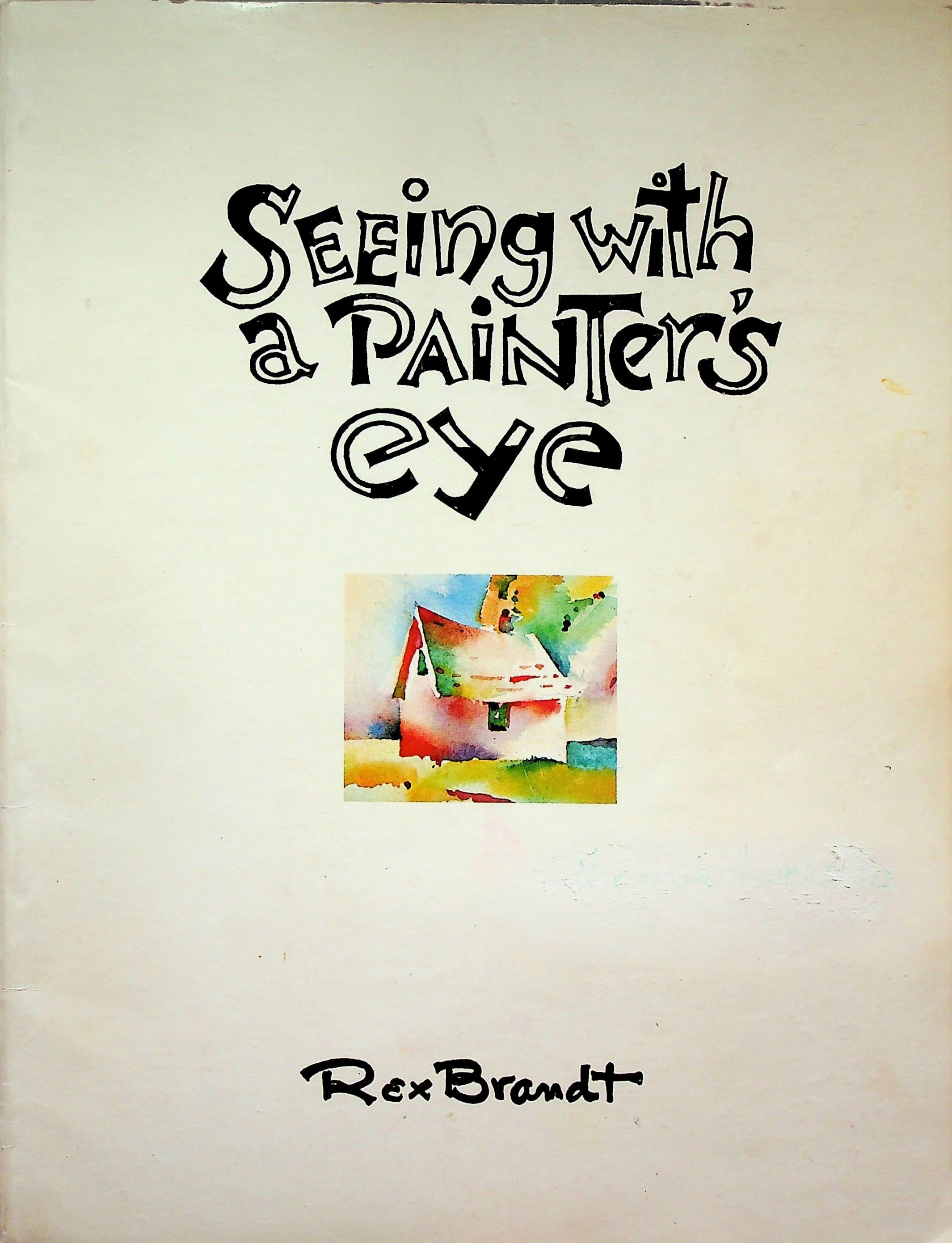
Description
Brandt Painting Workshops, Published 1981. Wraps, 63 pp; 28 cm; privately printed and published by the author's own workshop (the scarce 1981 first edition, distinct from and predating the widely distributed 1984 hardcover trade edition issued by Van Nostrand Reinhold); illustrated throughout with the author's pen-and-ink lesson-diagrams (150 in total per the cover statement) and twelve color reproductions of his watercolors.
Condition & notes
In Acceptable condition. Glossy white illustrated paper covers show moderate overall soiling, scuffing, and shelf wear, including a few small paint marks on the rear cover and a scuffed patch on the front cover where a previous owner's name has been erased. Binding tight. Interior pages are clean and unmarked with two exceptions: a few lines of text are highlighted in yellow on one page, and another page has a passage highlighted in blue with several pen underlines beneath it. A small embossed ownership stamp at the upper outer corner of the rear endpaper. Otherwise unmarked.Rex Brandt (1914-2000) was a central figure of the California Style watercolor school. A National Academician and past president of the National Watercolor Society, Brandt was born in San Diego, studied at the University of California at Berkeley, and worked for most of his career at Corona del Mar, where he and his wife, the artist Joan Irving, operated the Brandt Painting Workshops. He maintained a summer studio in the San Juan Islands of Washington, and his work is held in the National Academy of Design and in numerous public and private collections; through his many books on watercolor technique and his decades of workshop teaching he became one of the most widely read instructors of West Coast painters.This is Brandt's distillation of the seeing-painting principles he taught in his Corona del Mar workshops, drawn (per his foreword) "from my lectures and classes as the best illumination of the seeing-painting process I can present, both as a teacher and as a painter." The book is organized in three parts: Line (Kinds of drawing, Functions of line, Format, Subjective line, Articulate drawing, Tension, Signs symbols and silhouettes, Shape relationships, Space, Standpoint, Problems of perspective, Intersection/overlap, See relationships, Experiments); Value (External light, Internal light, Attention by contrast, Simultaneity, Visual gestalts, Interweave and interlock, Passage, Chiaroscuro, Experiments); and Color (The many ways of color, Resonance). Each section pairs concise text in Brandt's typed-and-handlettered format with pen lesson-diagrams and culminates in color demonstrations on the closing pages.