Description
Routledge & Kegan Paul, Published 1980. Hardcover, xiv, 207 pp.; 23 cm; First Edition.

Rare, out-of-print & unusual books · Since 1997
Turn the pages with the arrows, keyboard, or a swipe.
Routledge & Kegan Paul, Published 1980. Hardcover, xiv, 207 pp.; 23 cm; First Edition.
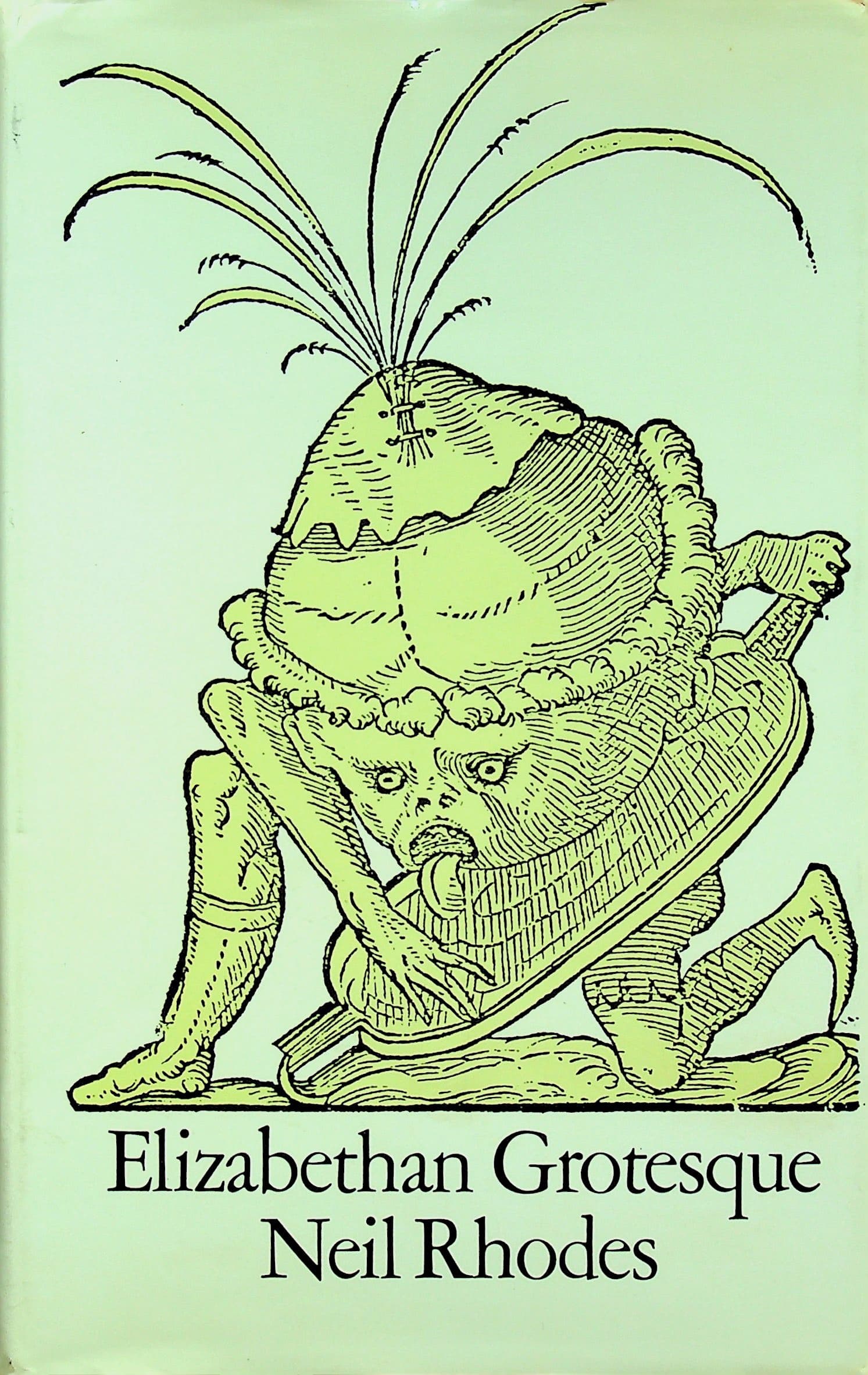
In Very Good condition with a Very Good dust jacket. Yellow cloth-covered boards with silver lettering on the spine; mild shelf wear and edge wear to the covers; binding tight. Previous owner's name, date, and city in ink at the top corner of the front free endpaper. Otherwise unmarked. Pale green illustrated dust jacket (woodcut-style grotesque figure on the front panel) has a few small nicks and creasing along the edges, mild toning overall, and toning with spotting to both the front and back jacket flaps. Now in an archival quality (removable) Brodart cover.[From front jacket flap] The comic grotesque is a powerful element in a great deal of Elizabethan literature, but one which has attracted scant critical attention. In this study Neil Rhodes examines the nature of the grotesque in late sixteenth-century culture, and shows what part it played in the development of new styles of comic prose and drama in Elizabethan England. In defining "grotesque" the author considers the stylistic techniques of Rabelais and Aretino, as well as the graphic arts. He discusses the use of the grotesque in Elizabethan pamphlet literature and the early satirical journalists such as Nashe, and argues that their work in turn stimulated the growth of satirical drama at the end of the century. The second part of the book explains the importance of Nashe's achievement for Shakespeare and Jonson: Neil Rhodes concentrates upon the three Falstaff plays, and on Every Man Out of His Humour and Bartholomew Fair, demonstrating that the novelty and comic power of the plays result from their exploration of the grotesque world of the body. It is this use of the grotesque which prompts the author's conclusion: that the linguistic resources of English Renaissance comedy are peculiarly (and perhaps uniquely) physical.Contents: Preface; Acknowledgments; Elizabethan comic prose and drama: a chronology; Part I: Literary grotesque, a sixteenth-century background; The low style in Elizabethan comic prose; Comedy and violence in Elizabethan pamphlet literature; Nashe and the beginning of satirical journalism; The grotesque and satirical comedy; Part II: Shakespearean grotesque, the Falstaff plays; Jonsonian grotesque, Every Man Out of his Humour and Bartholomew Fair; Conclusion; Notes; Select bibliography; Index.