Description
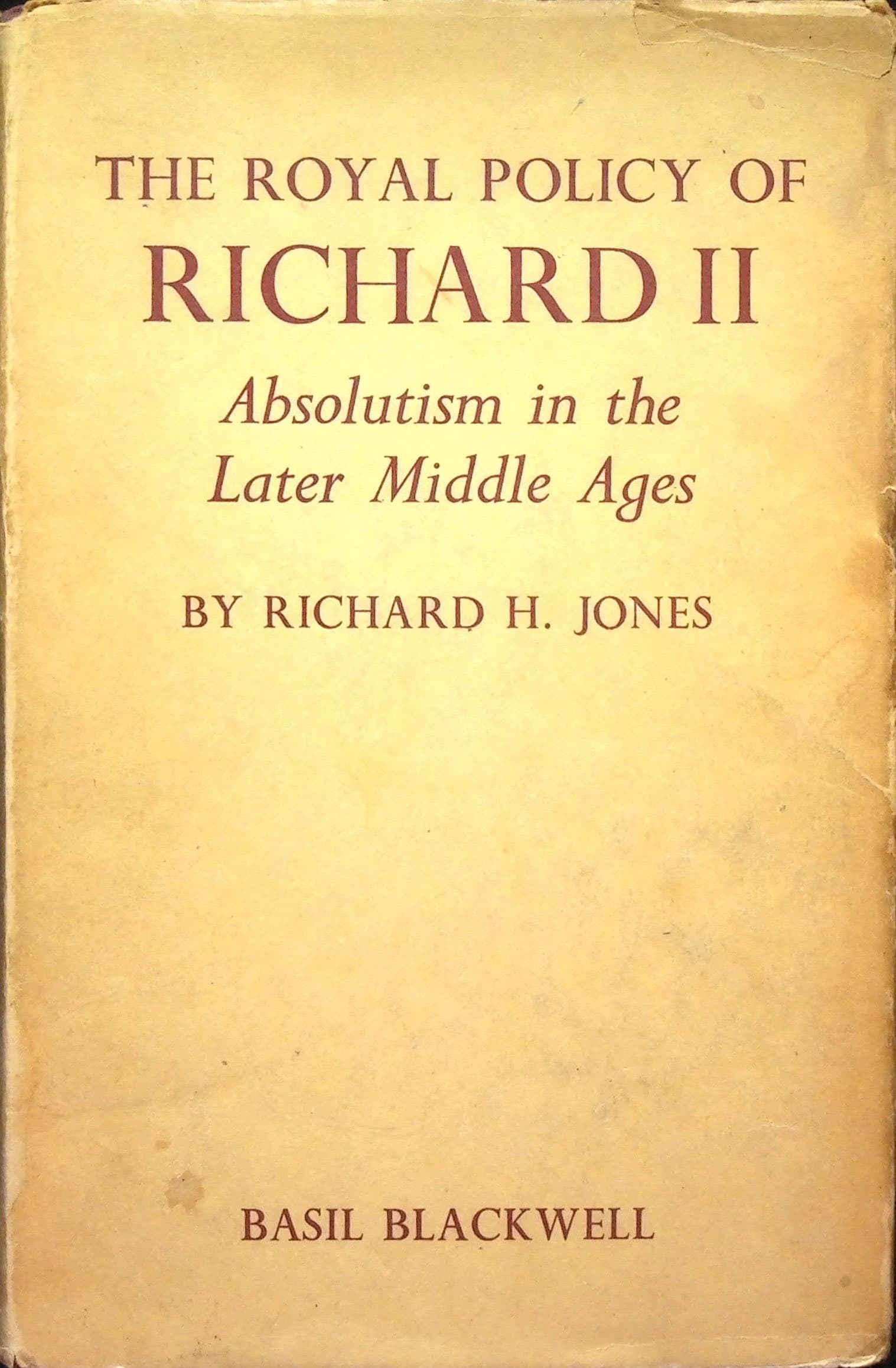
Blackwell, Oxford, 1968. Hardcover; viii, 199 pp; 22 cm. First edition. No illustrations.

Rare, out-of-print & unusual books · Since 1997
Turn the pages with the arrows, keyboard, or a swipe.
Blackwell, Oxford, 1968. Hardcover; viii, 199 pp; 22 cm. First edition. No illustrations.
In very good condition with acceptable+ dust jacket. Original publisher's brick-red cloth boards with gilt lettering on spine; mild surface wear; Previous owner's name in ink in top corner of front free end paper. Otherwise, interior pages are lightly toned but clean and unmarked. Dust jacket present; unclipped; moderate edge wear and rubbing; small nicks and short closed tears at extremities; light overall soiling; spine panel slightly darkened; Now in an archival quality (removable) Brodart cover. Study of royal authority and governance in late medieval England, examining the political theory and administrative practice of absolutism during the reign of Richard II (1377-1399). Issued as volume 10 in the Studies in Mediaeval History series. Contents include: Introduction; The background to absolutism; The theory of royal power; The practice of royal government; The crisis of 1386-1388; The king and the law; The personal rule, 1389-1397; The revolution of 1397-1399; Conclusion; Bibliography; Index. [from jacket flaps] The constitutional significance of the reign of Richard II has generally been obscured by concentration on the king's widely proclaimed defects of character. This volume traces the development of a programme for consolidation of royal authority from the early years of the minority and attributes its origins to courtiers whose influence with Richard endured until his death. They were keenly aware of the current weakness of monarchy and were sensitive to trends in European thought from which arguments on behalf of absolutism were readily derived. Richard's own contribution was a renewal of emphasis on the sacred character of kingship. The explanation of the programme and analysis of the reasons for its failure establish the importance of the reign to the history of the English constitution. The entire episode also demonstrates the dilemma of late mediaeval monarchy in striving to find its way between disintegration of central authority on the one hand and despotism on the other. There was to be no ultimately satisfactory solution within the framework of conventional modes of thought and procedure. And Richard II, in some respects bold and imaginative, was essentially a conventional fourteenth century prince. The royal policy, as here described, involved no novelty either in distribution of power among social classes or in devices for governmental administration. It was a systematic attempt to provide the king with unfettered control over all of the traditional instrumentalities through which mediaeval monarchy exercised jurisdiction. Its theoretical defenses were drawn from doctrines which had already become familiar to preceding generations.