Description
Cambridge University Press, Cambridge [Published date: 1991]. Hardcover, xiii, 284 pages; illustrations and maps; 30 cm. First published 1991.

Rare, out-of-print & unusual books · Since 1997
Turn the pages with the arrows, keyboard, or a swipe.
Cambridge University Press, Cambridge [Published date: 1991]. Hardcover, xiii, 284 pages; illustrations and maps; 30 cm. First published 1991.
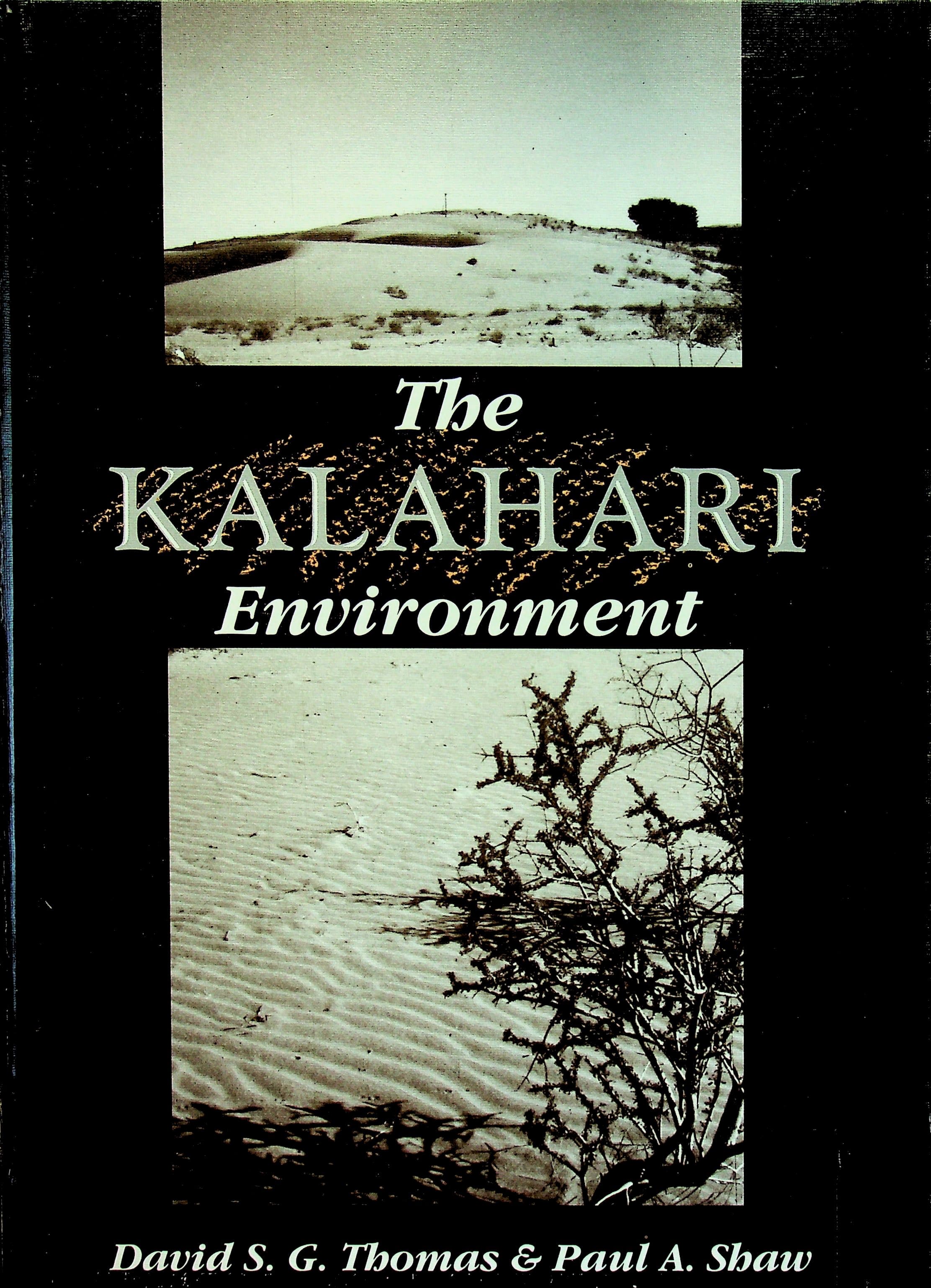
In very good condition / no dust jacket. Black and white pictorial boards show mild surface rubbing, light edge wear, and small scuffs. Corners lightly bumped. Binding tight. Interior pages clean and unmarked. From back cover: The Kalahari is an unusual and elusive place, embracing an environment of great ecological and geomorphological diversity. Its complex climatic and geological history and its long association with human societies attempting to utilise its natural resources are aspects of increasing scientific interest. This book has evolved from the authors own research in the Kalahari and surrounding areas over the past decade, and provides an integrated, thorough and up-to-date review of the nature and development of the Kalahari environment. The authors attempt to provide explanations and answers to some of the many questions raised about the Kalahari, ranging from the commonly asked "is it really a desert?" to more specific concerns about its evolution, dimensions and the impact of human activities. During recent years there has been an acceleration in the processes of change in the Kalahari, resulting from human activities set against a background of fluctuating climatic conditions. These changes have their origins in the distant past, but their impacts on the landscape are reaching unprecedented levels today as access to the Kalahari core improves and human activities intensify and diversify. Concern about these environmental changes and impacts have made apparent to the authors the need for an integrated scientific analysis of the Kalahari. The interdisciplinary approach will make the book of interest to researchers, lecturers and advanced students in earth sciences, environmental studies, geomorphology and Quaternary science. The very extensive bibliography will also make it an important source of reference. Contents include: Preface; Acknowledgements; An introduction to the Kalahari; Tectonic and geological framework; The Kalahari sediments; Climate, soils and vegetation of the Kalahari; The geomorphology of the Kalahari: rivers and lakes; The geomorphology of the Kalahari: aeolian, pan and rock landforms; The palaeoenvironmental history of the Kalahari; The Kalahari in the archaeological record; The Kalahari environment in the nineteenth and twentieth centuries; Appendices; Bibliography; Index.