
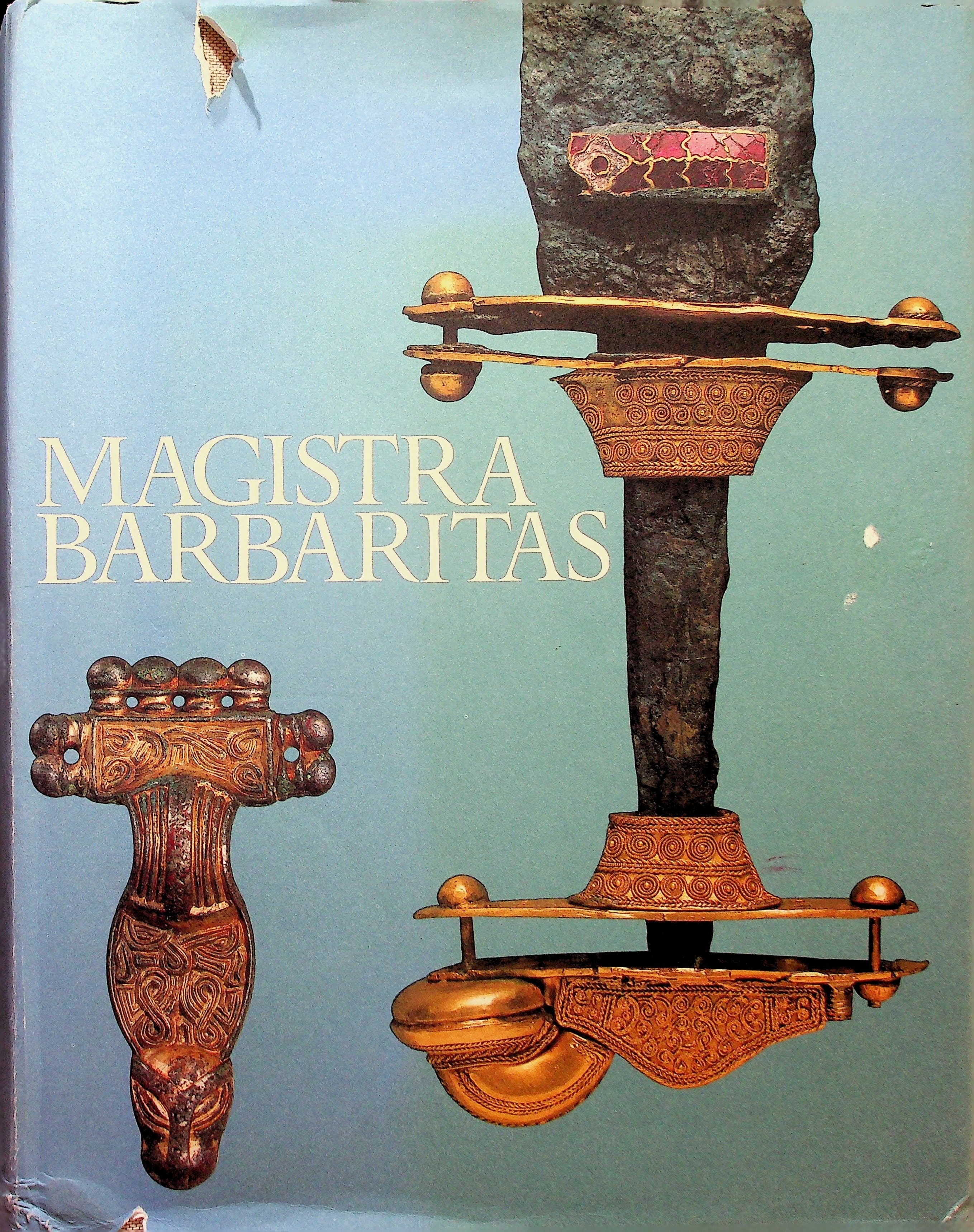
Description
Libri Scheiwiller, Milano, 1984. Hard cover, 689 pp. Text in Italian. Good+ in good dust jacket. Tan cloth covered boards with brown lettering on front and spine. Light bumping to bottom of spine near front edge of spine. Binding tight. 1" square patch of sticker residue on front free end paper. Fore-edge and top edge of text block have light spotting. Otherwise pages are clean and unmarked. Dust jacket has a 1" tear on the top edge of the front cover and a few other smaller nicks and tears with a 1/4" nick about 1" in from the fore-edge of the front covers. Light overall scuffing to jacket as well. Now in an archival-quality (removable) Brodart Cover. NOT Ex-Library. NO remainder marks. Black and white and color illustrations throughout. This comprehensive scholarly work examines the presence and influence of barbarian groups in Italy from the late Roman Empire through the early medieval period. It is divided into four major sections, covering historical, archaeological, artistic, and linguistic aspects of barbarian integration into Italian society. Part I: The Barbarians in Italy During the Roman Empire examines the presence and influence of various barbarian groups, including the Ostrogoths and Lombards, as well as the Hungarian incursions between the 8th and 10th centuries. Part II: Vikings and Longobard Artistic Contributions explores Viking incursions in Italy and the development of Longobard artistic traditions, including metalwork, architecture, and sculpture. Part III: Byzantine Historiography and Barbarian Representation analyzes how Byzantine and Western sources depicted the barbarians, with discussions on Theodoric the Great's governance, legal policies, and linguistic influences. Part IV: Archaeology and Economic Aspects focuses on barbarian coinage, archaeological findings related to Goths, Alamanni, and Lombards, as well as the cultural legacy of illuminated manuscripts and the continuity of classical traditions in the medieval period. The volume concludes with appendices covering topics such as barbarian colonization, early descriptions of the Huns, Theodoric's architectural policies, and medieval songs.