Description
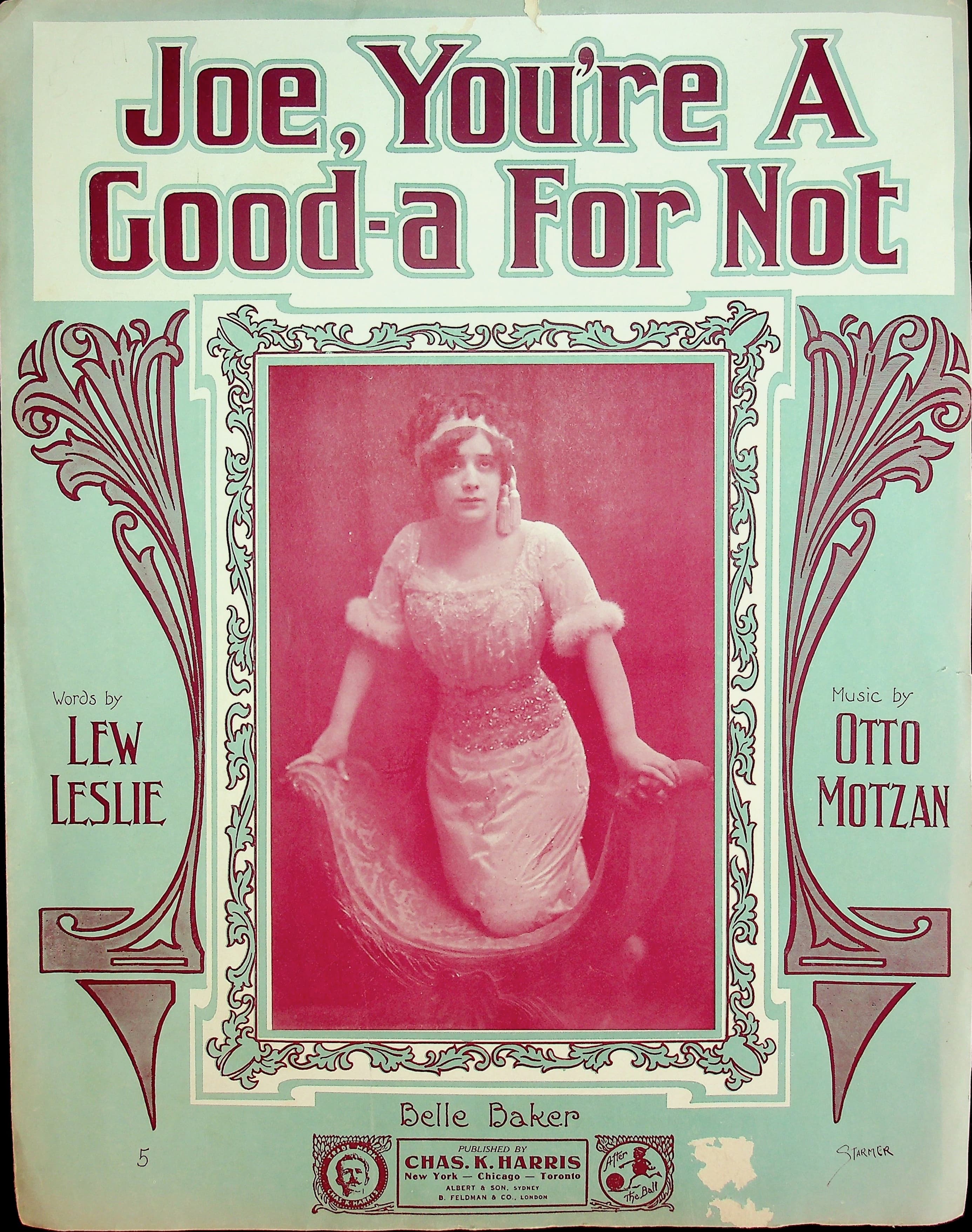
Chas. K. Harris [Published Date: 1911]. Sheet music, large format (10 x 13.5"). Paper covers, 6 pages (including covers). For voice and piano. Rear cover includes single lines of music from several "Popular Favorites by the Most Popular Composers"
Condition & notes
In good condition with several small nicks and tears to edges of pages and along top and bottom of folds. Light creasing to edges as well. 1" scratched patch at bottom of front cover where a sticker was removed taking a thin top layer of colored paper with it. Otherwise pages are lightly aged but unmarked. [Lyrics (first lines)]: I feel a disgust, my heart is a bust, I stand and I wait-a for Joe; I mak-a disgrace I go to de place, 'Cause I love-a him so. [Chorus] Hey Joe, Hey Jo home is de place that you go, You say yo love - a dis a gal more dan all a your life; What's the matter you kid, What's the matter your wife, Six years ago you marry me, you love me on de spot, Now you take a de ring and de whole dam-a ting "Joe" you're a good-a for not... Lew Leslie (1888 - 1963) was a prominent lyricist and producer associated with Tin Pan Alley, best known for producing the groundbreaking Broadway revue Blackbirds of 1928, which featured African American performers such as Ethel Waters and Cab Calloway, making a lasting impact on American musical theater. The composer, Otto Motzan (1880 - 1937) was a lesser-known but very active composer of ragtime and member of the Tin-Pan Alley community. Immigrating to the US from Austria-Hungary 1907, he was a skilled violinist and pianist, but quickly transitioned to orchestra conductor. By 1909, his own compositions, initially Yiddish tunes reflecting his heritage, began appearing in print. "Joe, You're A Good-a For Not" was his first popular piece with English lyrics. It was sung by Belle Baker (pictured on the cover), and Motzan became her musical director on several of her national tours. Motzan went on to work with over 65 lyricists throughout his prolific career. A note about the cover art: Some of the most creative and eye-catching cover art of the ragtime-era were done by one of the prolific, but elusive, Starmer Brothers. Their work was of consistently high quality and they were turning out nearly a quarter of all large format covers from the late 1890s to around 1919. The identity of the artists was unknown until an invoice was discovered with a printed heading describing "Starmer" as artist and medical draughtsman. Not much else is known about the Starmer family.