Description
University of Minnesota Press, Published 2000. Hardcover, x, 300 pp.; 24 cm; First Edition (with full number line); illustrated with black-and-white photographs, period illustrations, and maps.

Rare, out-of-print & unusual books · Since 1997
Turn the pages with the arrows, keyboard, or a swipe.
University of Minnesota Press, Published 2000. Hardcover, x, 300 pp.; 24 cm; First Edition (with full number line); illustrated with black-and-white photographs, period illustrations, and maps.
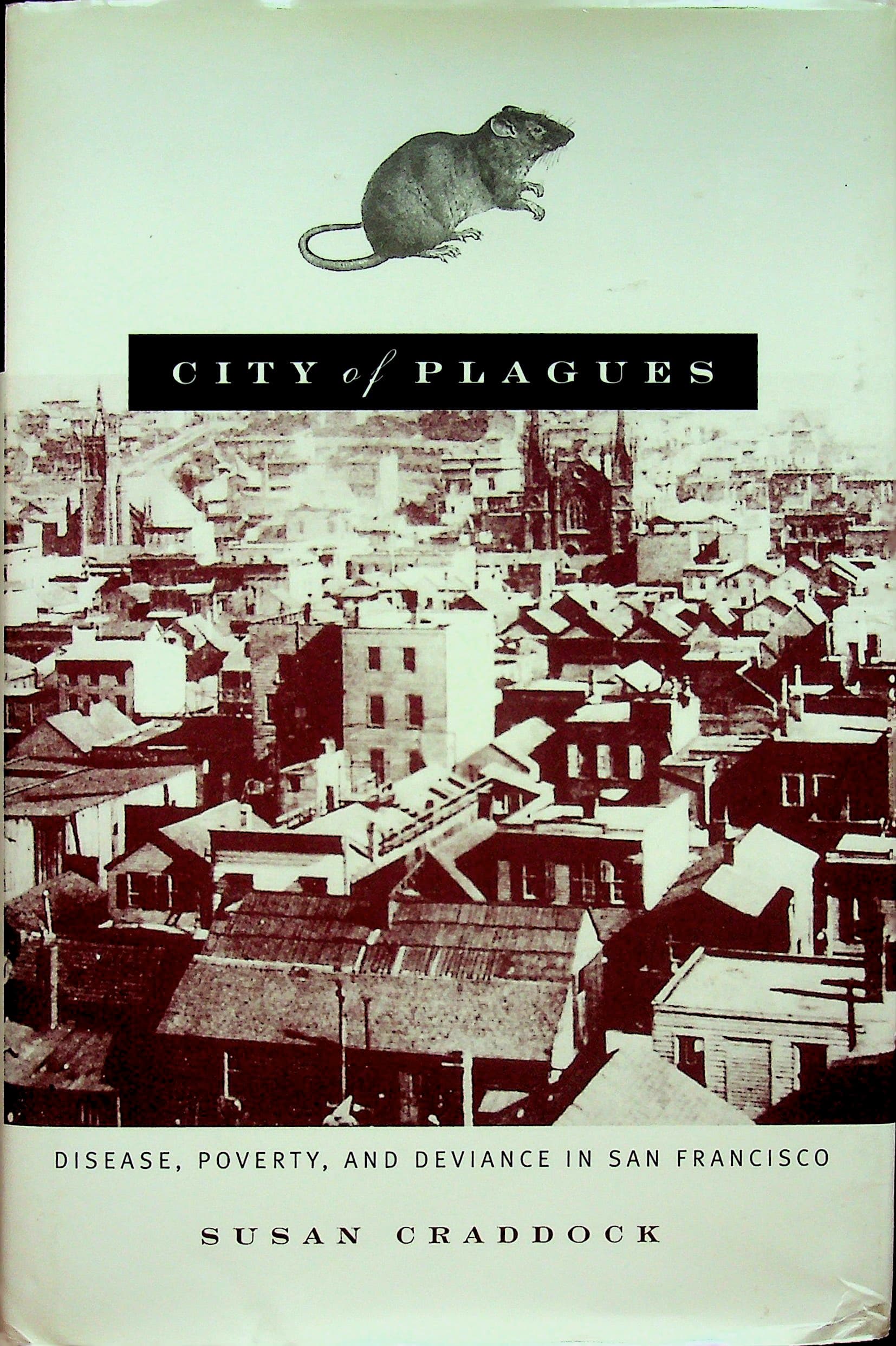
In Very Good condition with a Very Good dust jacket. Maroon textured paper over boards, mild shelf and edge wear, light bumping to edges and corners, light speckled spotting to lower edge of front cover. Binding tight. Pages clean and unmarked. Pictorial dust jacket (South of Market, San Francisco, circa 1860, from the Bancroft Library) has a few small nicks and light creasing at edges and corners. Now in an archival quality (removable) Brodart cover. A geographer's study of how San Francisco used disease as a political instrument between 1860 and 1940. Craddock traces smallpox, plague, syphilis, and tuberculosis through the city's health department reports and medical press, showing how the response to each epidemic was mapped onto particular neighborhoods and populations: Chinatown pathologized as the source of smallpox and the 1900 and 1907 plague outbreaks, South of Market tenements as the seat of tuberculosis, and the sanatorium and tuberculosis hospital as instruments of discipline as much as cure. The book grew out of her Antipode article on the pathologizing of Chinatown and has become a foundational text in health geography; the Bulletin of the History of Medicine called it a provocative work offering an invaluable perspective on public health and the construction of race. Original hardcover printing; the title was reissued in paperback in 2004 and the hardcover is out of print. Contents: Acknowledgments; Introduction; Tuberculosis, Tenements, and the Epistemology of Neglect; Sewers and Scapegoats: Epidemic Diseases and Their Spatial Metaphors in San Francisco, 1868-87; Negotiating the Boundaries, Policing the Borders of Disease; Structures of Susceptibility and the Architecture of Disease: The Plague Epidemics of 1900 and 1907; Reforming Bodies: Poverty, Discipline, and the Sanatorium Experience; Reforming the City: Domestic Restructuring and the Tuberculosis Hospital; Envisioning an Epilogue to Urban Maladies; Notes; Bibliography; Index.