Description
Corvina Verlag, Published 1976. Hardcover, 95 pp.; 29 cm; text in German; second edition (Zweite Auflage); illustrated with 52 color and 22 black-and-white reproductions.

Rare, out-of-print & unusual books · Since 1997
Turn the pages with the arrows, keyboard, or a swipe.
Corvina Verlag, Published 1976. Hardcover, 95 pp.; 29 cm; text in German; second edition (Zweite Auflage); illustrated with 52 color and 22 black-and-white reproductions.
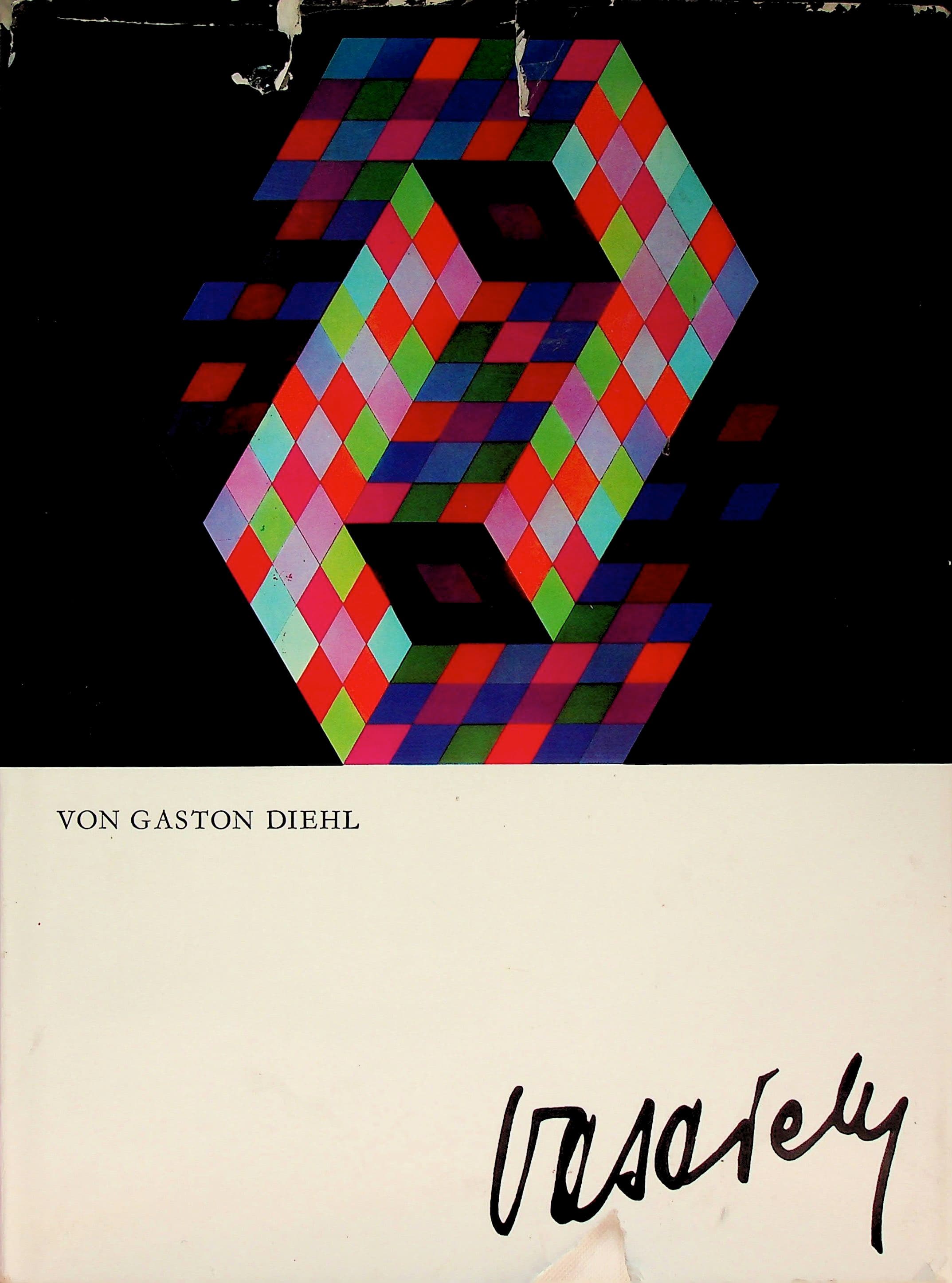
In Very Good condition with an Acceptable dust jacket. Cream cloth boards with Vasarely's signature stamped in brown on front cover and brown lettering on spine. Mild surface and edge wear to covers. Binding tight. Mild toning to endpapers. Pages clean and unmarked. Jacket has a 3/4 inch triangular chip at the bottom edge of front panel and three 1 inch tears along the top edge, two of them repaired with tape. Further small nicks, tears and creasing along the edges. Mild surface and edge wear overall with light soiling and toning. Printed Forint price on rear flap obscured in black ink. Now in an archival quality (removable) Brodart cover.Victor Vasarely (1906-1997) left Pecs for Budapest, trained at the Muhely, Sandor Bortnyik's Hungarian Bauhaus, and settled in Paris in 1930, where he became the founding figure of Op art. This is Corvina's monograph on him: the Hungarian state art publisher issuing its most famous emigre in German, in a joint edition with Sudwest Verlag of Munich, with distribution restricted to the European socialist countries. Gaston Diehl (1912-1999), a founder and long-serving president of the Salon de Mai who had already written on Matisse and Picasso, traces the work from the Budapest years through the Denfert, Belle-Isle and Cristal periods to the Vega canvases of the 1960s. Plates were chosen by Andre Gloeckner from the Vasarely Archive and photographed in part by Karoly Szelenyi. 52 color plates, each captioned with title, date, medium, dimensions and collection. Bibliography and list of illustrations at the rear.