Description
Privately printed, [No date: circa 1929]. Wraps, 182 pp.; 22 cm; title page states "For Private Distribution." SIGNED "Sincerely, F. E. Hadley" in pencil on the front free endpaper.

Rare, out-of-print & unusual books · Since 1997
Turn the pages with the arrows, keyboard, or a swipe.
Privately printed, [No date: circa 1929]. Wraps, 182 pp.; 22 cm; title page states "For Private Distribution." SIGNED "Sincerely, F. E. Hadley" in pencil on the front free endpaper.
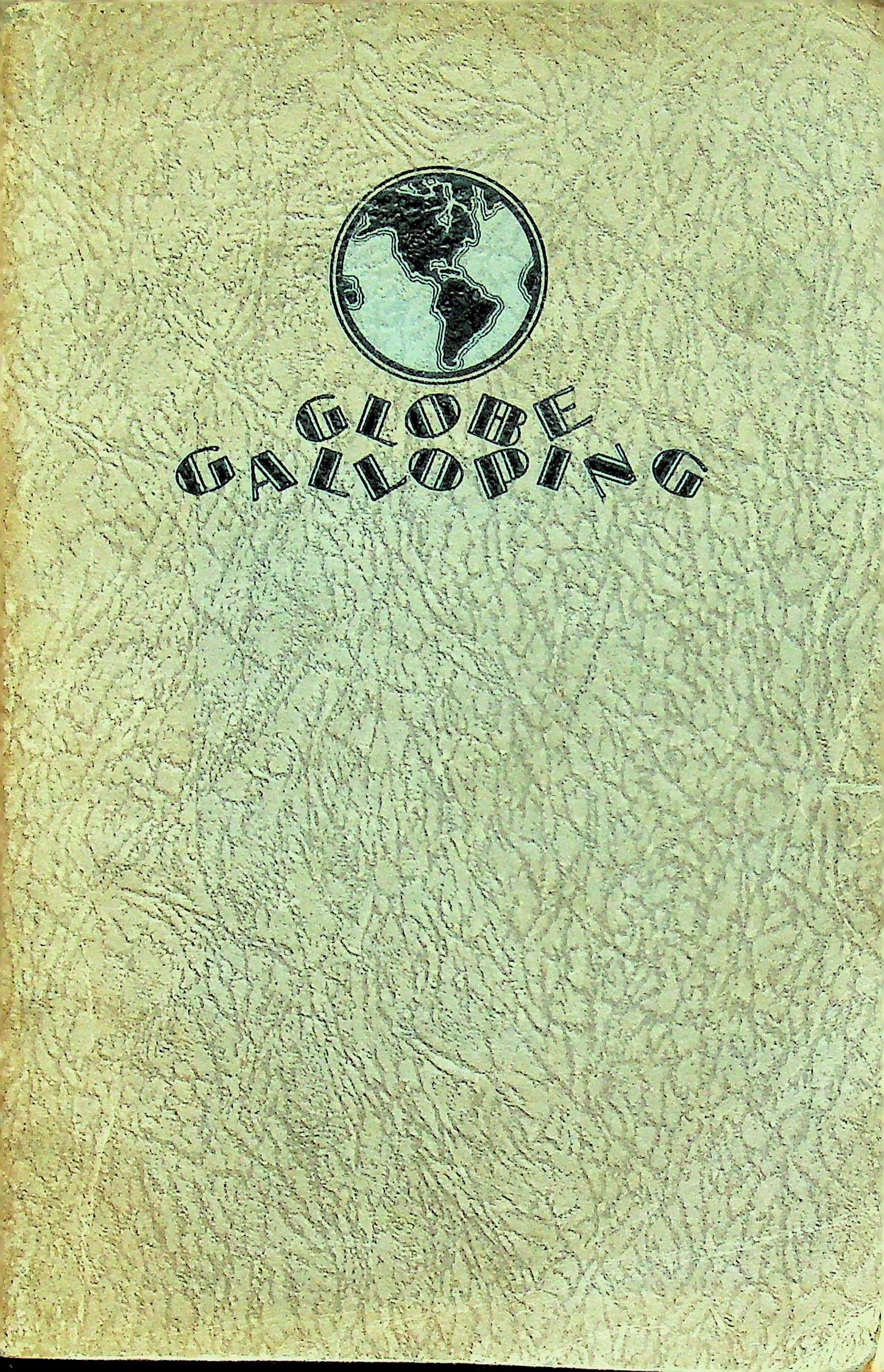
In good condition. Olive green textured paper covers, black-stamped globe device and title on front cover, bumping and creasing to edges and corners, mild to moderate overall toning with fading to edges and spine, half-inch tear to fore edge of front cover, light nicking to the paper at head of spine. Glued and staple bound; pages torn along the staples and the glue beginning to separate at the first two leaves, remainder solidly bound. Pages lightly toned, otherwise unmarked. Thirty-three chapters on a round-the-world voyage begun at San Diego on January 6, 1929, sailing from San Pedro two days later aboard the Dollar Line steamer President Polk, which had opened the first regular round-the-world passenger service in 1924. Honolulu, Japan, Shanghai, Hong Kong, Manila, Singapore, Penang, Ceylon, Suez and Egypt, then Italy, France, Germany, Switzerland, the Low Countries, England, Scotland and Ireland, home from Queenstown aboard the Cunard Laconia. Internal dates are consistent throughout: Pompeii on Monday, March 18, and Easter Sunday at Genoa. The most substantial passage concerns Senator Sergio Osmena, who boarded with his wife at Manila and who would become President of the Philippines in 1944. Hadley gives him two pages: former governor of Cebu, Speaker of the House for fifteen years, and a leader of the independence movement, travelling to Washington for a conference on the question. Osmena argues that Congress has promised independence only in a remote and shadowy future, that the Filipinos are grateful and would treat America as a favored nation in trade, that they can never afford a navy, and that what they want is a treaty signed by Great Britain, Japan and the United States guaranteeing Philippine neutrality. He tells Hadley the Filipinos do not fear Japan. Governor General Henry L. Stimson is noted as then on his way to Washington, placing the Manila call in February 1929. Hadley, himself a Republican state committeeman, concludes that he cannot say the Filipinos are wrong in their ambition. Elsewhere Hadley writes with the candor of a man addressing readers he assumes agree with him. On Hawaii he opposes statehood on the ground that the islands should be preserved for the predominance of the white man, reports being told that the Japanese vote would control them within ten years, and wants a commission government so that the alien vote may be held in check. He then turns to the prospect of war with Japan, judges that an attack on the islands might succeed "especially if they were aided from within," and asks what the thousands of Japanese and "so-called Japanese-Americans" living there would do. Doubt cast on the loyalty of American-born citizens, and the fear of an enemy assisted from within, are the arguments that would be used thirteen years later to justify Executive Order 9066 and the internment of the West Coast Japanese-American population; here they are set down in 1929 by a Minnesota newspaper editor who expects no argument from his readers. He ends his Japan chapter watching thousands of men and boys drilling and wondering what they are getting ready for. His China chapter is titled "A Land of Depressing Poverty," and a later summing-up of Asia finds palaces and hovels with no middle class between them. He credits Mussolini with saving Italy from Bolshevism and from black ruin. In Germany he finds the Kaiser despised as a man who misled his people and then deserted them, bullet marks still on the buildings from the revolutionary street fighting, and former soldiers saying that if their rulers want another war the rulers should shoulder guns and do the fighting themselves. He thinks the English dole a pension for those unwilling to work. The book ends with a long declaration of American superiority, granting Asia its temples, Egypt its antiquity and Europe its history while claiming modernity and inventive genius for the United States, and blaming Sinclair Lewis and Upton Sinclair for the caricature of American life then circulating in Europe in translation. The racial and ethnic language throughout is that of its period. Hadley sailed nine months before the Wall Street crash, on the kind of unhurried world tour the last year of the boom made possible; he notes that Americans spent $860,000,000 in Europe in 1928 and were expected to spend a billion in 1929. He was editor and publisher of the Winnebago Enterprise in Faribault County, Minnesota, president of the Minnesota Editorial Association in 1917-1918, and a member of the Republican State Central Committee, and addressed the National Editorial Association convention in 1915 on how to get and hold advertising. Son of W. E. Hadley, a pioneer San Diegan who kept the old Horton House, he returned to San Diego in the mid-1920s and died there at 55, his ashes taken back to Winnebago for burial. No copy of this title is recorded in WorldCat, the Internet Archive, or Open Library, and no other copy was located for sale.