Description
Twayne Publishers (Boston), Published 1976. Hardcover, 166 pp; 21 cm; First Edition (stated First Printing on copyright page); illustrated with a black-and-white frontispiece portrait of Cumberland after Romney.

Rare, out-of-print & unusual books · Since 1997
Turn the pages with the arrows, keyboard, or a swipe.
Twayne Publishers (Boston), Published 1976. Hardcover, 166 pp; 21 cm; First Edition (stated First Printing on copyright page); illustrated with a black-and-white frontispiece portrait of Cumberland after Romney.
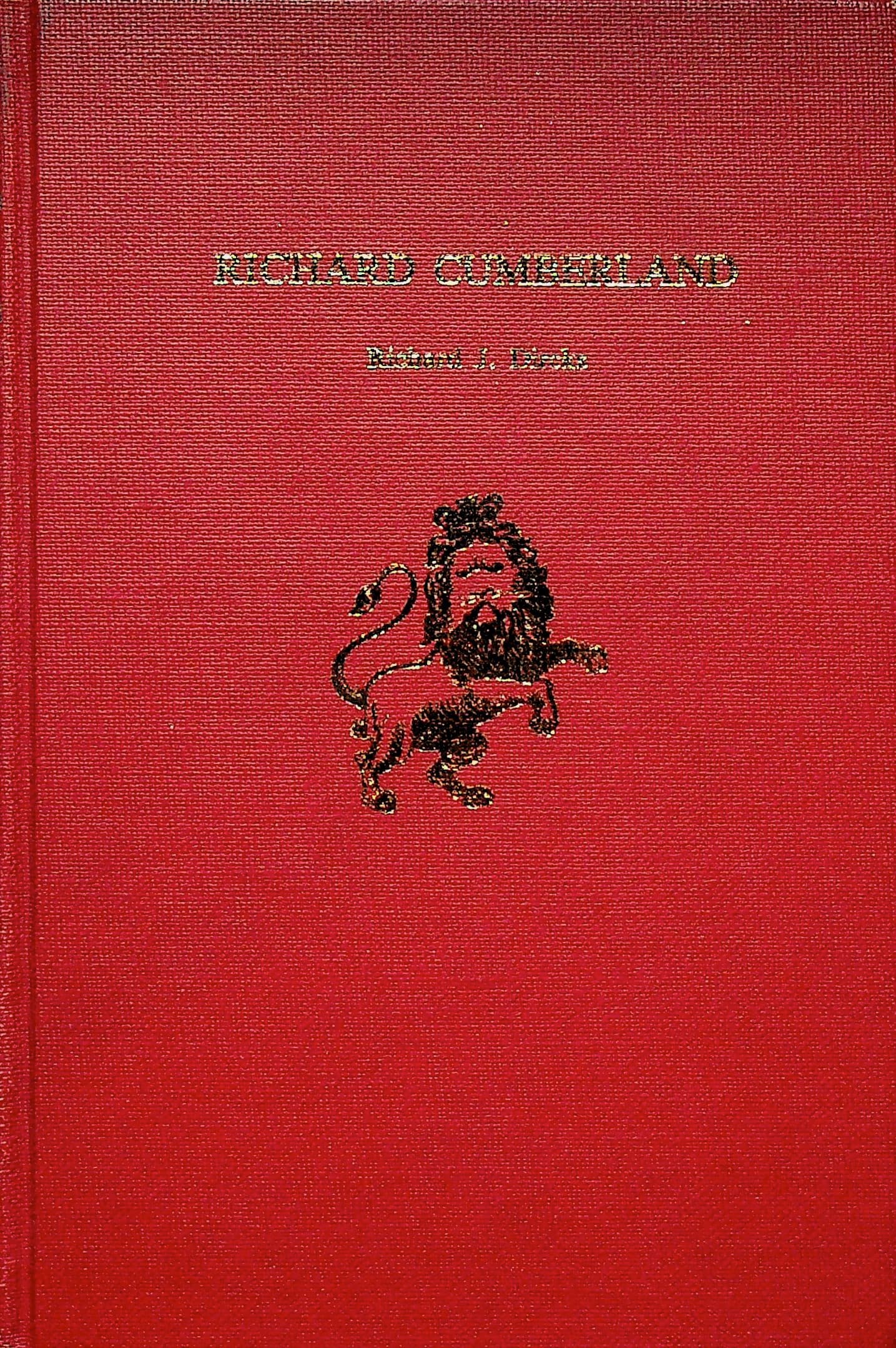
In Very Good condition, no dust jacket. Red cloth boards with gold-stamped lettering and the Twayne lion device on the front board; gold lettering on spine. The title and author lines on the front board show notable rubbing and gold loss; the lion device is well preserved. Spine titling rubbed but legible. Mild shelf wear to edges and corners. Binding tight. Pages clean and unmarked throughout. Otherwise unmarked.A critical study of the English Georgian-era dramatist, novelist, essayist, and poet Richard Cumberland (1732-1811), part of the Twayne's English Authors Series under general editor Sylvia E. Bowman. Richard J. Dircks (St. John's University) draws on previously unstudied manuscript material from the Larpent Collection at the Huntington Library to revise earlier assessments of Cumberland's career, particularly his later plays and the relationship between "The Arab" and "Alcanor," "The Country Attorney" and "The School for Widows," and the unpublished manuscripts of "The Widow of Delphi" and "The Armorer." Dircks treats Cumberland not only as a sentimental comedian but as a working dramatist whose body of work spans plays, novels (including "Arundel" and "Henry"), non-fictional prose, and poetry, and whose career bridges the late eighteenth century into the early Romantic era. The standard prior treatment was Stanley T. Williams's "Richard Cumberland: His Life and Dramatic Works" (1917).Contents: About the Author; Preface; Chronology; In the Literary Crosscurrents; The Emerging Dramatist: Experimentation and Success; The Later Plays: Resurgence and Decline; The Novels: Tradition as Structural Imperative; Non-fictional Prose: Observation and Controversy; Poetry: The Quest for Moral Order; Conclusion; Notes and References; Selected Bibliography; Index.