Description
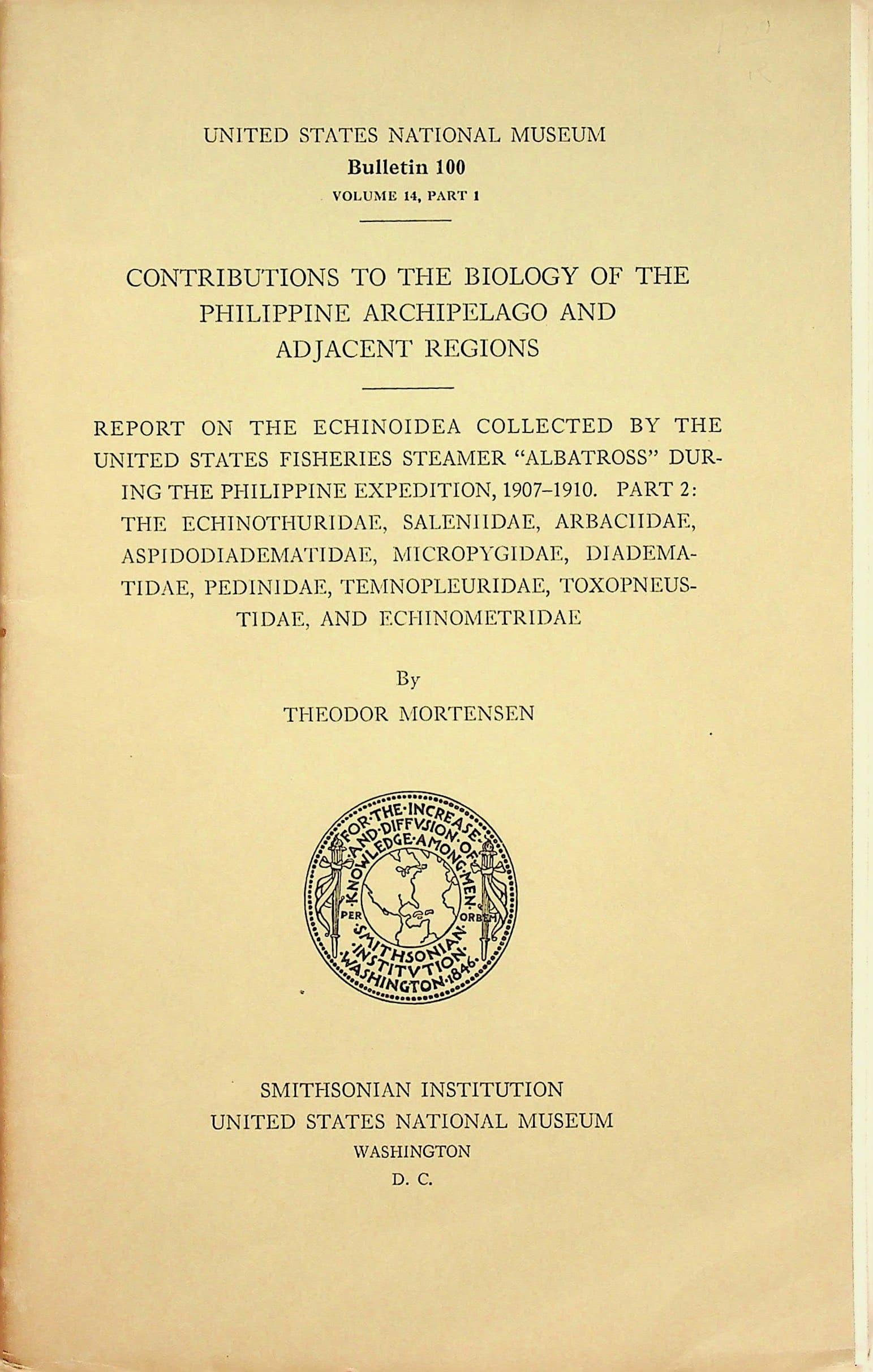
Smithsonian Institution, United States National Museum, Bulletin 100, Volume 14, Part 1. Washington, United States Government Printing Office, Published 1940. Wraps, iv + 52 pp.; 25 cm; staple-bound; with one full-page plate of pedicellariae line drawings and numerous in-text figures.
Condition & notes
In Good condition. Pale olive green paper wraps printed in black, the front cover with title and Smithsonian seal, the rear cover with a printed torch ornament. A few small nicks and light creasing along the edges of the covers, with a couple of small spots of soiling near the top of the front cover. Mild shelf wear and light toning to the covers. Binding tight. Pages lightly toned at the edges. Otherwise unmarked. Several leaves remain unopened along the top edges, indicating the pamphlet has seen little handling since publication.The 1907-1910 Philippine Expedition by the U.S. Fisheries steamer Albatross was a landmark biological survey of the Philippine archipelago and surrounding seas. Theodor Mortensen's taxonomic report on the sea urchins collected during the expedition was published by the Smithsonian in three installments: the first (1927, Bulletin 100, Volume 6, Part 4) treated the family Cidaridae; the present second installment, issued in 1940 as Bulletin 100, Volume 14, Part 1, covers ten further families spanning four orders; a third and concluding installment appeared in 1948 as Volume 14, Part 3. Mortensen (1868-1952), the Danish zoologist regarded as the twentieth century's leading authority on echinoderms and author of the monumental five-volume A Monograph of the Echinoidea (1928-1951), describes eight new species in this volume, one of which becomes the type of a new genus (Hemiphormosoma) within the Echinothuriidae; three new varieties are also introduced.Family coverage: Echinothuriidae, Saleniidae, Arbaciidae, Aspidodiadematidae, Micropygidae, Diadematidae, Pedinidae, Temnopleuridae, Toxopneustidae, and Echinometridae.Contents: Introduction; Order Lepidocentroida (Family Echinothuriidae, with Subfamilies Phormosominae and Asthenosominae); Order Stirodonta (Families Saleniidae, Arbaciidae); Order Aulodonta (Families Aspidodiadematidae, Micropygidae, Diadematidae, Pedinidae); Order Camarodonta (Families Temnopleuridae, Toxopneustidae, Echinometridae).