
Description
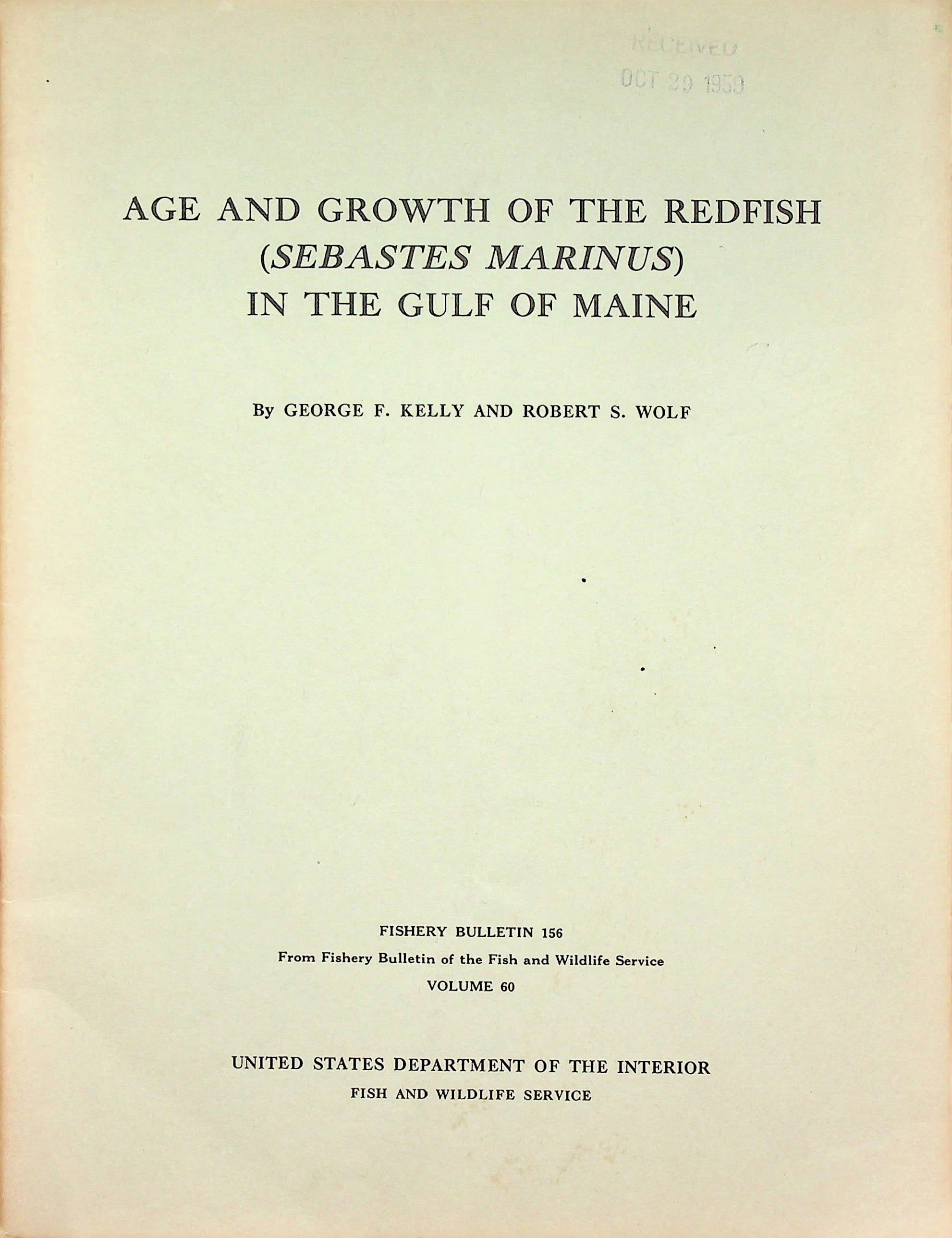
U.S. Fish and Wildlife Service / U.S. Govt. Print. Off., Published 1959. Wraps, iv + 31 pp.; 26 cm; illustrated with black-and-white photographs, diagrams, and tables. In Good Plus condition. Pale grey-green paper covers with black lettering, with mild shelf wear including light bumping and creasing to cover edges, toning to the spine, and a light crease to the lower left of the front cover. "Received" date stamp ("Oct 29 1959") at top corner of front cover. Staple binding sound. Interior pages with light toning, otherwise unmarked. Fishery Bulletin 156, issued as an extract from the Fishery Bulletin of the Fish and Wildlife Service, Volume 60. A study by George F. Kelly and Robert S. Wolf of age and growth in Gulf of Maine redfish (Sebastes marinus), based on otolith analysis, with photographic plates of otoliths and scales arranged by season and age class. [From abstract] Validity of the use of the otolith in age-growth studies of the redfish (Sebastes marinus) is demonstrated. Otoliths accrue one opaque and one hyaline band a year. The opaque band begins to form in April, the hyaline band in September. Otoliths preserved in ethanol may be read whole, although those from larger fish are more easily read after they are sectioned. Otoliths stored dry must be sectioned for reading. Redfish larvae can be collected in surface waters throughout the period of spawning, April to September. The fry descend into mid-depths as they grow and first appear on the bottom in August. Redfish reach an average length of about 50 mm. in their first year of life. The sexes grow at virtually the same rate until the tenth year, after which the male grows more slowly than the female. Redfish of the Gulf of Maine grow more slowly than those of northern European waters. While dominant age classes appear in the collections of young fish, they are not obvious in samples of older, commercially available fish. Contents include: Introduction; Brief review of the literature; Objectives and methods; Sampling the commercial catch; Sampling by research vessels; Preparing the otolith; Reading the otolith; Studies of the otolith (seasonal nature of banding in otolith, comparing whole mounts and cross sections of otoliths, comparing scales and otoliths, independent readings of otoliths); Age and growth (growth during first year, length composition of smaller fish, length composition of age groups, growth rate, age composition); Discussion and conclusions; Literature cited.