
Description
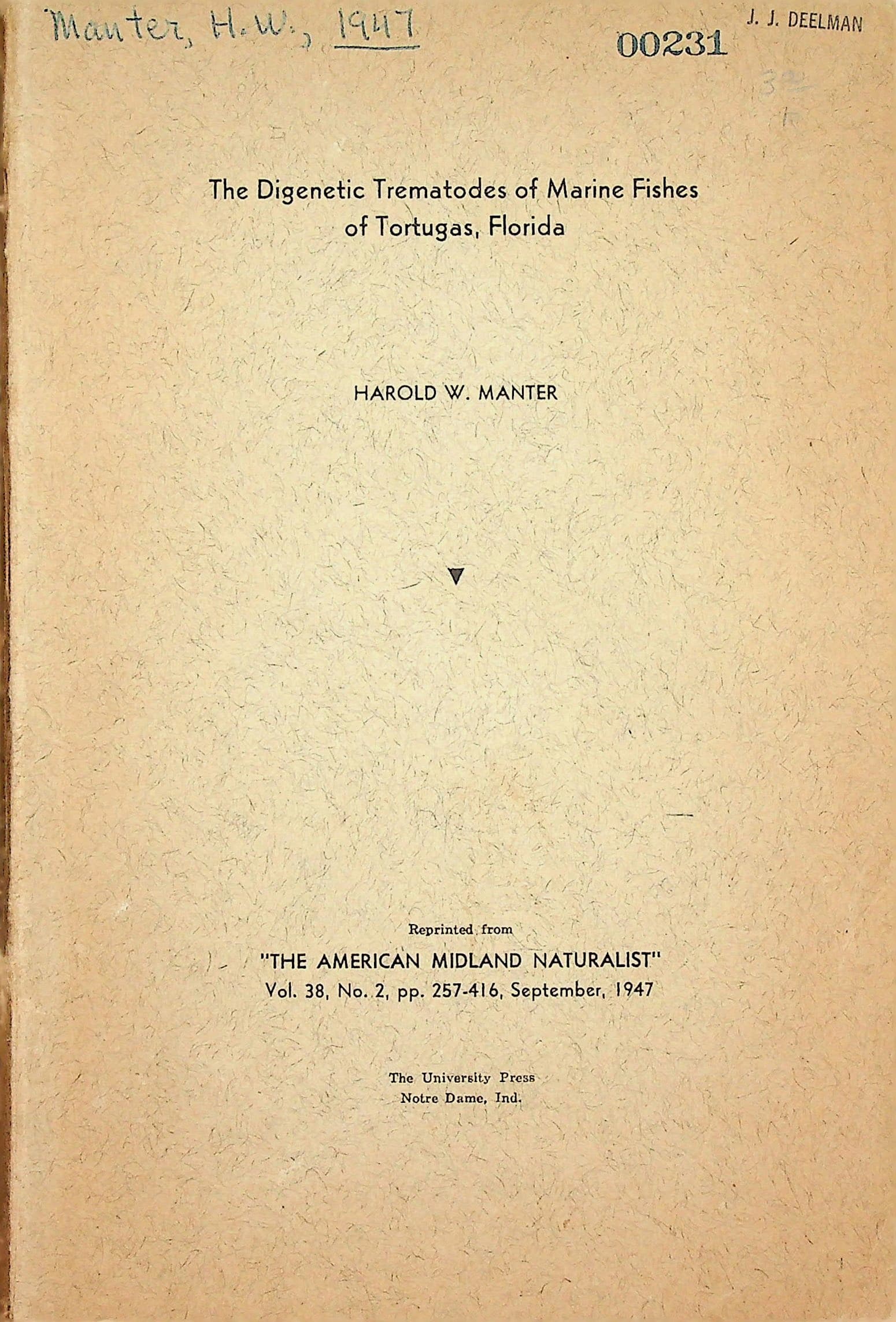
The University Press, Notre Dame, Indiana. Published 1947. Wraps, pp. 257-416 (160 pp.); 23 cm; profusely illustrated throughout with 138 numbered figures of diagrammatic line drawings of trematode anatomy and three statistical bar graphs. Offprint reprinted from "The American Midland Naturalist," Vol. 38, No. 2, September 1947, and issued as Studies from the Department of Zoology, University of Nebraska, No. 230. In Acceptable+ condition. Brown kraft paper covers, lightly toned. The author's name and date "Manter, H.W., 1947" written in ink at the upper left of the front cover; previous owner's rubber-stamped name and the accession number "00231" stamped at the upper right. Covers show a few nicks and light creasing along the edges, with mild shelf wear and some toning. Spine creased but binding is sound (staple bound). The first few leaves show chipping and tearing along the fore-edge from a sticky residue that adhered the pages along the fore-edge, but the text itself is unaffected. Interior pages lightly toned. Otherwise unmarked. A landmark in marine parasitology by Harold W. Manter (1898-1971), Professor of Zoology at the University of Nebraska. The monograph reports 189 species of digenetic trematodes from teleost fishes collected during the summers of 1930, 1931, and 1932 at the Carnegie Institution of Washington's Biological Laboratory at Dry Tortugas, Florida, including 44 species new to science, 9 new genera, 44 new combinations, 14 new synonyms, and 51 new host records. Of the 237 host species (some 2039 specimens) examined, 76.8% were parasitized. The work also analyzes host specificity and biogeography, comparing the Tortugas trematode fauna with those of Japanese, British, and American Pacific waters. Manter's research collection later formed the founding core of the Harold W. Manter Laboratory of Parasitology at the University of Nebraska, established in 1971. [Excerpt from the Introduction] "During the summers of 1930, 1931, and 1932, extensive collections of parasites of fishes were made at the Biological Laboratory of the Carnegie Institution of Washington at Dry Tortugas, Florida. Dr. W. H. Longley was at that time engaged in his studies of the fishes of that region, and a very considerable number and variety of fishes were made available to me for examination. Altogether, some 2039 fishes representing some 237 species of teleost fishes were examined. Several short papers (Manter, 1930; 1931; 1931a; 1932; 1933; 1933a; 1935; 1937; 1940; 1942; 1945; 1946) and one longer paper dealing with trematodes from deepwater fishes (Manter, 1934) have been published. The present paper includes all the species of digenetic trematodes which could be identified with reasonable certainty, altogether some 189 species. Species reported previously are listed with the others partly to provide as complete a list as possible and partly to make a few corrections particularly in names of hosts. Linton (1910) reported on trematodes of the Tortugas region, and a few species were studied by Pratt (1916) and McCoy (1929, 1930). All the species reported by them are represented in my collections with the exception of a single species, Hysterolecitha rosea Linton, 1910. Not included in this report are immature specimens; a few adults of which a single specimen was obtained; and a number of Didymozoonidae preserved material of which seemed inadequate for satisfactory identification.