Description
Manchester University Press, Manchester and New York. Published 2003. Paperback, ix, 209 pp.; 24 cm; first edition (with a complete number line); part of the Studies in Early Modern European History series edited by Joseph Bergin, William G. Naphy, and Penny Roberts.
Condition & notes
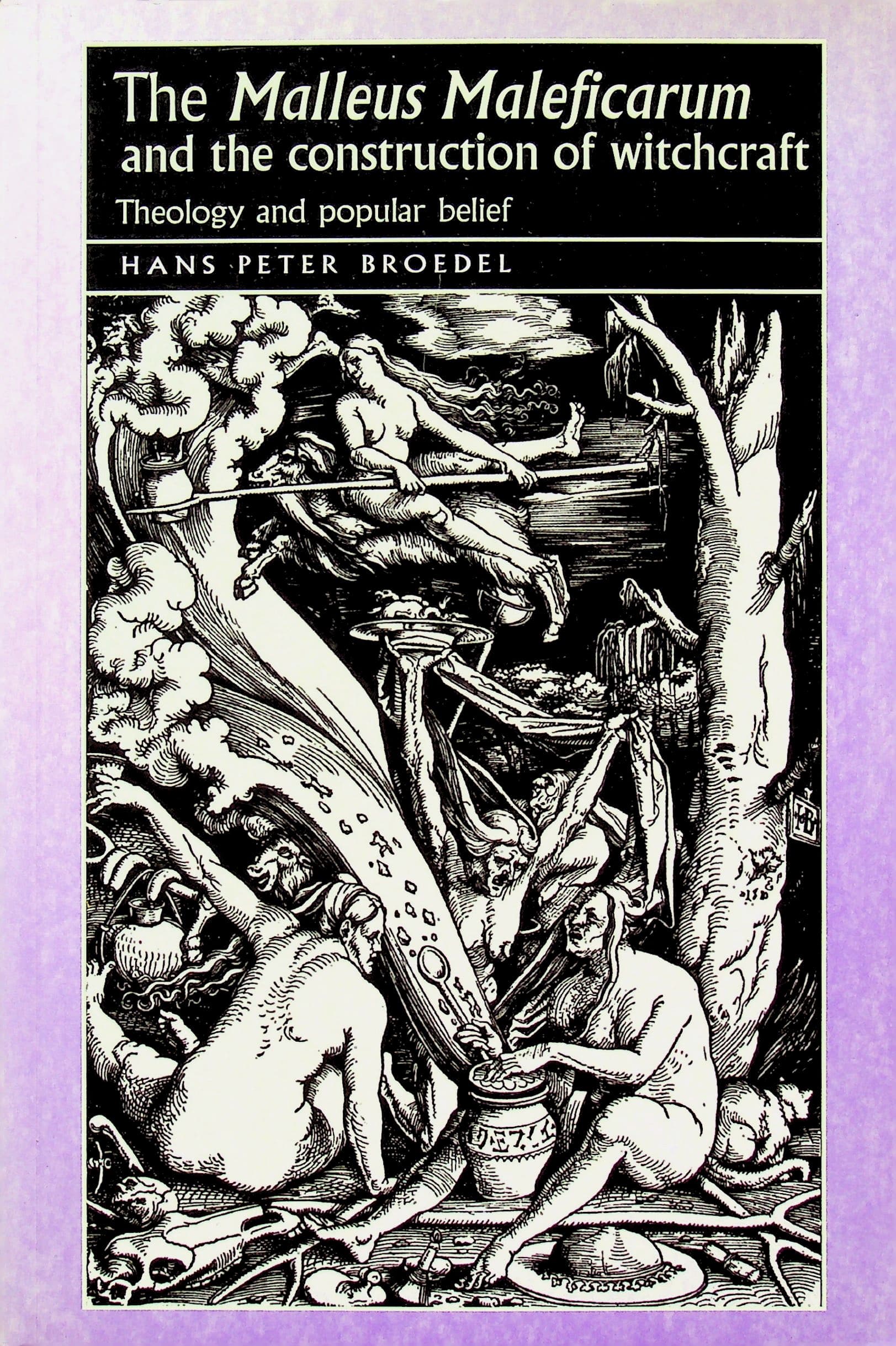
In Very Good condition. Glossy purple illustrated paper covers reproducing in black and white Hans Baldung Grien's 1514 woodcut "Witches Concocting an Ointment to Be Used for Flying to the Sabbath" on the front cover. Light bumping increasing to edges and corners with mild surface wear; moderate fading to the edges of the back cover. Binding tight; pages clean and unmarked. Hans Peter Broedel was Visiting Assistant Professor of History at Hamilton College at the time of publication. [From the rear cover] "What was witchcraft? Were witches real? How should witches be identified? How should they be judged? Towards the end of the middle ages these were serious and important questions, and completely new ones. Between 1430 and 1500, a number of learned 'witch-theorists' attempted to answer such questions, and of these perhaps the most famous are the Dominican inquisitors Henrich Institoris and Jacob Sprenger, the authors of the Malleus Maleficarum, or The Hammer of Witches. The Malleus is an important text and is frequently quoted by authors across a wide range of scholarly disciplines. Yet it also presents serious difficulties: it is difficult to understand out of context, and is not generally representative of late medieval learned thinking. This, the first book-length study of the original text in English, provides students and scholars with an introduction to this controversial work and to the conceptual world of its authors. Like other witch-theorists, Institoris and Sprenger constructed their witch out of a constellation of pre-existing popular beliefs and learned traditions. Therefore, to understand the Malleus, one must also understand the contemporary and subsequent debates over the reality and nature of witches. This book argues that although the Malleus was a highly idiosyncratic text, its arguments were powerfully compelling and therefore remained influential long after alternatives were forgotten. Consequently, although focused on a single text, this study has important implications for fifteenth-century witchcraft theory. This is a fascinating work on the Malleus Maleficarum and will be essential to students and academics of late medieval and early modern history, religion and witchcraft studies." Contents: Acknowledgments; Note on translation; 1. Introduction: contested categories; 2. Origins and arguments; 3. The inquisitors' devil; 4. Misfortune, witchcraft, and the will of God; 5. Witchcraft: the formation of belief, part one; 6. Witchcraft: the formation of belief, part two; 7. Witchcraft as an expression of female sexuality; Bibliography; Index.