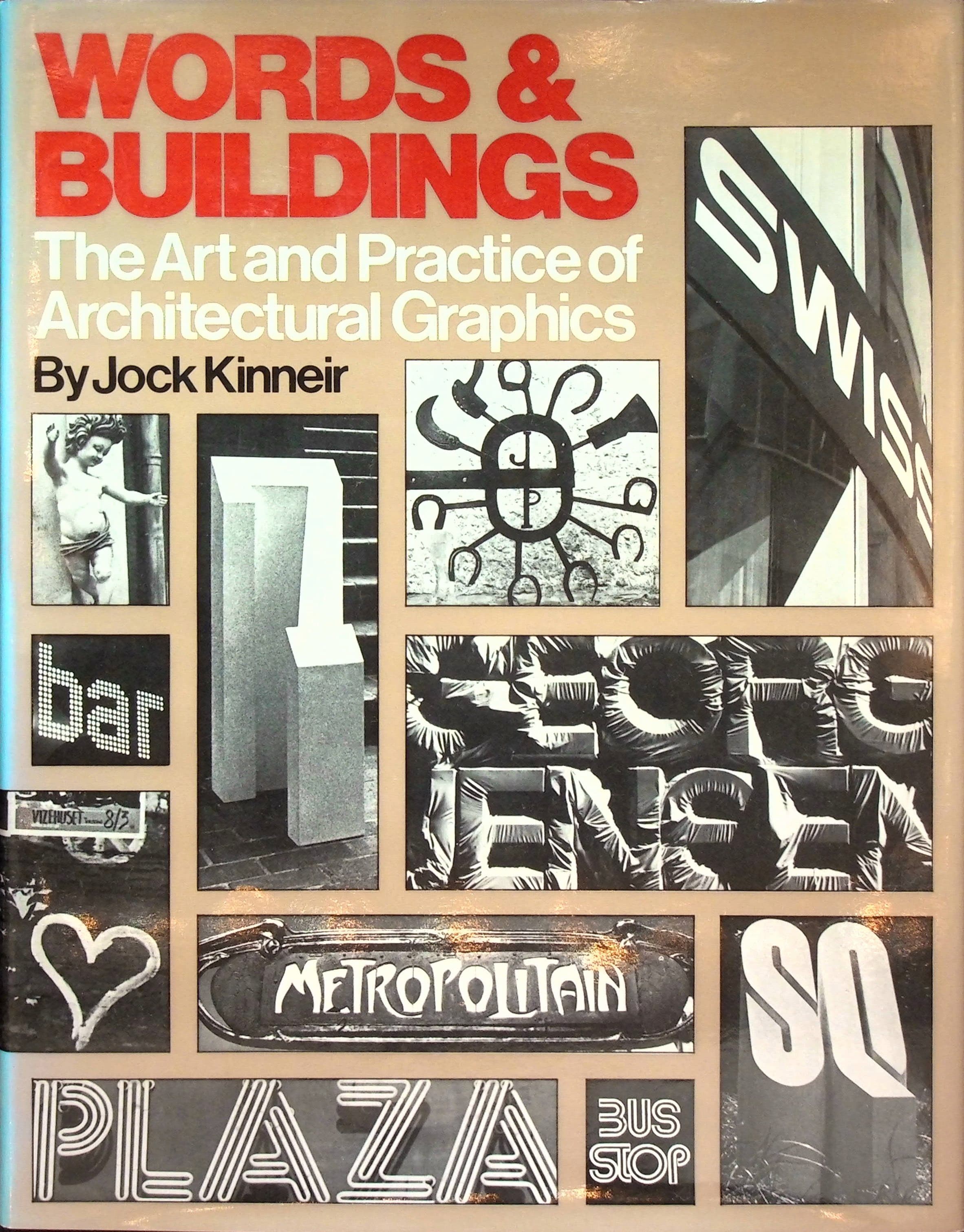
Description
Whitney Library of Design; Architectural Press, New York and London, [Published date: 1980]. Hardcover with dust jacket, 191 pp; 29 cm. First edition. Illustrated throughout with numerous black and white photographic reproductions of architectural lettering, inscriptions, signage, and typographic applications in built environments.
Condition & notes
In very good condition with good+ dust jacket. Black cloth covered boards with gilt lettering on spine; light edge and surface wear to covers and corners; binding firm. Previous owner's stamp on front free endpaper; otherwise pages are unmarked with light toning to edges. Dust jacket has light bumping and creasing to edges and mild surface wear; fading and discoloration to paper over spine; not price clipped; now in an archival quality removable Brodart cover. Comprehensive study of architectural lettering and environmental graphics by British designer Jock Kinneir (1917-1994), known for his work on British road signage systems. Examines the historical development of written forms in architectural contexts and their functional and visual roles in public space; traces the evolution of alphabets from ancient inscriptions through modern signage, and analyzes criteria for effective communication including legibility, expressiveness, and spatial integration; explores practical applications such as relief lettering, illuminated signage, and three-dimensional letterforms, illustrated with examples from historical monuments, commercial signage, and contemporary architectural design. Contents include: Background: Communication codes; Importance and early development of the alphabet; Influence of handwriting; Technical influences; Recent developments; Criteria: Expressiveness; Legibility; Conspicuity; Letter design; Word design; Space design; Practice: Flush lettering; Relief lettering; Three-dimensional lettering; Illuminated lettering; Integral lettering; Adjacent lettering; Mise-en-scene: Remarkable lettering; The next chapter; Notes and bibliography; Index.