
Description
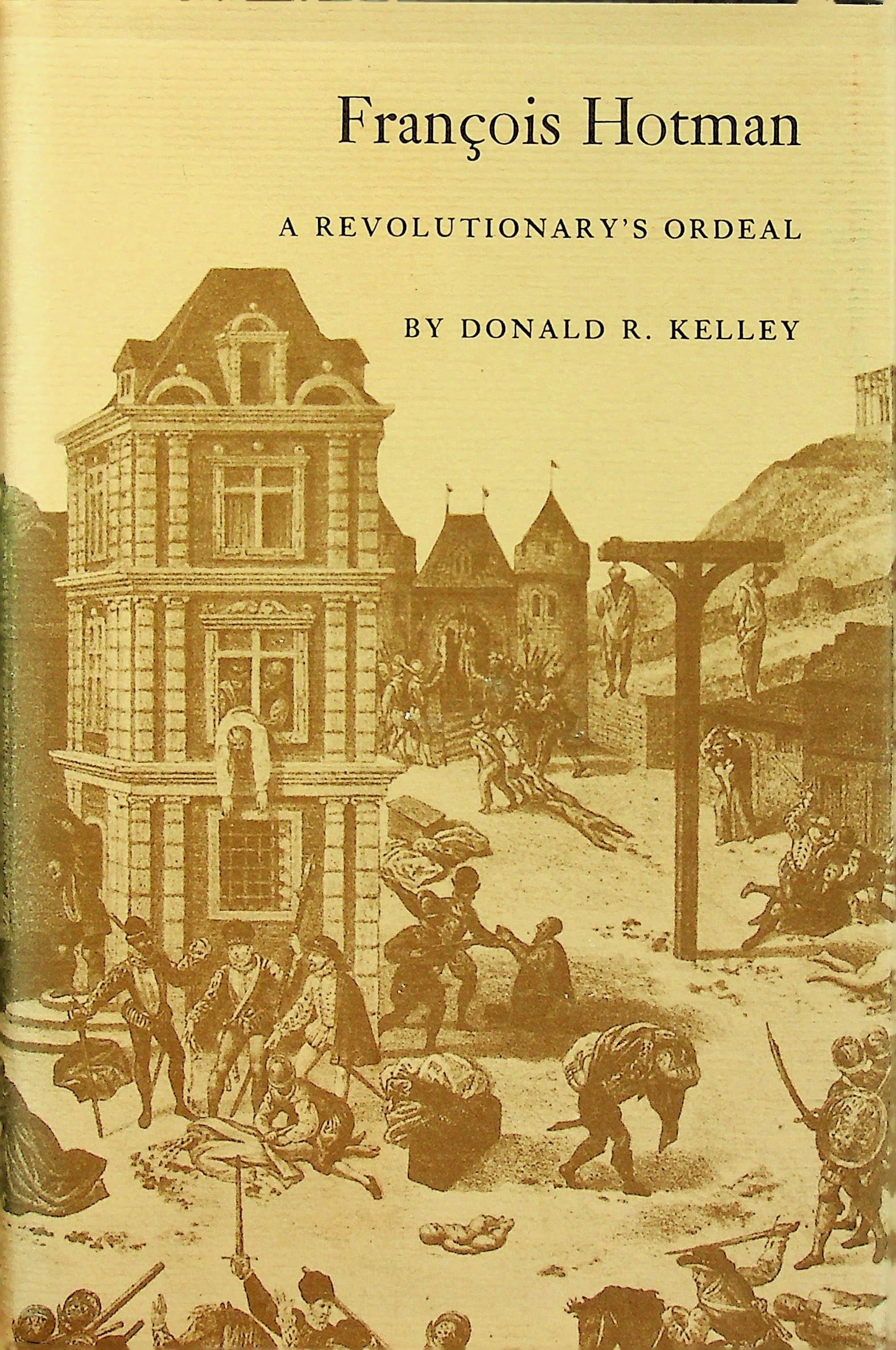
Princeton University Press, Princeton, New Jersey [Published date: 1973]. Hardcover, xii, 370 pp; illustrations; 22 cm. First edition. EX-LIBRARY. In acceptable+ condition / very good dust jacket. Black cloth boards stamped in gilt on spine. Light bumping and scuffing to edges of covers; some discoloration from tape residue. Binding tight. Usual library and ex-library markings including card pocket on front pastedown, barcode label, stamped call number on title page, shelf label remnants on spine, tape stains to front and rear endpapers, and a few stamps. Otherwise pages are clean and unmarked. Dust jacket has a few small nicks, light fading to spine panel, faint tape residue and light overall scuffing and soiling. Now protected in an archival quality (removable) Brodart cover. [Front jacket flap] The lifetime of Francois Hotman (1524-1590) was one of the most tumultuous periods in European history. Donald R. Kelley shows how this protege of Calvin and agent of many of the great Protestant princes became involved in ecclesiastical politics, Huguenot diplomacy, and conspiracy. One of the first modern revolutionaries, Hotman rebelled not only against his family and its faith, but against the laws and eventually the government of his country. As an embittered exile he produced a voluminous body of propaganda aimed at recovering a lost political and religious innocence on which to found a new community. At the same time he was one of the greatest and most versatile scholars of his age, achieving distinction as a jurist, teacher, classical scholar, dialectician, theologian, and historian. His Franco-Gallia and Anti-Tribonian have fascinated generations of political theorists, and his letters, reports, and anonymous works are of inestimable value to historians. Based on extensive research in much untouched source material, this book is written in a very readable and lively style, strikes a nice balance between the details of Hotmans career and the turbulent times in which he lived, and makes an important contribution to knowledge of the period, as it was experienced by an important observer and participant.