Description
Artibus Asiae, Ascona, Switzerland, 1962. Paper covers, [pages 95-119] 26 figures 31 cm. Reprinted from Artibus Asiae, vol. xxv, 1962.

Rare, out-of-print & unusual books · Since 1997
Turn the pages with the arrows, keyboard, or a swipe.
Artibus Asiae, Ascona, Switzerland, 1962. Paper covers, [pages 95-119] 26 figures 31 cm. Reprinted from Artibus Asiae, vol. xxv, 1962.
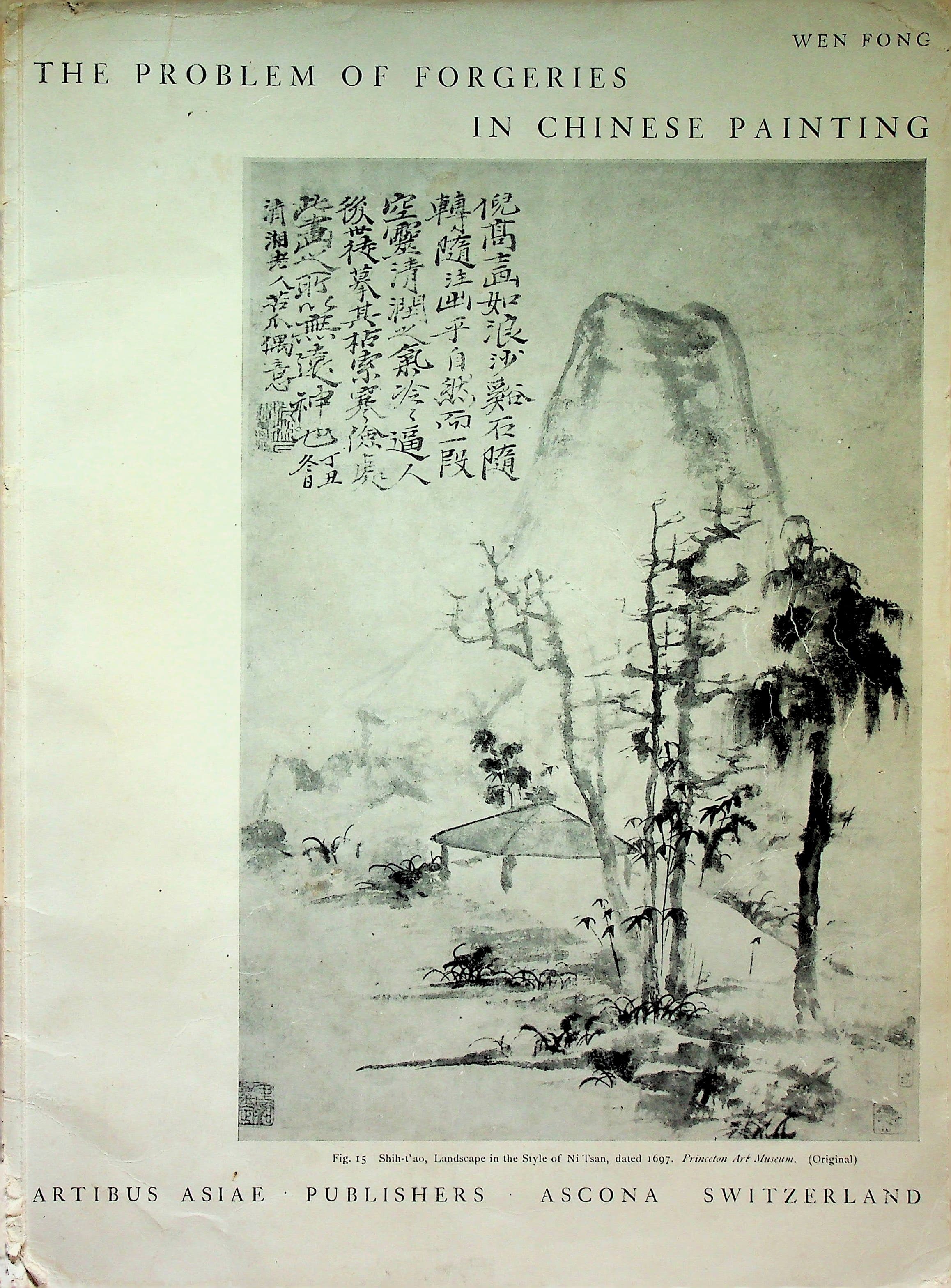
In acceptable condition. Black and white illustrated paper covers have chipping and tearing to the paper over the top and bottom of spine and light bumping and creasing to edges of covers. Light to moderate overall scuffing, aging and light soiling to covers as well. Binding is still intact. Previous owner's name in ink on front free end paper. Otherwise pages are lightly aged but unmarked. Not Ex-library. [From back cover] In this essay, the author discusses the problem of forgeries in Chinese painting with respect to five more or less representative cases: a forged T'ang figure painting, an exact traced copy, a free-hand copy, an imitation with an inscription adapted from a different picture, and a pastiche which comprises familiar elements borrowed from different pictures of the intended master. Except for the first, all the paintings are landscapes. The landscape examples are chosen to illustrate four methods of forging, known in Chinese as: "mu", to trace; "lin", to copy; "fang", to imitate; "tsao", to invent. It is the author's intention to demonstrate that no two manually-manufactured pictures can be precisely and exactly alike. Every "slip" of the hand reflects a change either in the physical circumstances, which may be entirely accidental, or in the attitudes of the maker, which, we hope to show, will be demonstrably meaningful. General observations on connoisseurship in Chinese painting are supported, in the footnotes, by quotations from old Chinese art-critical texts.