
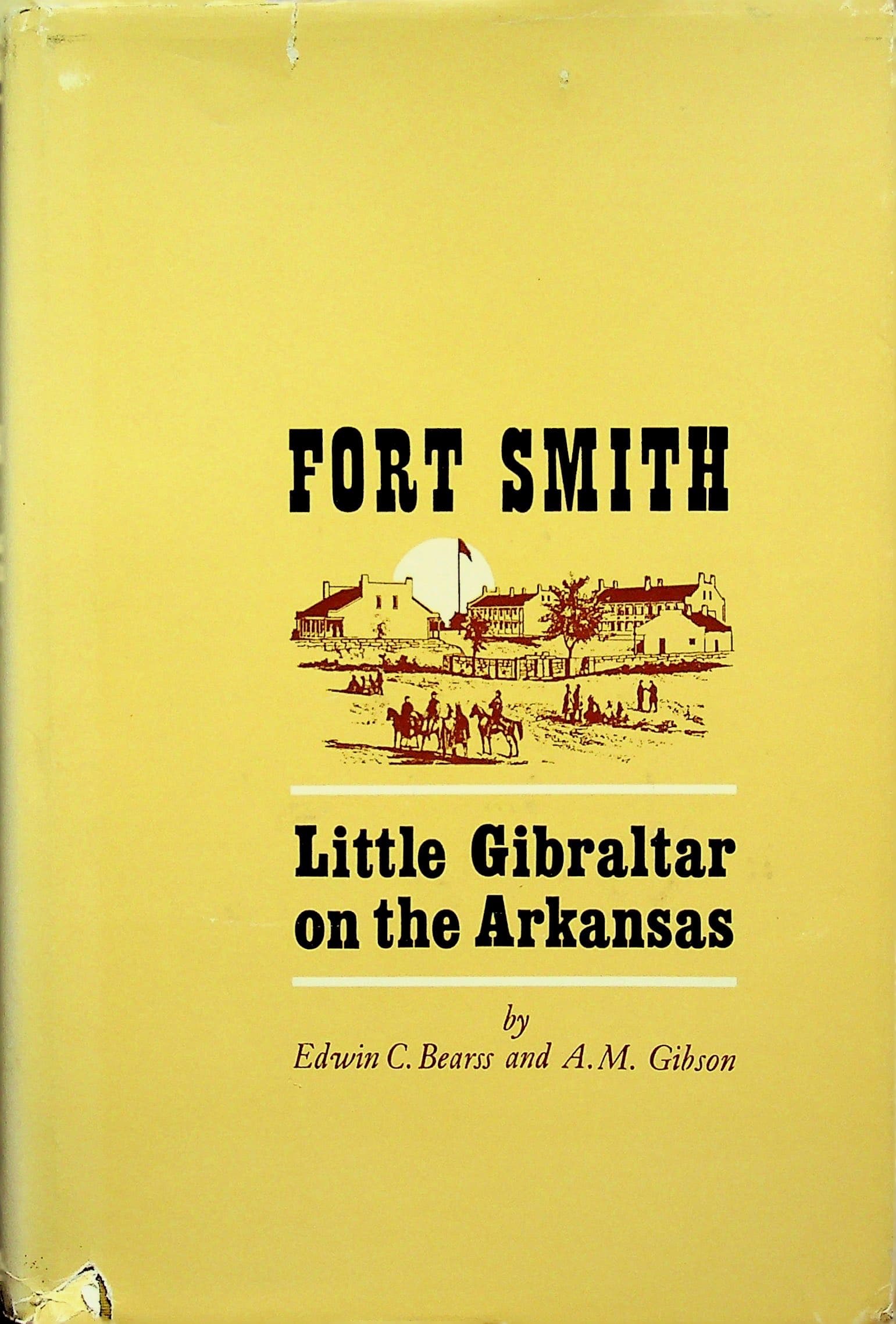
Description
University of Oklahoma Press [Published Date: 1969]. Hardcover, 349 pp. No other printings listed. Very good in good dust jacket. Tan cloth covered boards with tan block and gold lettering on spine. Light bumping and scuffing to edges of covers. Binding tight. Previous owner's gift inscription in ink on front free end paper. Otherwise pages are clean and unmarked. Dust jacket has a few 3/4" or less chips and tears and light creasing along edges. light overall scuffing, fading and soiling to jacket as well. Price clipped. Now in an archival-quality (removable) Brodart Cover. Black and white illustrations. [From jacket flaps] Few military installations can match the survival record of Fort Smith, repeatedly abandoned and reoccupied for fifty years, until it became known as the Belle Point Phoenix, the fort that "refused to die." This book tells the story of the famous old garrison from the time of its establishment in 1817 until it became a National Historic Site in 1961. The original fort was installed on the Arkansas River by Major William Bradford and a company of the Rifles Regiment. Bradford's mission was to stop a bloody war between the Osages and the Cherokees, a conflict discouraging the emigration of eastern Indians to the lands west of the Mississippi and thereby interfering with the government's removal policy. When Cantonment Gibson was established in 1824, Fort Smith was abandoned. It was reoccupied in the early 1830's, at the time of the mass migration of the Choctaws. Besides serving as a supply depot for the Choctaws, it was an army base in the "White Lightnin' Wars," the struggle against bootleggers vending liquor to the Indians. In 1838, political pressure led the government to begin construction of a masonry and bastioned work at Fort Smith, but not until 1846 was it completed, mainly in order to supply army posts in the Indian territory and northern Texas. During the Civil War, confederate armies at Wilson's Creek, Pea Ridge, and Prairie Grove were supplied from Fort Smith, and the Rebel force that crushed Opothleyoholo's band marched from Fort Smith. The fort was taken by Federal troops in September of 1863, and for the remainder of the Civil War it served as a Union base. In 1871 the army again abandoned the fort, but before the buildings could be disposed of, the Federal Court for the Western District of Arkansas was moved into the old fort. Under Judge Isaac Parker, renowned as the "Hanging Judge of Fort Smith," the court became a force for law and order in much of Indian territory.