
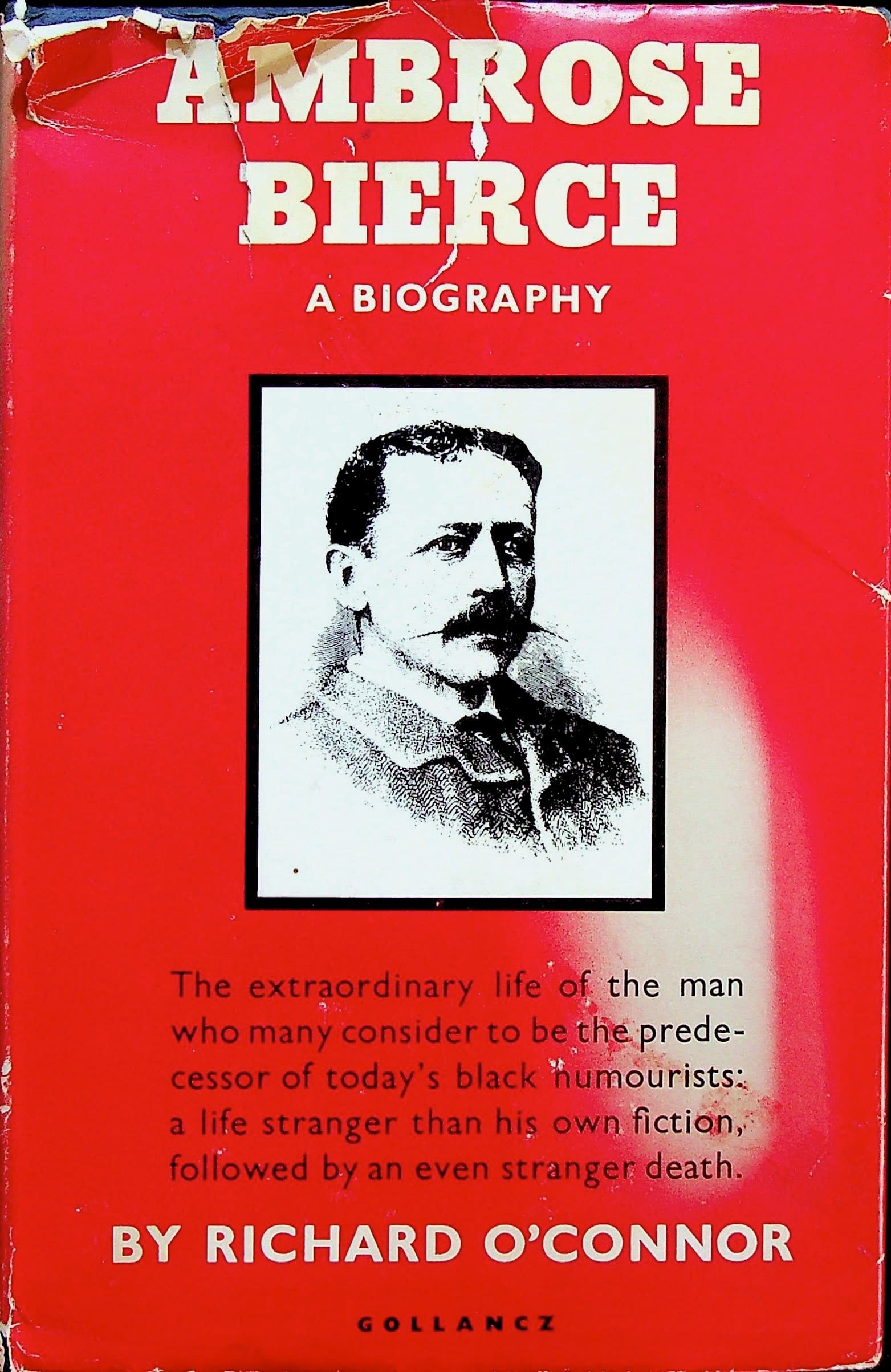
Description
Victor Gollancz, 1968. Hardcover, 333 pp. Good in acceptable dust jacket. Blue textured boards with gold lettering on spine. Light bumping, scuffing and fading to edges of covers. Binding tight. Previous owner's name in ink on front free end paper. Pages lightly aged but otherwise clean and unmarked. Dust jacket has several 1.5" or less chips and tears and creasing along edges. Light to moderate overall scuffing, aging, fading and soiling to jacket as well. Price clipped. Now in an archival-quality (removable) Brodart Cover. NOT Ex-Library. NO remainder marks. [Exceprts from jacket flaps and back cover] They called him "Almighty God Bierce." While he lived, America writhed under his Jovian glance and the ceaseless probings of his malicious pen. In death, the strangeness of his life and art persisted as a powerful influence on the American imagination. Even today, Ambrose Bierce stands second only to Poe as a master of the macabre, second to none in the savageness of his words and wit. In his Devil's Dictionary, . . . Bierce defined birth as "the first and direst of all disasters" . . . His own, he felt, was no exception . . . He left home at fifteen, never to return except for brief visits, and he was nineteen when in 1861, Fort Sumter's guns brought joyous anticipation of exciting days ahead. He enlisted at once, proved an excellent soldier, saw hard fighting on a dozen fields, was wounded and commissioned. The Civil War was the making of Bierce and it was during this violent half-decade that the handsome, ambitions farm-boy came of age both emotionally and intellectually . . . Richard O'Connor suggests in this, the first full study of Ambrose Bierce since 1929, that Bierce deserves far greater recognition than contemporary literary scholars have given him. His satire was often crude, but in that era of Victorian hypocrisy there was something splendid about it. His influence on such writers as Stephen Crane, Mencken and Sinclair Lewis was deep and lasting. His Civil War stories are the work of the only important writer who actually fought in the war. His brutal wit and perverse sense of humor make him the legitimate progenitor of the black humorists of today. He is still immensely readable, and it is fitting that his biography should be too . . .