
Description
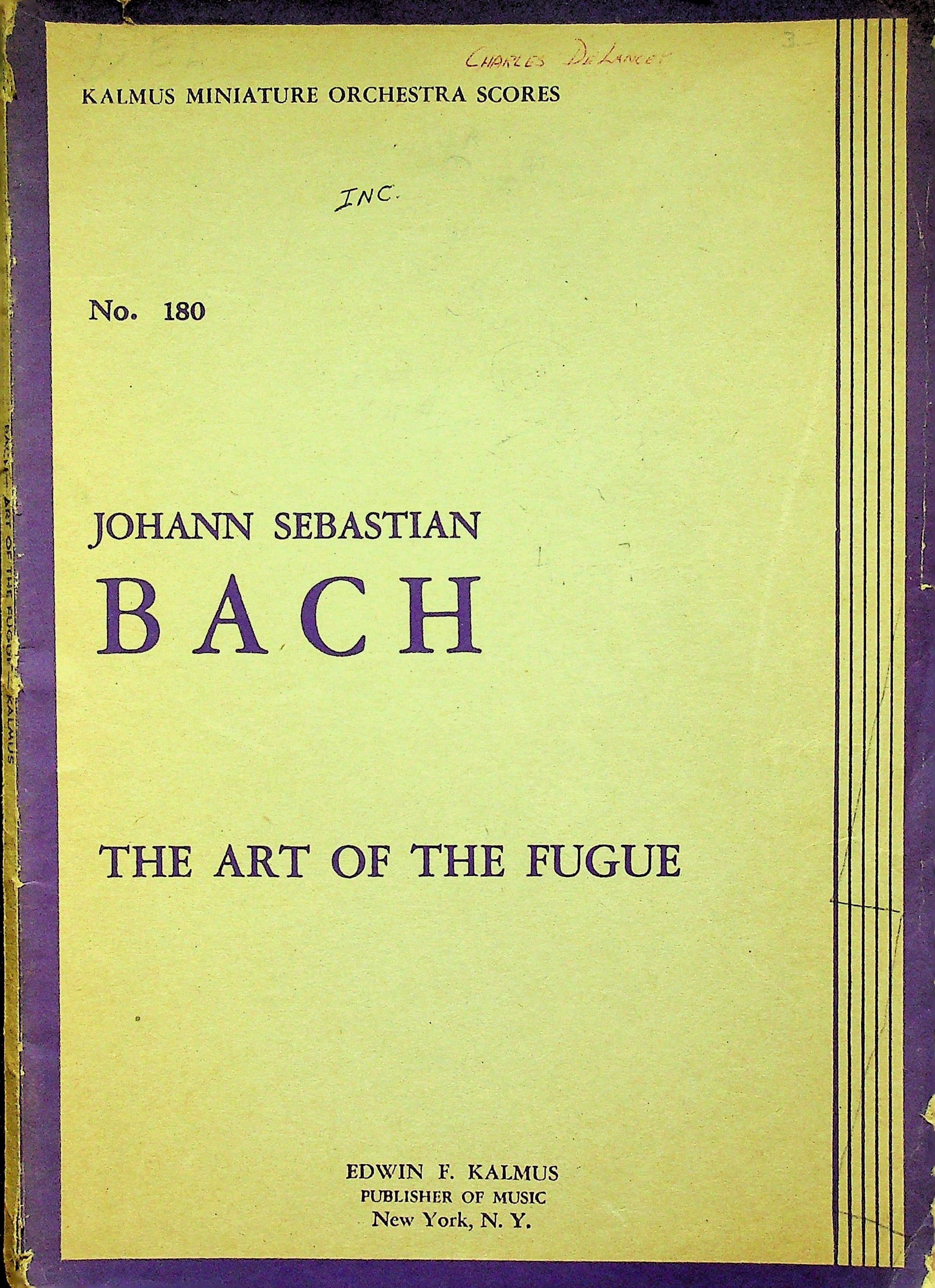
Edwin F Kalmus (Kalmus Miniature Orchestra Scores No. 180) [Published Date: no date listed, circa 1948]. Paper covers, 131 pp. In acceptable+ condition. Gray paper covers with blue lettering and border. Covers have 1" tears to the paper over the top and bottom of spine and several other smaller nicks and tear and creasing along edges. Previous owner's name and "INC" in ink on front cover. Otherwise pages are lightly aged but unmarked. NOT Ex-Library. NO remainder marks. A good reading copy. [From Preface] Johann Sebastian Bach's Art of Fugue, this hitherto unsurpassed, unique product of harmonic ingenuity containing every kind of counterpoint and canon in one and the same theme - is the last work which the great master wrote down with his own hand. A serious eye-disease prevented him, however, from quite completing the work, and hastened his death. This accounts for the noncompletion of the last fugue (page 78) consisting of 3 themes, in the last of which the letters spelling his name are heard in b,a,c,h. Bach also conceived, but never carried out, the unexampled idea of concluding his great work with a fugue which was to contain no fewer than 4 themes, all 4 parts of which were to be inverted and thus, as the most eminent masterpiece to form the key-stone to the Art of Fugue (cf. Forkel, Life of Bach, pp. 52-54). The first edition of all, which appeared in the year 1752, i.e. two years after the author's death, contained, as a supplement, the four-part hymntune: "When we must suffer deepest woe" which is still to be found in some of the early manuscripts. This hymntune Bach dictated a few days before he died, when he was completely blind, into the pen of his son-in-law Altnikol, and it was afterwards added to the work as a sort of compensation for the incompleted last fugue. This may have given rise to the idea that said hymntune belongs to the Art of Fugue, which is, however, highly improbable as it shows no relation to, or connection whatever with, the plan of the work, for which reason the hymn-tune does not appear in this edition, but in the Organ-book