Description
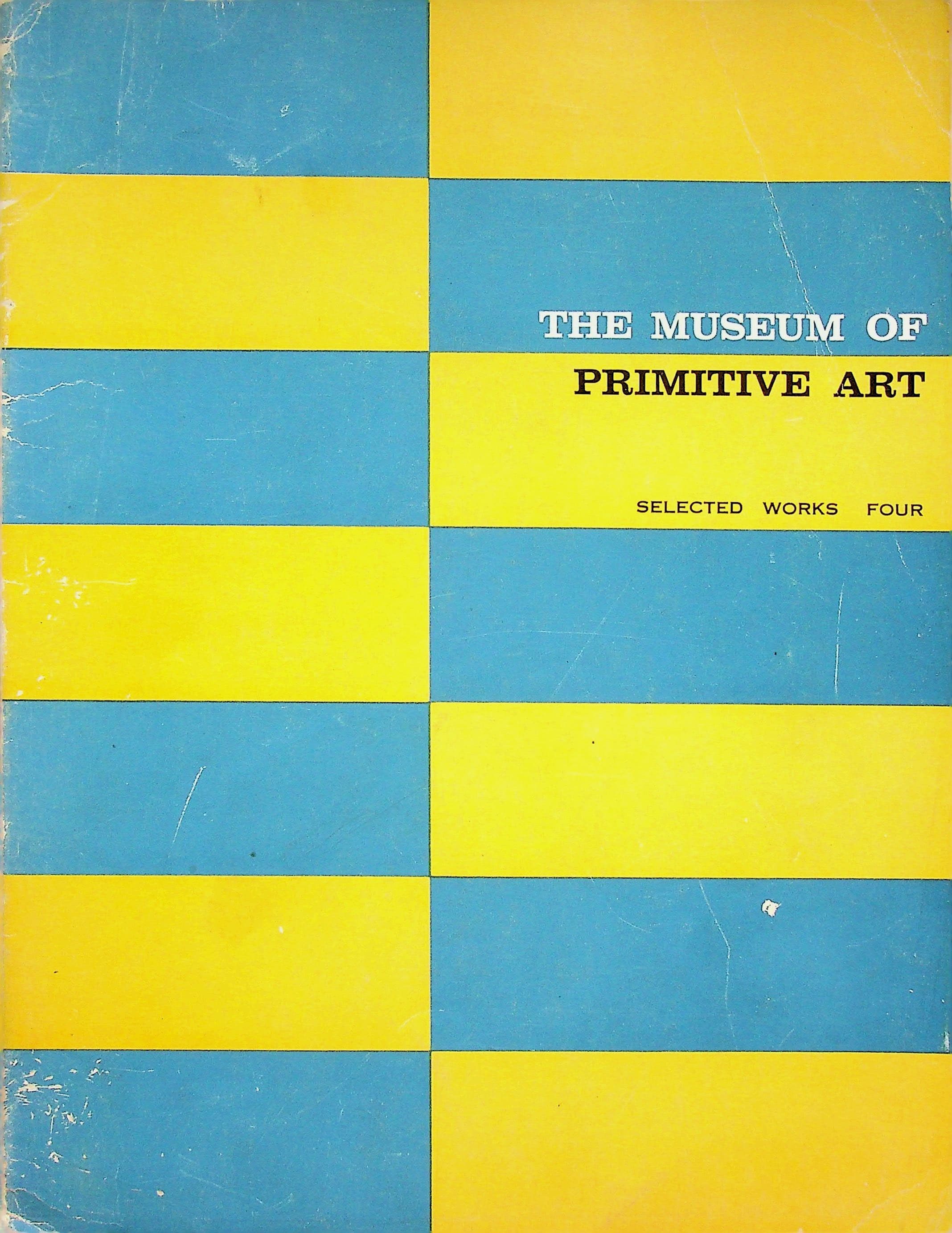
Museum of Primitive Art, Selected Works Four, Spring 1958. Exhibition catalogue. Paper covers, 30 pp.

Rare, out-of-print & unusual books · Since 1997
Turn the pages with the arrows, keyboard, or a swipe.
Museum of Primitive Art, Selected Works Four, Spring 1958. Exhibition catalogue. Paper covers, 30 pp.
In acceptable condition. Yellow and blue striped paper covers have 1/2" chips to the top and bottom of spine and bumping and creasing to edges and corners. Light to moderate overall scuffing and soiling to covers as well with the color scuffed off along the spine and a bit along the edges. Glued binding. Top corners of pages are lightly creased, but pages are otherwise lightly aged but clean and unmarked. NOT Ex-library. NO remainder marks. Black and white illustrations. [Excerpts from Introduction] For this exhibition the upper galleries have been given over to a selection of Peruvian fabrics from the Museum's collection. Though it is by no means a representative display of the numerous styles and techniques of pre-Columbian weaving, it includes some fine and beautiful examples from the Nazca, Tiahuanaco, Chimu and Inca periods. Most of those shown are in tapestry technique, while one gallery is devoted to mosaics of feathers tied to woven backgrounds. In spite of the limitations of this selection, the exhibition demonstrates vividly the technical ability and exquisite taste of the ancient Peruvian weavers. It reveals besides some of the outstanding characteristics both of Peruvian weaving and of Peruvian art in general. . . [T]he Peruvian weaver, whose skill and virtuosity compared favorably with those of the best European or Asiatic craftsmen, was seemingly never tempted to use his mastery of the medium to overcome or disguise the demands of the textile arts. On the contrary, he invented a most complex imagery adapted to emphasize the geometric order of the woven pattern. And the Nazca and Inca civilizations often used this "textile" imagery even in the decoration of their painted pottery . . . All this makes it quite understandable that the artistic genius of Peru found perhaps its finest expression in the textile arts. There is no basic technique of weaving known today that was not practiced in ancient Peru, and even in modern times many of the technical fats of the Peruvian waver have never been duplicated . . . A special gallery in this exhibition is devoted to fabrics decorated with leatherwork. This was an art form held in great esteem in Peru as well as in Mexico. Its rich coloring and surface made it ideal for ceremonial objects and courtly clothing. The most important exhibit in this gallery is a collection of sixteen feather panels, roughly seven by two and a half feet each, which are said to have been part of a single cache of some ninety such panels . . . We have no direct historical evidence fo the original use of these particular panels but is seems quite likely that in their entirety they constituted a huge wall covering for a ceremonial structure.