
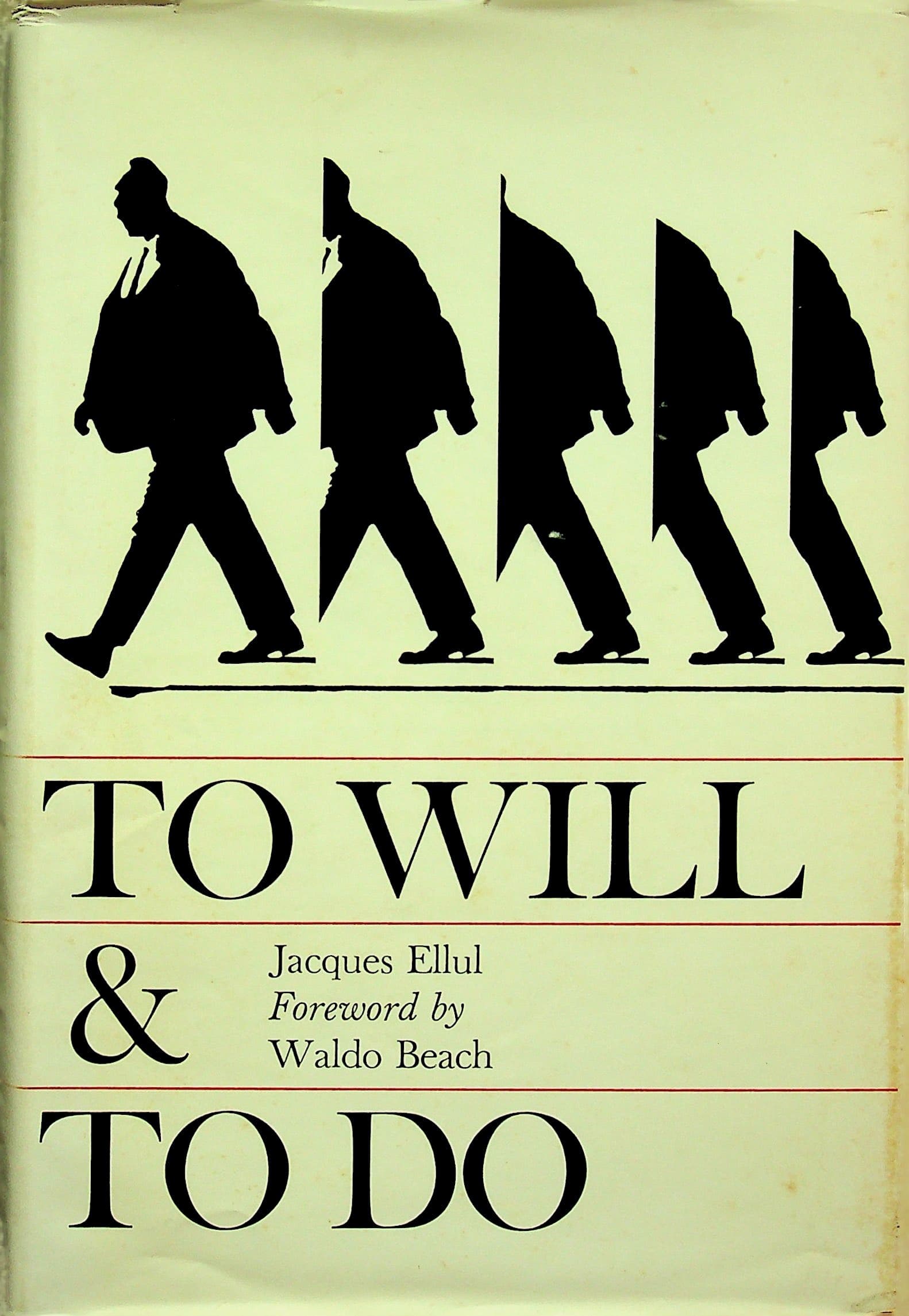
Description
Pilgrim Press [Published Date: 1969]. Hardcover, 310 pp. No other printings listed. Translation of Ellul's Le vouloir et le faire; recherches ethiques pour les chretiens. Forward by Waldo Beach. Translated by C. Edward Hopkin. Acceptable+ in acceptable+ dust jacket. Cream and black illustrated cloth covered boards have moderate scuffing, aging, spotting and soiling near edges. Binding tight. Moderate age spotting to top edge and fore-edges of text block. Otherwise pages are unmarked. Dust jacket has several small nicks and tears and creasing along edges. Moderate overall scuffing, aging and soiling to jacket as well. NOT price clipped Now in an archival-quality (removable) Brodart Cover. NOT Ex-Library. NO remainder marks. Jacques Ellul (1912 - 1994) was a French sociologist, theologian, and philosopher. [From jacket flaps] "The specialists will shrug their shoulders. Perhaps a man will pay attention. . ." Writing neither as a theologian nor as a philosopher but as a man trying to live fully in this age, Jacques Ellul thinks deeply about matters which not only Christians but all men hold as the foundation of their entire life attitude and action: the concepts of good and bad; the formulation of moralities; the impossibility yet necessity of a Christian ethic. How comfortable it has been to assume that the good which man's reason and culture have defined was the will of God. How impossible to rest completely on the unpredictable grace of God! Since the Fall of Adam man has desperately tried to be as God: to be the one to decide what was right and wrong. Therefore man playing God established norms as a safeguard against God so that God would not be able to do anything man had not already known. Men have tried to control the conduct of other men, judging between those who were acceptable and those who were not, but neither allowing for nor waiting upon the action of the Holy Spirit which follows not man's current customs but the eternal will of God. Not fully trusting him, man has tried to "tie God up in his own system" to insure his own salvation. Yet an ethic is necessary - to guide man when God remains silent, to serve as a temporary substitute for the word which will be revealed, to be a reminder of the truth which once was spoken and a source of hope. Those who have read Ellul's other translated works will know with what complex thoroughness he examines every point. Here he challenges his fellow searchers to delve into the arguments of such men as Bonhoeffer, Barth, Niebuhr, Ricoueur, Haering, Soe - Ellul's own thought is based solidly on biblical revelation: "The criterion of my thought is the biblical revelation; the content of my thought is the biblical revelation; the point of departure is supplied by the biblical revelation; the method is the dialectic in accordance with which the biblical revelation is given to us; and the purpose is a search for the significance of the biblical revelation concerning ethics." "For it is God which worketh in you both to will and to do of his good pleasure." Philippians 2:13